
AI for Content Creation

This guide forms part of our complete resource on Small Business AI & Automation.

Creating content for your business can feel like a constant pressure. You know you should be writing blog posts, updating your website, sharing ideas, and staying visible – but actually sitting down to do it is where things tend to stall.

It’s rarely about lack of knowledge. Most small business owners already have the experience, insights, and stories worth sharing. The challenge is turning all of that into clear, structured content without overthinking it or second-guessing every word.

This is where AI can be genuinely useful – not as a shortcut to “quick content,” but as a way to organise your thinking, reduce friction, and help you move from idea to execution faster.

Used properly, AI can help you plan what to write, structure your ideas, and build consistency in your content without it taking over your entire week. It can take something that feels overwhelming and break it down into manageable steps.

But there’s an important difference between using AI well and using it poorly. If you rely on it to do all the thinking for you, you’ll end up with generic content that doesn’t reflect your business. If you use it as a thinking partner, you can create content that feels natural, relevant, and aligned with how you actually work.

This page will walk you through how to use AI for content creation in a practical way – from planning and structuring your ideas to refining your content so it sounds like you. The goal isn’t more content. It’s better content that you can create consistently and confidently.

Planning Content Without Staring at a Blank Screen

Start With What You Already Know

You don’t need AI to invent brand new ideas. In fact, your best content usually comes from things you already deal with every day – client questions, common objections, repeated explanations, and conversations you’ve had more than once.

Instead of asking AI for “content ideas,” start by giving it context. For example, you might prompt it with:

“Here are the top 10 questions my clients ask me before working with me. Can you turn these into blog topics and group them into themes?”

This immediately gives you something more useful than a random list. It turns your real-world experience into structured content that reflects your business, not someone else’s.

If you’re unsure how to extract these ideas, you can explore practical examples in 121 Practical Things AI Can Help With When You’re a Solo Business Owner, which shows how everyday tasks can become content opportunities.

Turn Scattered Ideas Into Structured Topics

Most business owners don’t lack ideas – they lack structure. You might have notes, voice memos, half-written drafts, or things you’ve thought about posting but never followed through on.

This is where AI becomes useful as an organiser.

You can take a messy list like:

“website costs, SEO confusion, why no one is enquiring, what pages people need, branding questions”

…and turn it into something structured:

“Group these topics into 5 main content themes and suggest blog post titles under each theme.”

Now you’re not staring at a blank screen anymore. You’ve got direction. You’ve got categories. You’ve got a starting point.

This is also how you begin building content clusters that support your broader visibility strategy, which ties directly into your content and authority-building approach.

Use AI to Expand, Not Replace Your Thinking

This is where most people get it wrong. They ask AI to “give them ideas” and then copy whatever comes out.

The result? Generic content that sounds like everyone else.

Instead, use AI to expand on your ideas, not replace them.

For example:

“Here’s a topic I want to write about: ‘Why small business websites don’t get enquiries.’ Can you give me 5 different angles I could approach this from?”

This gives you options, not answers. You still choose the direction. You still shape the message. AI just helps you see possibilities you might not have considered.

If you want to go deeper into improving AI-generated content so it actually sounds human, this article on 27 Ways to Make Your AI Content Exceptional is worth exploring.

Create a Simple Content Plan You Can Actually Follow

Once you’ve got topics, the next step is turning them into a plan. Not a complicated content calendar that you’ll abandon in two weeks – a simple, realistic plan you can stick to.

You can ask AI:

“Based on these topics, create a simple 4-week content plan with one blog post per week and supporting social media ideas.”

This gives you structure without overwhelm. You know what you’re working on each week, and you’re not constantly deciding what to do next.

If you want to take this further and build out complete content assets faster, your guide Wait… You Can Do That? Save 8–12 Hours a Week with AI walks through how to move from ideas to finished content without getting stuck.

Avoid the Trap of “Endless Idea Generation”

Here’s a reality check. AI can give you thousands of content ideas. That doesn’t mean you need them.

One of the biggest time-wasters is constantly generating new ideas instead of actually creating and publishing content.

Planning should lead to action. If you find yourself asking for more and more ideas, it’s usually a sign you’re avoiding the next step.

A better approach is:

  • Choose 3–5 solid topics
  • Commit to creating them
  • Publish before generating more

This keeps your content grounded and prevents you from getting stuck in “planning mode” forever.

Use Real Examples to Guide Your Process

If you’re ever unsure how to use AI properly, look at real examples instead of theory. That’s where most advice falls apart – it sounds good, but it doesn’t show you what actually happens when you try it.

The ChatGPT Confessions series breaks this down through real prompts, real outputs, and honest results – including what worked and what didn’t.

This kind of practical insight is what helps you move from “this sounds useful” to “I can actually do this in my business.”

Planning content for your website

Writing Website Copy That Actually Sounds Like You

Start With Your Words, Not AI’s

The biggest mistake you can make is starting with a blank prompt like “Write my homepage.” That’s how you end up with content that sounds polished but completely disconnected from your business.

Instead, start by writing something yourself – even if it’s rough. It could be bullet points, a brain dump, or a messy paragraph explaining what you do, who you help, and how you work. This gives AI something real to work with and anchors the content in your actual experience.

You can then prompt AI with:

“Rewrite this in a clearer, more structured way while keeping the tone natural and not overly salesy.”

This keeps your voice at the centre of the process. AI becomes an editor, not the author, which is exactly where it’s most useful.

Use AI to Clarify, Not Complicate

Website copy doesn’t need to be clever. It needs to be clear. Most visitors are scanning quickly, trying to understand what you do and whether you can help them.

AI can help simplify your message without stripping out meaning. For example:

“Can you simplify this explanation so it’s easier for a small business owner to understand without losing the intent?”

This is especially helpful if you tend to over-explain or use industry language without realising it. Clear content builds trust faster than clever wording ever will.

If you want to take this further, the article Boost Your Brand Voice: Turning AI Text into Human-Friendly Content breaks down how to make AI-assisted content feel more natural and readable.

Refine Your Tone So It Feels Consistent

One of the strengths of AI is that it can help you maintain a consistent tone across your website. This is something many business owners struggle with, especially when writing pages at different times.

You can guide AI with prompts like:

“Adjust this so it sounds friendly, professional, and straightforward, without sounding too formal or too casual.”

By reusing similar instructions across pages, your content starts to feel cohesive rather than pieced together. This consistency makes your website easier to read and more comfortable to trust.

This also ties directly into how your website presents your brand overall, which is a core part of your website design approach.

Structure Your Copy So It’s Easy to Follow

Even strong writing can fall flat if it’s not structured properly. Long blocks of text, unclear sections, or missing headings make it harder for visitors to engage with your content.

AI can help organise your copy into a clearer format:

“Break this into sections with headings and short paragraphs so it’s easier to read on a website.”

This doesn’t change your message – it just makes it more accessible. And that small shift can make a noticeable difference in how people interact with your site.

It also supports how search engines and AI tools interpret your content, helping with visibility as well as readability.

Avoid the “Polished but Empty” Trap

AI is very good at producing content that sounds impressive but says very little. This is where a lot of AI-generated website copy falls apart.

If your content feels vague, overly smooth, or full of generic phrases, it’s a sign that AI has taken over too much of the thinking.

The fix is to bring it back to specifics. Ask:

“Can you make this more specific and include clearer examples or explanations?”

Specificity is what makes your copy believable. It’s also what helps visitors quickly decide whether you’re the right fit for them.

Treat AI as a Drafting Tool, Not the Final Step

No matter how good AI gets, your website copy still needs a final human pass. This is where you adjust wording, remove anything that doesn’t feel right, and make sure the message reflects your business accurately.

Think of AI as a way to get to a strong first draft faster. From there, your job is to refine, personalise, and shape it into something you’re confident sharing.

If you want a structured way to do this across your entire website, your guide Wait… You Can Do That? Save 8–12 Hours a Week with AI walks through how to move from rough ideas to finished content without getting stuck.

And if you want to see how this works in practice, the ChatGPT Confessions series shows real prompts, real outputs, and what actually happens when you refine them.

Creating Blog Content That Builds Authority Over Time

Focus on Topics That Actually Matter to Your Audience

One of the biggest mistakes business owners make with blogging is writing about what they feel like, rather than what their audience is actively trying to figure out.

Authority doesn’t come from publishing more content. It comes from publishing the right content – the kind that answers real questions, addresses real concerns, and helps people make decisions.

AI can help you identify these topics more clearly. Instead of asking for “blog ideas,” give it direction:

“What are the most common questions someone would search before hiring a [your service]?”

This shifts your content from random posts to purposeful articles that align with what people are already looking for.

If you want a broader view of how these topics connect, the article AI Content Creation: How Artificial Intelligence Can Help Small Businesses Create Irresistible Copy expands on building content that attracts the right audience.

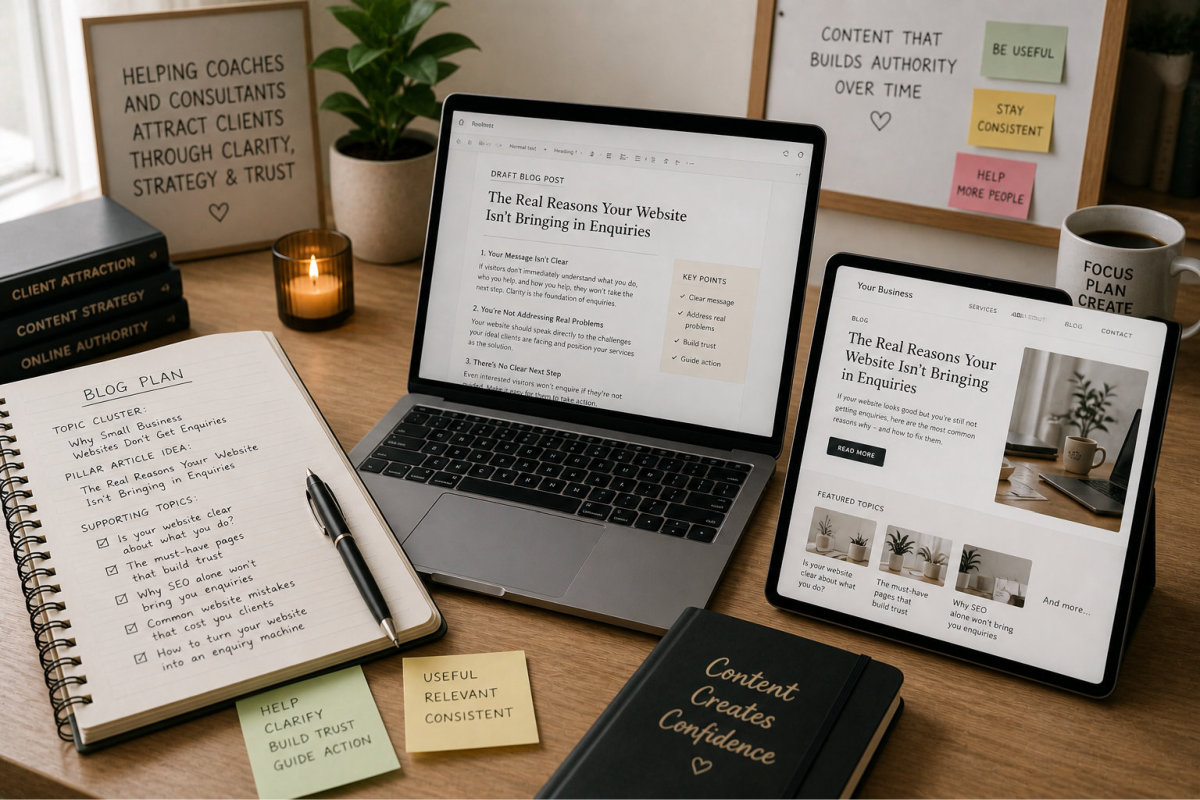
Build Depth Around a Topic, Not Just One-Off Posts

Writing a single blog post on a topic won’t build authority. It might be helpful, but it won’t position you as the go-to person.

Authority comes from depth – covering a topic from multiple angles so that your website becomes a useful resource, not just a one-off answer.

AI can help you expand a single idea into a group of related topics:

“Give me 8 blog post ideas that support the topic ‘why small business websites don’t get enquiries,’ each focusing on a different angle.”

This is how you start building content clusters that strengthen both your SEO and your credibility.

It also ties directly into your broader authority-building strategy, where consistency and depth matter more than volume.

Use AI to Speed Up Research Without Losing Accuracy

Research is often the most time-consuming part of writing blog content. It’s also where many people either get stuck or rush through it.

AI can help you organise and summarise information quickly, but it shouldn’t be treated as a final source of truth.

A more effective approach is:

  • Use AI to outline key points and questions
  • Cross-check important details where needed
  • Add your own insights and explanations

This keeps your content grounded while still saving time. You’re not replacing research – you’re making it more efficient.

If you’re using AI more broadly across your business, the article From Data to Decisions: Using AI for Smarter Business Growth gives additional context on how to apply it strategically.

Write for Clarity First, Not SEO Tricks

There’s still a lot of outdated advice around blogging – keyword stuffing, awkward phrasing, and writing for algorithms instead of people.

The reality is simpler. Clear, helpful content performs better because it’s easier to understand and more useful to the reader.

AI can help refine clarity without making your writing sound unnatural. For example:

“Can you rewrite this so it’s easier to follow, with shorter sentences and clearer explanations?”

This improves readability without turning your content into something generic or overly optimised.

Well-structured, human-friendly content is also more likely to be picked up by AI-driven search tools, which reinforces your visibility over time.

Stay Consistent Without Burning Out

Consistency is one of the biggest factors in building authority, but it’s also where most people fall off.

AI can help you maintain momentum by reducing the effort required to get started each time. You can reuse prompts, build on previous topics, and create a simple workflow that keeps you moving.

For example:

“Based on my last blog post, suggest 3 follow-up topics I could write next.”

This removes the friction of deciding what to do next and helps you stay in a steady rhythm.

If you want a more structured approach to staying consistent without overwhelm, your guide Wait… You Can Do That? Save 8–12 Hours a Week with AI walks through how to build this into your weekly workflow.

Measure Authority by Usefulness, Not Just Traffic

It’s easy to get caught up in numbers – page views, clicks, rankings. While these matter, they don’t tell the full story.

Authority is built when your content is genuinely useful. When someone reads your blog and thinks, “That actually helped me understand this better,” you’re moving in the right direction.

AI can’t measure that for you, but it can help you refine your content based on feedback and clarity.

If you want to see how content evolves through real use and testing, the ChatGPT Confessions series shows what happens when you experiment, adjust, and improve over time.

That’s how authority is built – not through perfect content, but through consistent, useful content that gets better with each piece you publish.

Creating blog content

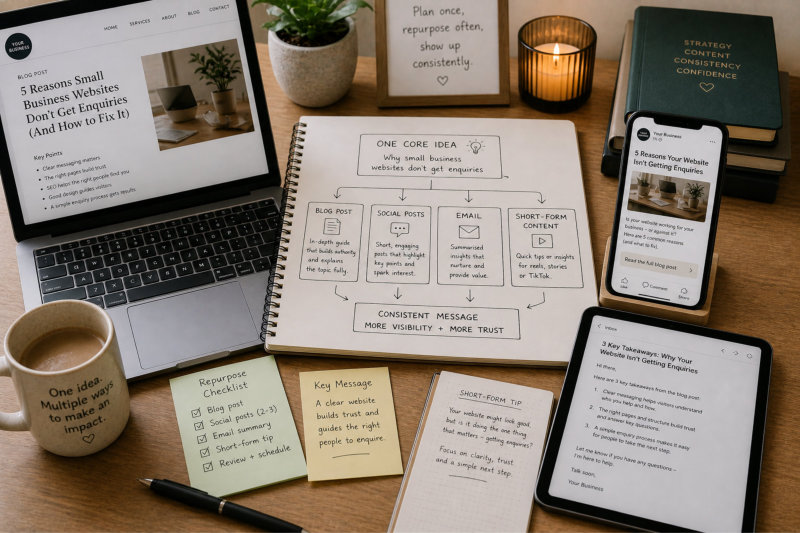
Repurposing One Idea Into Multiple Pieces of Content

Start With One Strong Idea, Not Ten Weak Ones

Most business owners think they need constant new ideas to stay visible. That’s usually what leads to inconsistency and burnout.

The reality is simpler. One solid idea can be turned into multiple pieces of content if you approach it the right way. Instead of chasing new topics, focus on getting more value out of what you’ve already created.

AI helps you do this by expanding a single idea into different formats and angles. For example:

“Take this blog topic and suggest 5 different ways I could repurpose it into social media posts, emails, or short-form content.”

This shifts your thinking from “what should I create next?” to “how can I reuse what I already have?”

Break One Blog Post Into Smaller Content Pieces

A well-written blog post is not just one piece of content. It’s a source of multiple smaller assets that can be used across different platforms.

AI can help you extract these quickly:

“Turn this blog post into 5 short social media captions, each focusing on a different key point.”

Or:

“Summarise this article into 3 key takeaways I can use for an email.”

This allows you to stay visible without constantly creating from scratch. You’re simply reusing your ideas in a more efficient way.

If you want more practical ways to do this, the article 121 Practical Things AI Can Help With When You’re a Solo Business Owner includes examples of how content can be adapted across different formats.

Adapt Content for Different Platforms Without Rewriting Everything

Each platform has a slightly different style. What works on your website won’t always work as-is on social media or in an email.

Instead of rewriting everything manually, AI can help you adjust tone and format:

“Rewrite this blog paragraph into a short, engaging LinkedIn post that feels conversational.”

This saves time while still allowing you to tailor your message to each platform.

The key is to review and adjust the output so it still feels like you. AI should speed up the process, not remove your personality.

Repurposing one idea into multiple pieces of content

Turn One Idea Into a Content Series

If a topic is important to your audience, it’s worth exploring it in more than one piece of content.

AI can help you expand a single idea into a series:

“Turn this topic into a 3-part blog series, with each post focusing on a different aspect.”

This approach builds depth and keeps your content connected. Instead of isolated posts, you create a body of work that reinforces your authority.  This also supports your overall visibility strategy, where consistent, related content strengthens your position over time.

Avoid Repetition Disguised as Repurposing

Repurposing doesn’t mean repeating the same thing word for word across different platforms. That quickly becomes obvious and reduces the impact of your content.

AI can help you vary the angle instead of duplicating the message:

“Rewrite this idea with a different perspective, focusing on a common mistake instead of general advice.”

This keeps your content fresh while still staying aligned with your original topic.  It’s a small shift, but it makes a big difference in how your content is perceived.

Build a System So Repurposing Becomes Automatic

The real benefit of repurposing comes when it becomes part of your workflow, not something you do occasionally.

For example, every time you write a blog post, you might automatically create:

  • 2–3 social media posts
  • 1 email summary
  • 1 short-form tip or insight

AI makes this process faster and more repeatable. You’re not starting from scratch each time – you’re following a system.

If you want a structured way to build this into your weekly routine, your guide Wait… You Can Do That? Save 8–12 Hours a Week with AI shows how to turn one idea into multiple assets without overcomplicating the process.

And if you want to see how this works in real situations, the ChatGPT Confessions series gives examples of how a single prompt can lead to multiple outcomes.

Using AI Without Losing Your Voice (Reality Check)

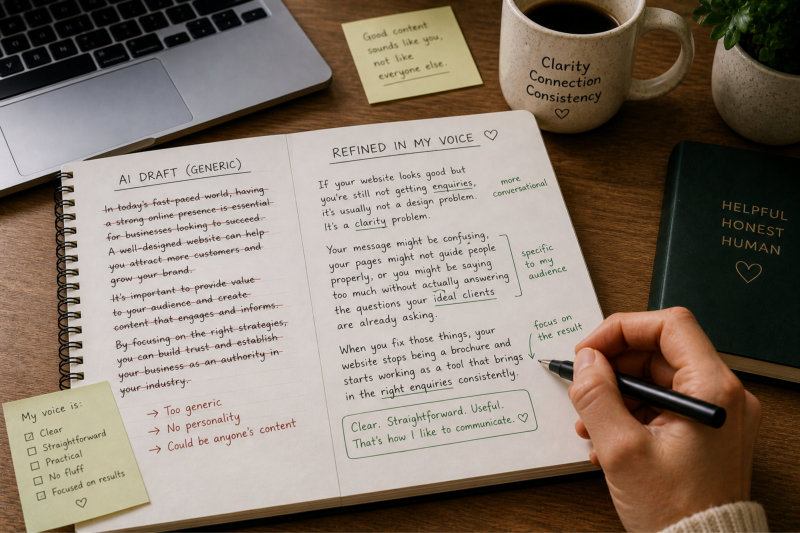
AI Defaults to Generic – Unless You Give It Direction

Out of the box, AI doesn’t know your business, your clients, or how you naturally communicate. So it fills the gap with what it’s been trained on – which is broad, safe, and often generic.

This is why so much AI-generated content sounds the same. It’s not because AI is “bad.” It’s because it hasn’t been given anything specific to work with.

If you want content that actually reflects you, you need to feed it real input. That means your wording, your examples, your tone, and your way of explaining things.

A simple shift in prompting makes a big difference:

“Rewrite this using my tone – clear, straightforward, and practical, without sounding overly polished or salesy.”

The more direction you give, the less generic the output becomes. Without that direction, you’re just getting the default version – and that’s rarely what you want to publish.

Your Voice Comes From Experience, Not AI

Your voice isn’t something AI can create for you. It comes from how you think, how you explain things, and the way you’ve developed your approach over time.

AI can help shape and refine that voice, but it can’t replace it. If you remove your input from the process, you remove what makes your content different.

This is especially important for service-based businesses. People aren’t just reading your content for information – they’re deciding whether they trust you.

That trust comes from recognising a real perspective, not perfectly written but empty content.

If you want to strengthen how your voice comes through in AI-assisted content, the article Boost Your Brand Voice: Turning AI Text into Human-Friendly Content goes deeper into making your content feel more natural and aligned.

Don’t Accept the First Output – It’s Rarely the Best One

One of the easiest ways to spot AI content is when it looks like it’s been copied straight from the first response.

The first output is usually a starting point, not a finished result. It gives you structure and direction, but it still needs refining.

A better approach is to treat AI like a drafting tool:

  • Ask for an initial version
  • Refine the tone
  • Make it more specific
  • Adjust anything that doesn’t feel right

You can prompt this directly:

“Make this less generic and more specific to a small business audience.”

This extra step is where your content starts to stand out. Skipping it is what makes everything sound the same.

Using AI without losing your voice

Watch for Over-Polishing – It Removes Personality

AI tends to smooth everything out. It removes repetition, sharp edges, and anything that feels slightly imperfect. That might sound like a good thing, but it often strips out personality at the same time.

If your content feels too polished, it can come across as distant or impersonal. Readers don’t connect with perfection – they connect with clarity and honesty.

Sometimes the better choice is to keep a sentence slightly imperfect if it sounds more like how you would naturally say it.

You can guide AI away from over-polishing by prompting:

“Keep this natural and conversational – don’t over-refine or make it sound too formal.”

This keeps your content grounded and relatable instead of overly produced.

Use AI to Support Your Thinking, Not Replace It

This is the biggest shift to understand. AI works best when it supports your thinking, not when it replaces it.

If you rely on it completely, your content becomes generic. If you use it to organise, refine, and expand your ideas, your content becomes clearer and more consistent.

The difference is subtle, but it shows in the final result.

If you want to see how this plays out in real situations, the ChatGPT Confessions series walks through actual prompts, outputs, and what needed to be fixed along the way.

And if you want a more structured way to use AI without losing control of your content, your guide Wait… You Can Do That? Save 8–12 Hours a Week with AI shows how to use it as a practical tool without letting it take over the process.

Turning AI Into a Simple Content Workflow You Can Stick To

Why Most Content Plans Fail

Most content plans fail because they’re unrealistic. They look good on paper, but they don’t fit into how you actually work day to day.

It’s easy to create a plan that includes blogging, social media, emails, and everything else – but when it comes time to execute, it becomes too much. That’s when consistency drops off and the whole thing gets abandoned.

AI doesn’t fix this on its own. If anything, it can make it worse by giving you more ideas, more options, and more things to do.

The real solution is to simplify. Instead of trying to do everything, focus on a small number of content actions that you can repeat consistently. AI should support that process, not expand it.

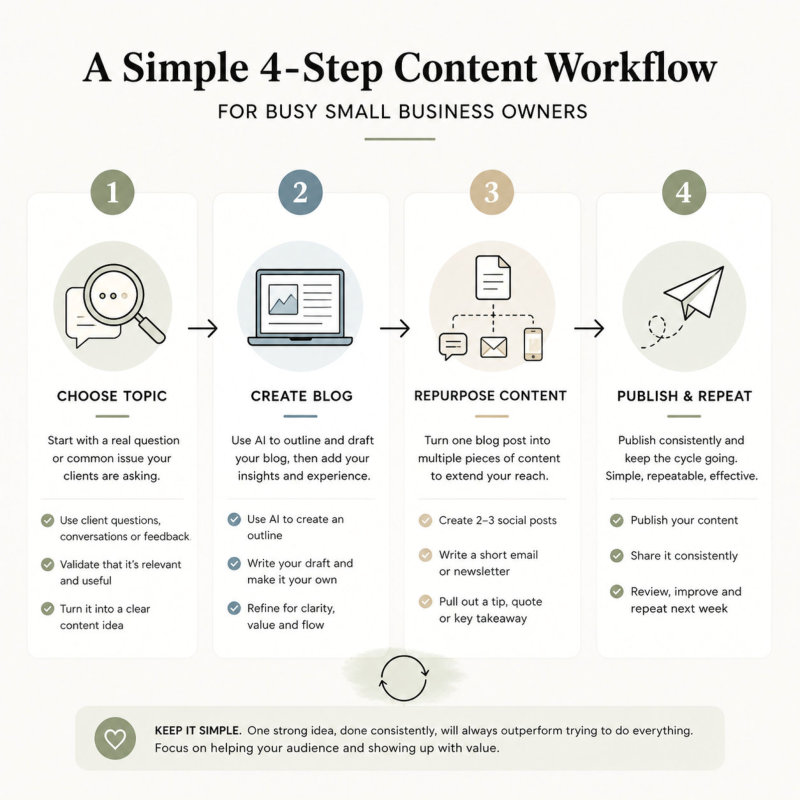
A Simple Weekly Content Workflow Using AI

A practical workflow doesn’t need to be complicated. In fact, the simpler it is, the more likely you are to stick to it.

A basic weekly structure might look like this:

  • Choose one topic based on a real client question or common issue
  • Use AI to outline the blog post
  • Write and refine the content using your own input
  • Repurpose it into 2–3 smaller pieces (social posts, email, etc.)

This approach keeps everything connected. You’re not creating random pieces of content – you’re building around one idea at a time.

If you want to expand this further, the 121 Practical Things AI Can Help With When You’re a Solo Business Owner article includes examples of how AI fits into everyday business tasks, including content creation.

How to Move From Idea to Published Content Faster

One of the biggest delays in content creation is the gap between having an idea and actually publishing something.

This is where AI becomes most useful. It reduces friction at each step:

  • Planning → turning ideas into structured topics
  • Drafting → getting a first version written quickly
  • Refining → improving clarity and tone

Instead of spending hours figuring out where to start, you’re moving through a guided process.

You can use prompts like:

“Turn this idea into a structured blog outline with clear sections and key points.”

That alone can save significant time and mental effort, especially when you’re juggling other parts of your business.

If your goal is to consistently move from idea to finished content without getting stuck, your guide Wait… You Can Do That? Save 8–12 Hours a Week with AI breaks this process down step by step.

Turning AI into a 4 step content flow

Keeping It Realistic So You Don’t Burn Out

It’s easy to get motivated at the start and try to do too much. Posting more often, creating more content, trying to be everywhere at once.

That usually doesn’t last.

A better approach is to set a pace you can maintain. One strong blog post per week, supported by a few smaller pieces of content, is more than enough for most small businesses.

AI helps you maintain that pace by reducing the effort required, but it doesn’t remove the need for consistency.

If your workflow feels heavy or hard to maintain, it’s a sign that it needs to be simplified, not expanded.

Turning This Into a Repeatable System

The real value of AI comes when your workflow becomes repeatable. You’re not figuring things out from scratch each time – you’re following a system that works.

This might include:

  • Reusing prompts that give you good results
  • Following the same content structure each week
  • Building on previous topics instead of starting over

Over time, this creates momentum. Content becomes part of how your business runs, not something you struggle to keep up with.

If you want to see how this evolves in real situations, the ChatGPT Confessions series shows how prompts, workflows, and results improve through actual use.

The goal isn’t to create more content. It’s to create a system that helps you stay visible, build authority, and keep moving forward without constantly starting from zero.

Frequently Asked Questions

The key is to start with your own input. AI works best when you give it something real to work with – your ideas, your wording, your client questions, or your rough drafts. Instead of asking AI to “write content,” ask it to refine, structure, or expand on what you’ve already written. Also, don’t rely on the first output. Adjust the tone, make it more specific, and remove anything that feels too polished or vague.

No – but generic content is. Search engines and AI-driven tools are getting better at recognising useful, clear, and well-structured content. If your content is helpful, relevant, and written with your audience in mind, it can perform well regardless of whether AI was involved. The problem happens when people publish low-quality, repetitive content that doesn’t add real value.

AI is most useful for content planning, structuring ideas, rewriting drafts, summarising information, and repurposing existing content. It can also help with brainstorming blog topics, refining website copy, and turning one piece of content into multiple formats. It’s less effective when you expect it to fully replace your thinking or create something meaningful without any input.

Not really – especially not for service-based businesses. AI can speed up the process and help with drafting, but it doesn’t understand your business, your clients, or your positioning the way a human does. It’s a tool that supports content creation, not a complete replacement for strategy, messaging, or experience-based insight.

A simple test is to read it back and ask: does this sound like me, and would this actually help my audience? If it feels vague, overly polished, or like it could apply to any business, it needs more work. Add specifics, simplify the language, and make sure it reflects your real experience. If you wouldn’t confidently stand behind it, don’t publish it yet.

Consistency matters more than frequency. It’s better to create one solid piece of content per week than to try to produce large amounts and burn out. AI helps you maintain that consistency by reducing the effort required to plan, draft, and refine your content. Focus on building a rhythm you can realistically stick to.

Relying on it too much. Many people copy the first output and publish it without refining it. This leads to content that sounds generic and doesn’t build trust. AI should be part of your process, not the entire process. The best results come when you guide it, adjust it, and make the final decisions yourself.

No. You don’t need complicated prompts – you need clear ones. Simple instructions like “rewrite this more clearly,” “make this more specific,” or “structure this into sections” are often enough. Over time, you’ll naturally refine how you prompt based on what works for you. If you want ready-to-use examples, your prompt library can shortcut this learning curve.

This Only Works If You Actually Use It

AI can make content creation easier, but it doesn’t replace the thinking behind it. The businesses that get real value from AI are the ones that use it to support their ideas, not avoid them.

Planning your content, writing your website copy, building blog articles, and repurposing your ideas all become more manageable when you’re not starting from scratch each time. AI helps you move faster, stay consistent, and reduce the mental load that usually comes with content creation.

But the difference comes down to how you use it. If you rely on it too heavily, your content becomes generic. If you guide it, refine it, and keep your voice at the centre, your content becomes clearer, more useful, and more aligned with your business.

You don’t need a complicated system to make this work. A simple workflow, built around one idea at a time, is enough to create consistent content that builds authority over time.

If you’re ready to take this further and want a structured way to plan, write, and repurpose your content without it taking over your week, the guide Wait… You Can Do That? Save 8–12 Hours a Week with AI shows you how to turn this into a repeatable process you can actually stick to.

Start simple. Stay consistent. Use AI as a tool, not a shortcut – and your content will start working for you instead of feeling like something you have to keep up with.

AI Sounds Great … But Where Do You Actually Start?

I’m Ivana, a website designer who works with small business owners, coaches and consultants to create websites they actually feel confident sharing. I focus on clarity, structure and making things feel simple – whether that’s your website or how you use tools like AI in your business.

If you’re reading this and thinking, “I know AI could help, but I don’t know where to start or what to use it for,” you’re not alone.

Most small business owners aren’t struggling with effort. They’re struggling with clarity — what to use AI for, how to use it properly, and how to make it fit into their day without creating more work.

That’s exactly where the difference is.

If you want a practical, no-fluff way to start using AI to save time, organise your thinking, and actually get things done, you can explore it here:

Wait… You Can Do That? – Save 8–12 Hours a Week with AI

Or if you’d rather see how this works in real situations, including what worked and what didn’t:

ChatGPT Confessions

The goal isn’t to use AI for everything.
It’s to use it in the right places so your business feels simpler, clearer, and easier to run.

Ivana Katz - Website designer