
AI Search & Visibility
How AI Search Actually Finds and Uses Content

This guide forms part of our complete resource on Small Business AI & Automation.

Search is changing. People are no longer relying only on Google results to find information. They are asking questions directly in tools like ChatGPT, using AI-generated answers, and expecting clear, immediate responses rather than scrolling through multiple pages.

This shift is not about replacing traditional search. It is about how people access information and how decisions are being influenced. If your business is not visible in these new environments, you are missing opportunities to be discovered in ways that did not exist before.

At the same time, much of the advice around AI visibility is vague or overly technical. Many small business owners are told to “optimise for AI” without a clear understanding of what that actually means or how to apply it in a practical way.

The reality is simpler than it sounds. AI tools rely on clear, structured, and relevant content. They draw from sources that explain topics well, answer real questions, and provide useful context. This means your existing content strategy already plays a significant role in how visible you are in AI-driven search.

This page focuses on how to improve your visibility in AI tools by building content that is easy to understand, easy to reference, and aligned with how people search today. It connects directly with your broader Content & Visibility strategy, where clarity and structure form the foundation of being found online.

When done properly, this is not about chasing trends. It is about making sure your business shows up in the places where people are already looking for answers.
How AI Is Changing the Way People Find Businesses

AI Does Not Rank Pages, It Builds Answers

Traditional search engines present a list of results and leave it to the user to choose what to click. AI search works differently. It generates an answer by combining information from multiple sources, which means your content is not simply competing for position. It is being evaluated as something that can be extracted, summarised, and included within a response.

This changes how visibility works. Instead of focusing only on ranking, your content needs to be usable. AI tools look for sections that clearly explain a concept, answer a question, or provide structured insight. If your content is vague, overly wordy, or difficult to interpret, it becomes harder for AI to use it as part of an answer.

For example, if someone asks, “How long does it take to build a website?”, AI is more likely to reference content that gives a direct, structured explanation such as timelines, stages, and variables. A page that mentions timelines briefly but does not clearly break them down is far less likely to be used.

This is why clarity matters more than ever. You are not just writing for someone to read your page. You are writing for your content to be understood, extracted, and reused in a different format.

AI Looks for Clear, Self-Contained Sections

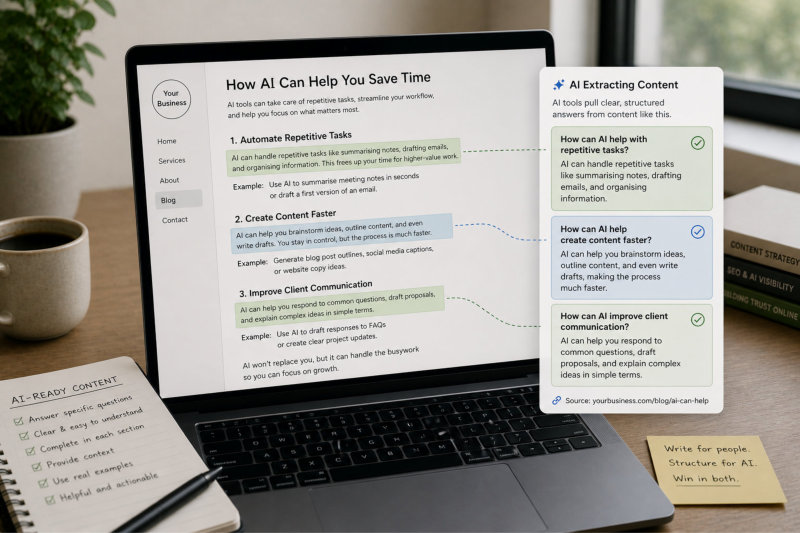
AI tools do not always use entire pages. They often extract specific sections that answer a question clearly on their own. This means each section of your content needs to make sense independently, without relying on the reader having gone through the entire article.

This is where structure becomes critical. Well-defined headings, clear subtopics, and logically organised sections make it easier for AI to identify what each part of your content is about. When a section directly answers a question, it becomes a strong candidate for inclusion in AI-generated responses.

For example, a section titled “How Much Does a Website Cost?” that clearly explains pricing factors, ranges, and what influences cost is far more useful than a general paragraph buried within a broader article. The clearer the section, the easier it is for AI to extract and use.

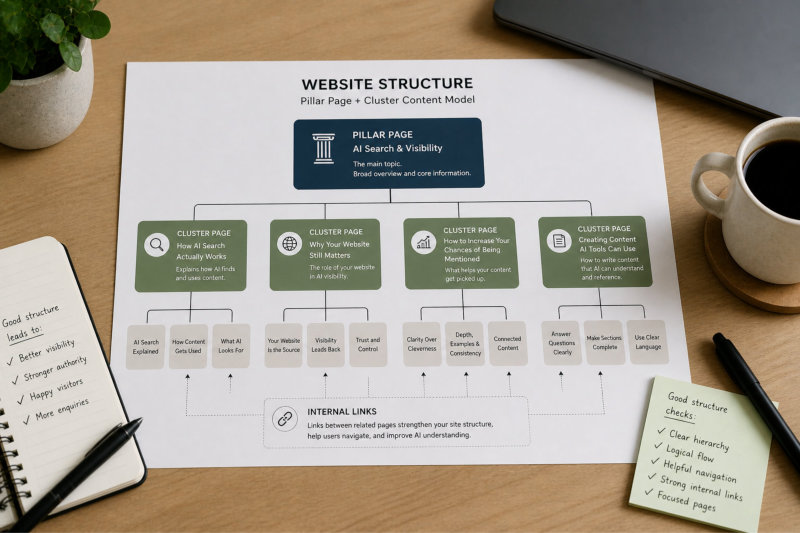
This is exactly why your pillar and cluster structure works so well. Each section is focused, structured, and built around a specific idea, which increases the likelihood of it being referenced in AI-generated answers.

Content Needs to Answer Real Questions, Not Just Describe Services

Many business websites focus heavily on describing services, but AI search is driven by questions. People are asking complete, natural-language questions and expecting direct answers. Content that aligns with those questions is far more likely to be surfaced.

For example, a service page that says “We design websites for small businesses” is informative, but it does not answer a specific question. Compare that with content that answers “What should a small business website include?” or “How do I know if my website needs a redesign?” The second approach is far more aligned with how people search today.

This does not mean abandoning your services content. It means supporting it with content that answers the questions your audience is already asking. Over time, this creates multiple entry points into your website, both through traditional search and AI-generated responses.

Your existing content across Content & Visibility already supports this direction, particularly where articles are structured around specific problems and solutions rather than general descriptions.

Depth and Context Increase Your Chances of Being Referenced

AI tools look for content that provides enough context to be useful. A short or surface-level explanation may not be sufficient, even if it includes the right keywords. Content that explores a topic in detail, explains different angles, and provides examples is more likely to be seen as valuable.

For example, a short paragraph explaining that “AI can help with content creation” is unlikely to be used in a meaningful way. A detailed section that explains how AI fits into content planning, drafting, and refining, along with practical examples, gives AI something it can actually work with.

This is where your long-form, structured content becomes an advantage. Instead of relying on brief explanations, you are creating content that fully explores a topic. This increases the chances of your content being used across a wider range of queries.

It also reinforces your authority. When your content consistently provides depth and clarity, it becomes a stronger reference point, both for users and for AI systems.

Consistency Across Topics Strengthens Visibility

AI visibility is not based on a single piece of content. It comes from how your content connects across related topics. When multiple articles cover different aspects of the same subject, they reinforce each other and create a stronger overall signal.

For example, having one article about AI content creation is useful, but having a cluster that covers planning, writing, repurposing, and workflows creates a much clearer picture of your expertise. AI tools can then draw from multiple pages when building responses, increasing your overall visibility.

This is why your cluster strategy is so important. It is not just about SEO. It is about creating a network of related content that supports how AI systems understand your authority in a specific area.

Over time, this consistency builds momentum. Instead of relying on individual pages to perform, your content works together as a system that strengthens your presence across both traditional search and AI-driven platforms.

Your Website Remains the Source of Truth

Even as AI-generated answers become more common, your website remains the foundation of your visibility. It is where your content lives, where your messaging is defined, and where potential clients go when they want to understand your services in more detail.

AI tools may summarise or reference your content, but they still rely on it as a source. This is why having a clear, well-structured website is essential. Without it, there is nothing to reference.

Your website also plays a critical role in converting visibility into enquiries. Being mentioned in an AI response is only the first step. The next step is whether someone can land on your website, understand what you do, and feel confident reaching out.

This reinforces your core positioning that your website is the centre of your business. It connects your content, your visibility, and your client experience in one place, which is what ultimately drives results.

If you want to see how this foundation is built, your website design services and content strategy work together to support both visibility and conversion.

Why Your Website Still Matters More Than Ever

Your Website Is Still the Source Behind AI Answers

Even though AI tools are generating answers directly, they are not creating information out of nothing. They rely on existing content as a source, and your website is where that content lives. Every article, page, and explanation you publish contributes to how your business is represented and understood.

This means your website has not lost importance. In many ways, it has become more critical. AI tools may summarise or reference your content, but they still depend on it to form those responses. Without clear, structured content on your website, there is nothing for AI to draw from.

For example, if you have a detailed article explaining how website design works, including timelines, stages, and common mistakes, that content becomes a strong candidate for being referenced in AI-generated answers. If that information does not exist, your business simply does not appear in those conversations.

Your website is not being replaced. It is being used in a different way, which makes the quality of your content even more important.

AI Visibility Still Leads Back to Your Website

Being mentioned in an AI-generated response is only the first step. What happens next is just as important. If someone wants to learn more, validate the information, or explore your services, they will look for your website.

This is where many businesses fall short. They focus on visibility without considering what happens when someone arrives on their site. If the messaging is unclear, the structure is confusing, or the content does not match what was referenced, the opportunity is lost.

Your website needs to support the visibility you are building. It should clearly explain what you do, who you help, and what the next step is. This is where your positioning around your website design services becomes essential, as it ensures your site is not only visible but also effective.

Visibility without a strong website leads to missed opportunities. A clear, well-structured website turns that visibility into enquiries.

Your Website Connects All of Your Content

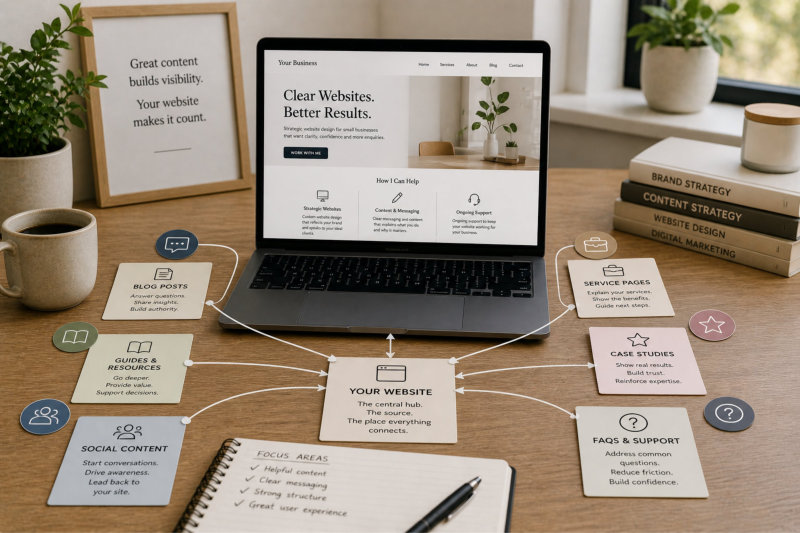
AI visibility is not created by a single piece of content. It comes from how your content works together across your website. Your articles, service pages, and guides all contribute to a broader picture of your expertise.

This is why your website acts as the central hub for your business. It connects your content, your messaging, and your visibility in one place. Each page supports the others, creating a stronger overall presence.

For example, a blog post about AI content creation can link to your broader content strategy, which in turn connects to your services. This creates a pathway for both users and AI tools to understand how your content fits together.

Your Content & Visibility pillar already supports this structure, helping to reinforce your authority across related topics.

Why your website still matters

Your Website Builds Trust Beyond the AI Answer

AI-generated responses can introduce your business, but they cannot replace the experience of engaging with your website. When someone visits your site, they are forming an impression based on how clearly you communicate, how your content is structured, and how easy it is to understand what you offer.

This is where trust is built. Clear explanations, well-organised content, and a consistent tone all contribute to how confident someone feels about working with you. If your website reinforces what they have already seen in an AI response, that confidence increases.

On the other hand, if your website feels disconnected or unclear, it creates doubt. This is why your website needs to reflect the same level of clarity and structure as the content being referenced elsewhere.

Your website is where people move from awareness to consideration. It plays a critical role in whether that initial visibility leads to a real opportunity.

Your Website Gives You Control Over Your Visibility

Platforms change. Algorithms change. The way people search and consume information continues to evolve. Your website is one of the few assets you fully control.

When your content lives on your website, you decide how it is structured, how it is presented, and how it connects to your services. This gives you a stable foundation that supports your visibility regardless of how external platforms change.

AI tools may use your content, but your website remains the source. This gives you a level of control that you do not have on other platforms, where visibility can shift without warning.

If you want to build a system that supports both traditional search and AI-driven visibility, your guide Wait… You Can Do That? Save 8–12 Hours a Week with AI shows how to structure your content and workflows in a way that remains effective over time.

Your website is not just part of your business. It is the foundation that everything else connects back to, including how you are discovered in AI-driven search.

How to Increase Your Chances of Being Mentioned in AI Answers

Clarity Always Beats Cleverness

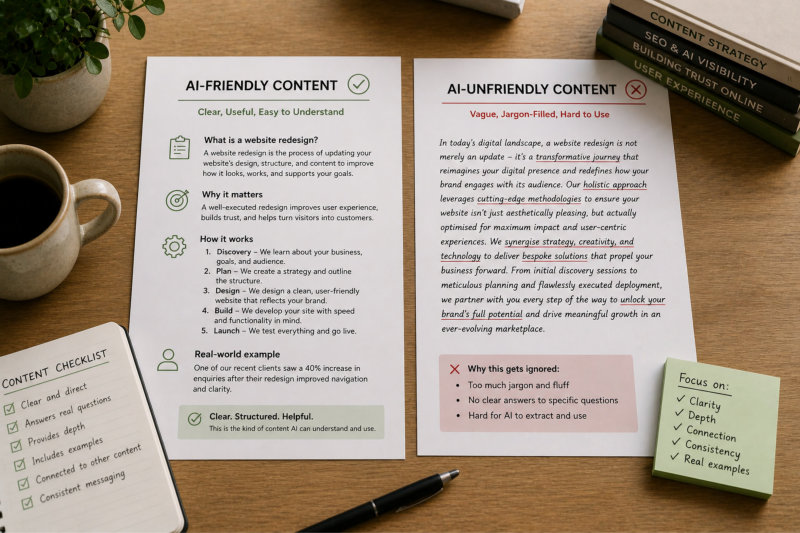
One of the biggest differences between businesses that show up in AI-generated answers and those that do not is how clearly they communicate. Content that tries to sound clever, overly polished, or filled with industry language often becomes harder to interpret. While it may look impressive at first glance, it does not always explain the topic in a way that is easy to understand or reuse.

AI tools favour content that is clear, direct, and focused on explaining a concept in a way that stands on its own. If a section of your content answers a question in a straightforward way, it becomes much easier for AI to extract and use it as part of a response.

For example, a simple, well-structured explanation of how a website redesign works is far more useful than a paragraph filled with vague language about “transforming digital presence.” The first can be used directly. The second requires interpretation, which makes it less reliable as a source.

This is why clarity is not just a writing preference. It directly affects whether your content is visible in AI-driven search.

Surface-Level Content Gets Ignored

Content that only touches on a topic briefly does not provide enough value to be used in AI-generated responses. A short paragraph or a general overview may introduce an idea, but it does not answer a question in a way that is complete or useful.

AI tools are looking for content that provides enough depth to stand as a reliable explanation. This includes breaking down concepts, providing context, and showing how something works in practice. Without that level of detail, your content is less likely to be referenced.

For example, stating that “AI can improve productivity” is not enough. Expanding on how AI fits into daily workflows, where it saves time, and where it does not gives the content more substance. This is what allows it to be used in a meaningful way.

Your cluster content naturally supports this because it builds depth across related topics, rather than relying on isolated, surface-level articles.

How to increase your chances of being mentioned

Disconnected Content Weakens Visibility

AI visibility is not based on a single page. It is influenced by how your content connects across your website. When pages exist in isolation, they provide limited context. When they are linked and structured as part of a broader topic, they reinforce each other.

For example, a single article about AI content creation is useful, but when it is connected to content about productivity, workflows, and visibility, it creates a much stronger signal of expertise. AI tools can then draw from multiple sources within your site, increasing your overall presence.

This is where your internal linking and cluster structure play a key role. By connecting related content, you are making it easier for both users and AI systems to understand the full scope of what you offer.

Your broader Content & Visibility strategy supports this by building interconnected content rather than isolated pages.

Inconsistent Messaging Creates Confusion

When your messaging changes across different pages, it becomes harder for AI tools to understand what your business actually focuses on. If one page emphasises one area and another page presents something slightly different, the overall signal becomes weaker.

Consistency does not mean repeating the same words everywhere. It means reinforcing the same core ideas across your content. Your services, your approach, and your positioning should be clear regardless of which page someone lands on.

For example, if your positioning is built around creating clear, structured websites that support business growth, that idea should appear consistently across your content. This helps AI systems form a clearer understanding of what you do and when to reference your content.

This consistency also improves the user experience, as visitors are not trying to piece together conflicting messages.

Lack of Real Examples Reduces Trust

Content that only explains concepts without showing how they apply in real situations is less useful for both users and AI systems. Examples provide context and make abstract ideas easier to understand. They also demonstrate that the information is grounded in real experience rather than theory.

For example, explaining that AI can help with client communication becomes much more useful when you show how it is used to draft responses, structure proposals, or simplify explanations. This gives the content a practical dimension that makes it more valuable.

AI tools are more likely to reference content that includes this level of detail because it provides a clearer answer. It also helps users understand how to apply the information, which increases the overall usefulness of the response.

If you want to see how practical application strengthens content, your guide Wait… You Can Do That? Save 8–12 Hours a Week with AI shows how real examples and structured workflows make information easier to apply.

Being visible in AI search is not about tricks or shortcuts. It comes from creating content that is clear, connected, consistent, and grounded in real use. Businesses that focus on these fundamentals are far more likely to be picked up and referenced.

Creating Content That AI Tools Can Actually Use

Focus on Answering Specific Questions Clearly

Content that performs well in AI-driven search usually has one thing in common. It answers a specific question clearly and completely. Broad, general content may introduce a topic, but it often does not go far enough to be useful when someone is looking for a direct answer. AI tools are designed to respond to questions, which means they prioritise content that reflects how people actually ask those questions.

This requires a shift in how content is planned. Instead of starting with a general topic, it is more effective to start with a specific question or problem. For example, “How do I get more enquiries from my website?” is far more useful than simply writing about “website marketing.” The first gives you a clear direction for the content and a clear outcome for the reader.

When a section of your content directly answers a question, it becomes much easier for AI tools to extract and use it. This is where your content becomes more than just informative. It becomes usable.

Make Each Section Complete and Self-Contained

AI tools often extract individual sections rather than using an entire page. This means each section of your content needs to stand on its own. If a section relies heavily on earlier context or feels incomplete on its own, it becomes harder for AI to use it effectively.

This is why structure matters. Each heading should clearly define what the section covers, and the content within that section should fully explain the idea. The reader, or the AI system, should not need to refer elsewhere to understand it.

For example, a section explaining website pricing should include the key factors, typical ranges, and what influences cost. If it only hints at these ideas and refers elsewhere, it loses its usefulness as a standalone explanation.

This approach also improves the user experience. Content that is easy to follow in sections is easier to read, easier to understand, and more likely to hold attention.

Use Clear Language That Requires No Interpretation

AI tools favour content that is easy to interpret. This means writing in a way that does not require the reader to decode what you are saying. Overly complex language, vague statements, or abstract explanations can reduce the usefulness of your content.

For example, phrases like “enhancing digital presence” or “leveraging innovative strategies” may sound polished, but they do not clearly explain what is actually being done. A clearer explanation, such as “improving your website so it attracts more enquiries,” is easier to understand and more likely to be used.

This does not mean simplifying your content to the point where it loses depth. It means making sure that each idea is expressed clearly and directly. When your content is easy to understand, it becomes easier for AI to summarise and include in responses.

Creating content that AI tools can use

Provide Enough Context to Make the Content Useful

Content that lacks context often fails to deliver value, even if it includes the right information. A brief statement or surface-level explanation may introduce an idea, but it does not help the reader understand how to apply it or what it means in practice.

AI tools look for content that provides enough detail to be useful on its own. This includes explaining how something works, when it should be used, and what to expect. Without this level of context, the content is less likely to be referenced.

For example, saying that “AI can help with productivity” is not particularly useful. Expanding on how it fits into daily workflows, what tasks it supports, and where it may not be effective creates a much stronger piece of content.

This is where your long-form, structured approach becomes an advantage. It allows you to provide the level of detail that both users and AI tools are looking for.

Support Your Content With Real Examples

Examples play a critical role in making content usable. They take abstract ideas and show how they apply in real situations, which makes the information easier to understand and more relevant to the reader.

For example, explaining how AI can support content creation becomes much more practical when you show how it can be used to outline a blog post, draft an email, or restructure existing content. This gives the reader a clear picture of how to apply the information.

AI tools also benefit from this level of detail because it provides a clearer answer. Content that includes examples is more likely to be seen as complete and reliable, which increases the chances of it being referenced.

If you want to see how this works in practice, your guide Wait… You Can Do That? Save 8–12 Hours a Week with AI shows how real examples and structured workflows make content easier to apply and more useful overall.

Creating content that AI tools can use is not about optimisation tricks. It is about writing in a way that is clear, structured, and grounded in real use. When your content meets that standard, it becomes far more visible and far more valuable.

Structuring Your Website for AI and Search Visibility

Start With a Clear Content Hierarchy

A website that performs well in both traditional search and AI-driven visibility usually has a clear structure behind it. This means your content is organised in a way that makes sense not only to visitors, but also to search engines and AI systems trying to understand what your site is about.

Many small business websites grow over time without a clear plan. Pages are added when needed, topics are covered in isolation, and content ends up scattered rather than connected. While this may still work on a basic level, it makes it much harder for AI tools to interpret your content as part of a larger, coherent topic.

A structured approach, such as using pillar pages supported by related cluster content, creates a clear hierarchy. Your main topics are defined at a high level, and each supporting page explores a specific part of that topic in more detail. This makes it easier for both users and AI systems to understand how your content fits together.

This is exactly what your current structure is designed to achieve. Each pillar connects to multiple related pages, which together build a stronger signal of authority in that area.

Make Navigation Simple and Logical

Navigation is not just about helping users find their way around your website. It also plays a role in how your content is discovered and understood. When your navigation is clear and logical, it reinforces the structure of your content and makes it easier to explore related topics.

If navigation is cluttered, inconsistent, or difficult to follow, it creates friction for both users and search systems. Important pages may be harder to find, and the relationship between different pieces of content becomes less clear.

A well-structured navigation should reflect your main pillars and guide visitors toward the most important areas of your website. From there, internal links within your content can lead to more specific topics.

This layered approach allows both users and AI tools to move through your content in a logical way, which improves overall visibility and engagement.

Structuring your website for AI

Use Internal Linking to Connect Related Content

Internal linking is one of the most effective ways to strengthen your website structure. It connects related pages, reinforces your content hierarchy, and helps both users and AI systems understand how different topics relate to each other.

For example, a page about AI content creation should naturally link to related topics such as productivity, workflows, and visibility. This creates a network of content rather than isolated pages. When these links are placed within relevant context, they guide the reader while also strengthening the overall structure of your site.

This is particularly important for AI visibility. When multiple pages support the same topic and are clearly linked, it increases the likelihood of your content being referenced across different queries. It also reinforces your authority in that area.

Your Content & Visibility strategy already supports this approach, where content is designed to work together rather than compete for attention.

Ensure Each Page Has a Clear Purpose

Every page on your website should have a clear role. If a page tries to cover too many topics or lacks a defined purpose, it becomes harder for both users and AI systems to understand what it is meant to do.

A focused page is easier to interpret and more likely to be used as a reference. This means clearly defining what each page is about and what question or problem it is addressing. When that focus is maintained, the content becomes more effective and easier to navigate.

For example, a page about website redesign should focus specifically on that topic, rather than combining it with unrelated information about marketing or content creation. This clarity makes the page more useful and increases its relevance for both search and AI-driven visibility.

This approach also supports your overall site structure, where each page contributes to a specific part of a larger topic rather than trying to do everything at once.

Align Your Structure With How People Search Today

Search behaviour has shifted from short keyword phrases to more natural, question-based queries. This means your website structure needs to reflect how people actually look for information. Instead of grouping content in a way that only makes sense internally, it should align with the questions and problems your audience is trying to solve.

For example, rather than organising content purely around services, you can structure it around common questions, challenges, and decisions that your audience faces. This creates a more intuitive pathway for both users and AI tools.

When your content is aligned with real search behaviour, it becomes easier to match with relevant queries. This improves your chances of being discovered, whether through traditional search results or AI-generated answers.

Your website design services play a key role here, as they ensure your site is not only structured correctly but also designed to guide visitors through that structure effectively.

A well-structured website does more than organise your content. It makes your business easier to understand, easier to navigate, and far more visible in the places where people are already searching for answers.

Building Authority So You Get Referenced, Not Ignored

Authority Comes From Depth, Not Just Presence

Simply having content on your website does not mean it will be used or referenced. Many businesses publish articles regularly, but those articles only skim the surface of a topic. While this creates activity, it does not build authority in a meaningful way.

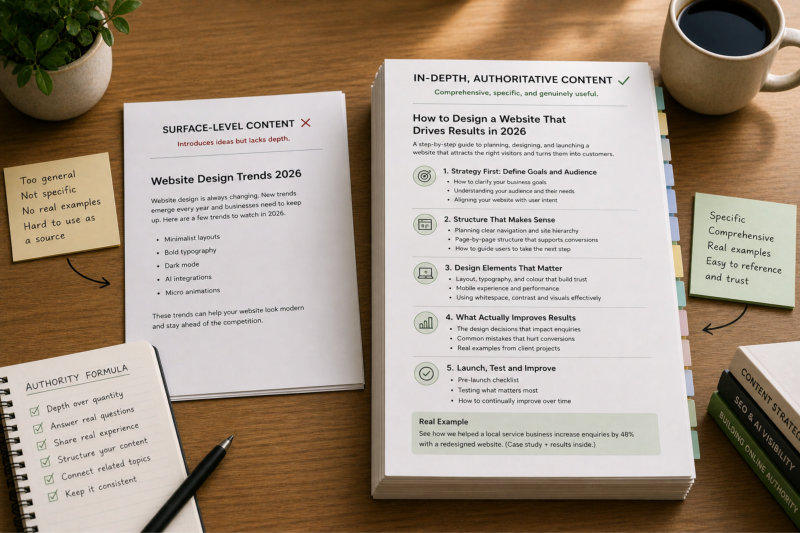
AI tools look for content that provides enough depth to be useful as a source. This means going beyond basic explanations and fully exploring a topic. It includes breaking down how something works, why it matters, and how it applies in real situations. Without this level of detail, your content is less likely to be selected when an answer is generated.

For example, a short article about website design trends may introduce ideas, but it does not provide enough substance to be referenced. A detailed guide that explains how to structure a website, what elements matter, and how decisions affect results becomes far more valuable. This is the type of content that gets used.

Authority is not built through volume alone. It is built through the depth and usefulness of what you publish.

Consistency Across Topics Builds a Stronger Signal

Authority is not based on a single page. It is built across multiple pieces of content that reinforce each other. When you consistently publish content around related topics, you create a clearer signal of what your business focuses on.

For example, having one article about AI productivity is useful, but it does not establish strong authority on its own. When that article is supported by related content covering workflows, communication, and content creation, it creates a more complete picture. AI tools can then draw from multiple sources within your site, which strengthens your visibility.

This is where your cluster strategy becomes important. Each page supports a specific part of a larger topic, and together they create a stronger foundation. Instead of isolated content, you are building a connected body of work that reinforces your expertise.

Over time, this consistency increases the likelihood of your content being referenced across different types of queries.

Real Experience Carries More Weight Than Generic Advice

Content that is based on real experience tends to be more useful than content that simply repeats general advice. It includes practical insights, examples, and observations that come from actually doing the work, rather than just describing it.

AI tools are more likely to use content that reflects this level of understanding because it provides clearer, more reliable explanations. Generic advice often lacks context and can feel interchangeable with other sources, which reduces its value.

For example, explaining how you use AI to structure client communication or streamline workflows gives your content a level of specificity that generic advice cannot match. It shows how concepts apply in real situations, which makes the information more useful.

This is also where your ChatGPT Confessions series becomes valuable. It demonstrates real use, which strengthens your authority and makes your content more distinctive.

Building authority so you get referenced

Clear Positioning Helps AI Understand What You Do

Authority is closely linked to clarity. If your content sends mixed signals about what your business does, it becomes harder for AI tools to understand when to reference it. This does not mean you cannot cover multiple topics, but those topics need to connect back to a clear core focus.

For example, if your content consistently reinforces that your website is the centre of your business and connects design, content, and visibility, that message becomes easier to recognise. AI systems can then associate your content with those themes.

In contrast, if your content is scattered across unrelated topics without a clear connection, it weakens your overall signal. Even if individual pieces are strong, the lack of cohesion reduces their impact.

Your structured approach, where content is organised around defined pillars, supports this clarity and strengthens how your business is understood.

Authority Increases When Your Content Is Referenced and Connected

Authority is reinforced not only by what you publish, but by how your content is used and connected. When your content is referenced, linked, and supported by related pages, it creates a stronger signal of relevance and trust.

Internal linking plays a role here by connecting your content in a way that reflects how topics relate to each other. External references and mentions also contribute, but the foundation starts with how your own content is structured.

For example, linking from your AI content to your broader Content & Visibility strategy helps reinforce the relationship between these topics. It shows how different areas of your expertise connect, which strengthens your overall authority.

Over time, this creates a network of content that is easier to understand, easier to navigate, and more likely to be referenced. Authority is not something that happens instantly. It builds gradually as your content becomes more connected, more consistent, and more useful.

When your content reaches that level, it is far less likely to be ignored and far more likely to be used as a source.

The Gap Between “Being Online” and “Being Found”

Having a Website Does Not Mean You Are Visible

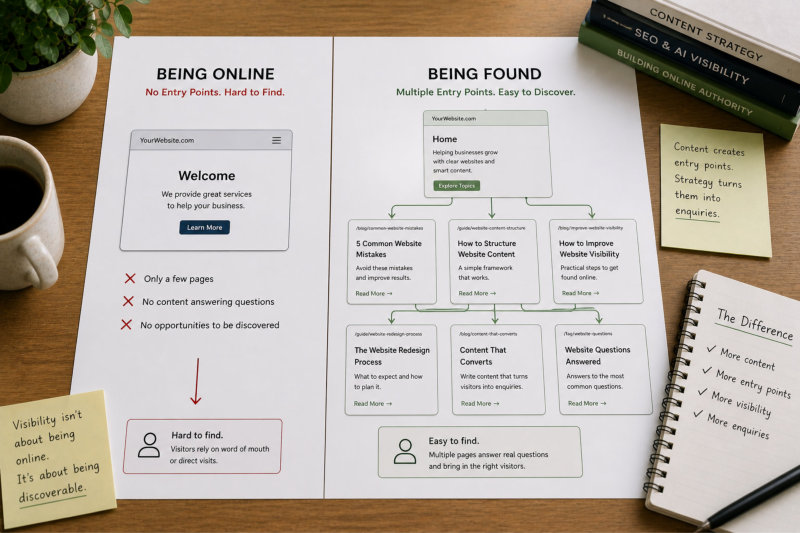
One of the most common assumptions small business owners make is that once their website is live, they are “online” and therefore visible. While this is technically true, it does not reflect how people actually find businesses today. A website without supporting content, structure, and visibility strategy is unlikely to be discovered in any meaningful way.

Search engines and AI tools do not surface websites simply because they exist. They surface content that answers questions, provides value, and fits within a broader context. If your website does not meet those criteria, it becomes one of many that remain unseen.

For example, a well-designed website with only a homepage and a few service pages may look professional, but it offers very few entry points for someone searching for specific information. Without content that answers real questions, there is little opportunity for it to be found.

This is where the gap begins. Being online is the starting point. Being found requires a different level of intention.

Most Websites Are Built for Presence, Not Discovery

Many websites are created with the goal of establishing an online presence rather than being actively discovered. They describe the business, outline services, and provide contact details, but they are not designed to attract new visitors through search or AI-driven platforms.

This is not necessarily a mistake. It reflects how websites have traditionally been used. However, it does limit how effective they can be as a growth tool.

To be found, your website needs to go beyond describing what you do. It needs to answer questions, explore topics, and provide content that aligns with how people search. This is where your broader Content & Visibility strategy becomes essential.

When your website is built for discovery, it creates multiple pathways for people to find you, rather than relying on direct visits or referrals.

Visibility Comes From Entry Points, Not Just One Page

Being found rarely happens through a single page. It happens through multiple entry points across your website. Each article, guide, or page that answers a specific question becomes an opportunity for someone to discover your business.

This is particularly important in AI-driven search, where content is surfaced based on how well it answers a query. A single service page is unlikely to cover the range of questions your audience is asking. Supporting content fills that gap.

For example, someone searching for advice on improving their website may find an article about common website mistakes, another about content structure, and another about visibility. Each of these pages acts as an entry point, leading them back to your core services.

This is how your content works together. It creates multiple opportunities to be found, rather than relying on one page to do all the work.

The gap between being found

A Strong Website Turns Visibility Into Enquiries

Visibility on its own does not guarantee results. Once someone finds your website, the next step is whether they understand what you do and feel confident taking action. This is where the quality of your website becomes critical.

If your messaging is unclear, your structure is difficult to follow, or your content does not align with what brought the visitor there, the opportunity is lost. Being found is only part of the process. Converting that attention into enquiries depends on how well your website performs.

This is why your website design services are so important. They ensure that your site not only attracts visitors but also guides them toward the next step in a clear and structured way.

When visibility and usability work together, your website becomes far more effective as a business tool.

Bridging the Gap Requires a Clear Strategy

Moving from “being online” to “being found” does not happen by accident. It requires a deliberate approach to how your website is structured, what content you create, and how everything connects together.

This includes building content that answers real questions, organising your site into clear topics, and ensuring that each page has a defined purpose. It also involves linking your content in a way that reflects how those topics relate to each other.

AI tools and search engines both rely on this structure to understand your content. When it is in place, your visibility improves naturally because your website becomes easier to interpret and use.

If you want a practical way to implement this without overcomplicating the process, your guide Wait… You Can Do That? Save 8–12 Hours a Week with AI shows how to build content and workflows that support consistent visibility.

The gap between being online and being found is not a technical issue. It is a strategic one. Once that is understood, it becomes much easier to close.

Frequently Asked Questions

There is no direct submission or optimisation setting that guarantees your website will be mentioned. AI tools draw from content that is clear, structured, and useful. This means your focus should be on creating content that answers real questions, provides enough depth, and is easy to understand. Over time, consistently publishing this type of content increases your chances of being referenced.

No, but it is changing how people access information. Traditional search results are still widely used, but many people are now turning to AI tools to get direct answers. This means your content needs to perform in both environments. Strong content that is well-structured will support visibility across both search engines and AI-generated responses.

Keywords still play a role, but they are no longer the main focus. AI tools are designed to understand natural language and context, which means your content should reflect how people actually ask questions. Writing in a clear, natural way that answers specific queries is more effective than trying to optimise for isolated keywords.

Content that is structured, detailed, and focused on answering specific questions performs best. This includes guides, how-to articles, and content that explains processes clearly. Pages that provide context, examples, and practical insights are more likely to be used because they offer complete answers rather than surface-level information.

Website structure plays a significant role. A well-organised site with clear topics, logical navigation, and strong internal linking makes it easier for both search engines and AI tools to understand your content. This improves how your content is interpreted and increases the likelihood of it being surfaced in responses.

Yes, because AI search is not based solely on brand size or authority in the traditional sense. It is based on how useful and relevant your content is. A small business that creates clear, structured, and detailed content around specific topics can compete effectively by providing value that larger, less focused sites may not offer.

Like traditional SEO, this is a gradual process. Visibility builds over time as your content grows and becomes more connected. Consistency is key. Publishing well-structured content regularly and linking it across related topics helps build momentum and increases your chances of being referenced.

No, but you do need to improve how your content is structured and connected. This includes making your content clearer, focusing on answering real questions, and ensuring your website has a logical structure. Small, consistent improvements often have a bigger impact than a complete overhaul.

Making Your Business Easier to Find in a Changing Search Landscape

Search is evolving, but the fundamentals have not changed as much as it might seem. People are still looking for clear answers, practical information, and businesses they can trust. The difference is how that information is being delivered.

AI tools are changing the way content is accessed by generating answers rather than simply listing results. This makes clarity, structure, and usefulness more important than ever. Content that explains topics well, answers real questions, and provides enough depth is far more likely to be surfaced and referenced.

Your website remains at the centre of this. It is where your content lives, where your expertise is demonstrated, and where potential clients go when they want to learn more. When your content is structured properly and connected across related topics, it becomes easier to understand, easier to find, and more effective at attracting the right type of enquiries.

This is not about chasing trends or trying to outsmart search systems. It is about building a clear, consistent foundation that supports how people look for information today. When your website, your content, and your structure are aligned, your visibility improves naturally across both traditional and AI-driven search.

If you want a practical way to apply this without overcomplicating your approach, your guide Wait… You Can Do That? Save 8–12 Hours a Week with AI shows how to build content and workflows that support consistent visibility and long-term growth.

AI Sounds Great … But Where Do You Actually Start?

I’m Ivana, a website designer who works with small business owners, coaches and consultants to create websites they actually feel confident sharing. I focus on clarity, structure and making things feel simple – whether that’s your website or how you use tools like AI in your business.

If you’re reading this and thinking, “I know AI could help, but I don’t know where to start or what to use it for,” you’re not alone.

Most small business owners aren’t struggling with effort. They’re struggling with clarity — what to use AI for, how to use it properly, and how to make it fit into their day without creating more work.

That’s exactly where the difference is.

If you want a practical, no-fluff way to start using AI to save time, organise your thinking, and actually get things done, you can explore it here:

Wait… You Can Do That? – Save 8–12 Hours a Week with AI

Or if you’d rather see how this works in real situations, including what worked and what didn’t:

ChatGPT Confessions

The goal isn’t to use AI for everything.
It’s to use it in the right places so your business feels simpler, clearer, and easier to run.

Ivana Katz - Website designer