

Understanding What You’re Actually Paying For
Design, Development and Website Structure
A website is not just a visual layout. It involves structuring pages in a way that makes sense to users and supports how they move through your content. This includes navigation, page hierarchy, and how information is grouped. A well-structured website reduces confusion, improves usability, and makes it easier for visitors to take action.
Design is the visual layer, but development is what brings it to life. This includes building responsive layouts, ensuring the site works across devices, and setting up the underlying framework. When structure and development are done properly, the website is stable, scalable, and easier to manage long term.
- Page hierarchy and navigation planning
- Responsive layout across desktop, tablet, and mobile
- Theme or framework setup
- Consistent layout systems across pages
Planning, Strategy and Scope Definition
Before any design work begins, decisions are made about what the website needs to include. This stage defines the number of pages, the purpose of each section, and how users will interact with the site. Without clear planning, projects often expand unexpectedly, increasing both time and cost.
Scope definition ensures that both sides understand what is being built. It sets boundaries around functionality, content, and timelines. When scope is unclear, it leads to revisions, delays, and additional work that could have been avoided with proper upfront planning.
- Defining core pages and purpose
- Mapping user flow and navigation paths
- Identifying required features and integrations
- Setting realistic expectations for delivery
Content Preparation and Content Structure
Content is one of the most underestimated parts of a website build. Every page requires clear messaging, structured headings, and well-organised information. If content is missing or unclear, the design process slows down because decisions cannot be finalised.
Structured content also impacts how easy the website is to read and navigate. Headings, sections, and supporting text need to be planned so users can quickly find what they are looking for. Strong content reduces confusion and improves the overall effectiveness of the website.
- Page-by-page content planning
- Headings and section structure
- Call-to-action placement
- Consistency across all pages
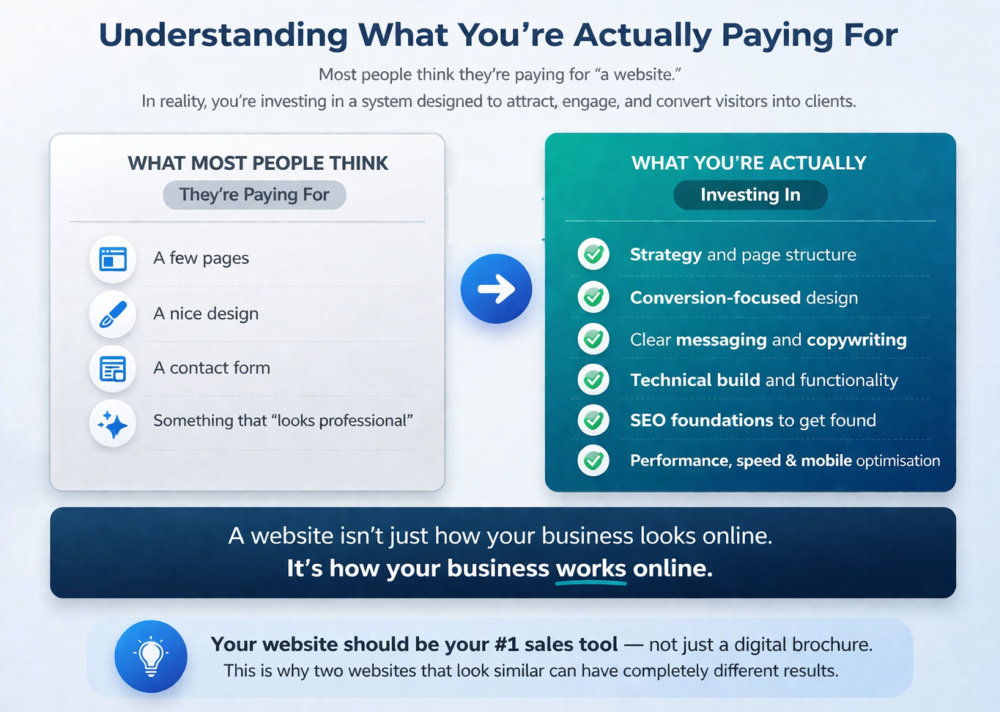
Functionality, Features and Integrations
Most websites require more than just static pages. Features such as contact forms, booking systems, email integrations, and CRM connections add functionality but also increase complexity. Each feature needs to be configured, tested, and integrated properly.
The more functionality included, the more time is required to ensure everything works together. Poorly implemented features often cause issues after launch, which can be more expensive to fix later. Careful planning ensures only necessary features are included from the start.
Testing, Refinement and Launch Preparation
Before a website goes live, it needs to be tested across different devices and browsers. This ensures that layouts display correctly, links work, and all functionality behaves as expected. Testing helps identify issues that may not be obvious during development.
Launch preparation also includes final checks, backups, and performance reviews. Skipping this stage often leads to problems appearing after the site is live. A structured launch process ensures the website is stable and ready for real users.
- Cross-device and browser testing
- Link and functionality checks
- Performance and loading speed review
- Final pre-launch checklist
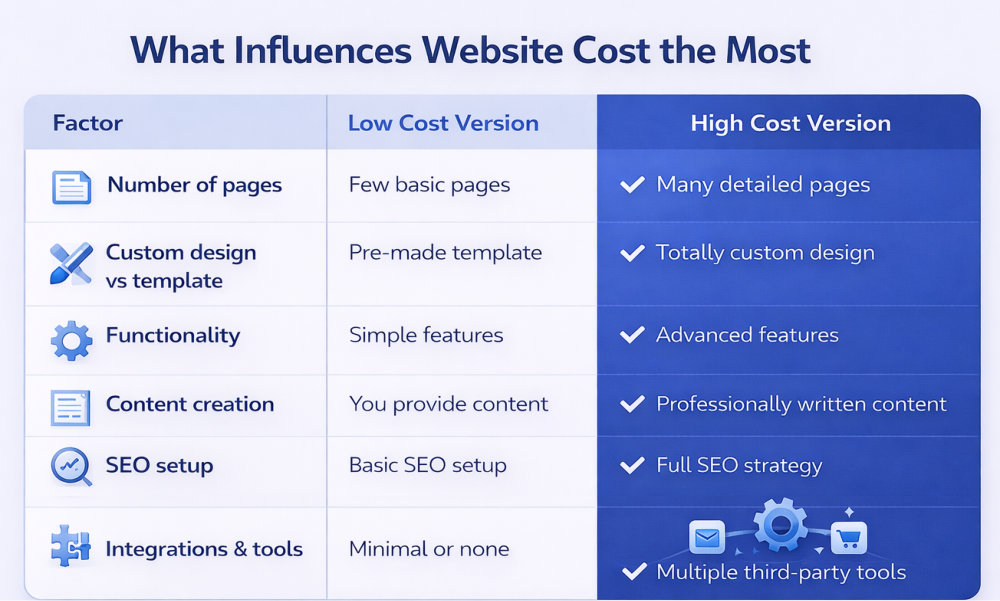
What Influences Website Cost the Most
Number of Pages and Overall Website Size
The number of pages on your website is one of the biggest cost drivers. Each page requires planning, layout, content placement, and testing. A simple five-page website can be built relatively quickly, while a larger site with 15–30 pages requires significantly more time and coordination.
It’s not just the page count, but the level of detail within each page. A single long-form service page with multiple sections can take as much time as several simple pages. This is why two websites with the same number of pages can still vary in cost depending on complexity.
Expanding your website later is possible, but starting with a clear structure avoids unnecessary rework. If you’re unsure how many pages you actually need, reviewing How Much Does a Coaching Website Cost? can help you understand what’s typically included at different levels.
- More pages = more design, content, and setup time
- Complex page layouts increase build time
- Poor planning leads to unnecessary pages
- Clear structure reduces future rebuilds
Level of Design Customisation
The level of design customisation has a direct impact on both cost and timeline. Template-based designs follow a predefined structure, which makes them faster to implement. Custom designs require more time for layout creation, revisions, and refinement to ensure the final result aligns with your brand.
A more customised design involves additional decision-making, feedback rounds, and adjustments. This includes spacing, typography, colour consistency, and how different sections work together across the site. The more tailored the design, the more time is required to achieve a cohesive result.
For many small businesses, a structured package approach provides a strong balance between cost and quality. You can review available options on our Website Design Packages page to see what is included at different levels.
- Template designs reduce build time and cost
- Custom designs require more refinement and revisions
- Brand alignment increases design complexity
- More design flexibility = higher investment
Content Readiness and Clarity
Content is one of the biggest factors affecting both cost and timeline. When content is clear, structured, and ready to go, the build process moves efficiently. When content is missing, unclear, or constantly changing, it slows everything down and often increases costs.
Every page requires headings, supporting text, and a clear flow of information. Without this, design decisions cannot be finalised. This often leads to multiple revisions, delays, and additional work that could have been avoided with proper preparation.
If you are unsure what content is required or how detailed it needs to be, reviewing Professional Website vs DIY Website vs No Website can help you understand the effort involved at each level.
- Clear content speeds up design and development
- Unfinished content delays the entire project
- Frequent changes increase revision time
- Structured content improves usability and clarity
Integrations, Features and Third-Party Tools
Most business websites require more than just pages and content. Features such as contact forms, booking systems, email marketing platforms, and CRM integrations all add functionality. Each of these needs to be configured, connected, and tested to ensure everything works smoothly.
The complexity increases when multiple systems need to work together. Even simple integrations can require setup time, troubleshooting, and ongoing maintenance. The more tools involved, the more time is needed to ensure reliability and consistency.
For businesses planning online stores or advanced functionality, it’s important to understand the additional layers involved. Articles such as 7 Often Overlooked Costs of eCommerce Business Development highlight how quickly these costs can add up.
- Forms, bookings, and CRM integrations increase setup time
- Third-party tools require configuration and testing
- More integrations = higher complexity and cost
- Poorly planned features lead to issues after launch
Decision Speed and Client Responsiveness
The speed at which decisions are made during a project has a direct impact on both timeline and cost. When feedback is provided quickly and clearly, the project moves forward efficiently. When decisions are delayed or unclear, progress slows and additional time is required to revisit work.
Website projects involve multiple decision points, including design approvals, content confirmation, and functionality choices. Delays at any stage can create bottlenecks, especially when work needs to be paused and then resumed later.
Inconsistent feedback or frequent changes can also increase revision time. This often leads to extended timelines and additional work that was not originally planned. Clear communication and timely responses help keep the project on track and within scope.
Understanding the full scope of website costs, including how timelines impact pricing, is outlined in What Are All the Small Business Website Costs You Might Incur?.
- Fast decisions keep projects moving efficiently
- Delayed feedback slows progress and increases time
- Frequent changes lead to additional revisions
- Clear communication reduces unnecessary delays
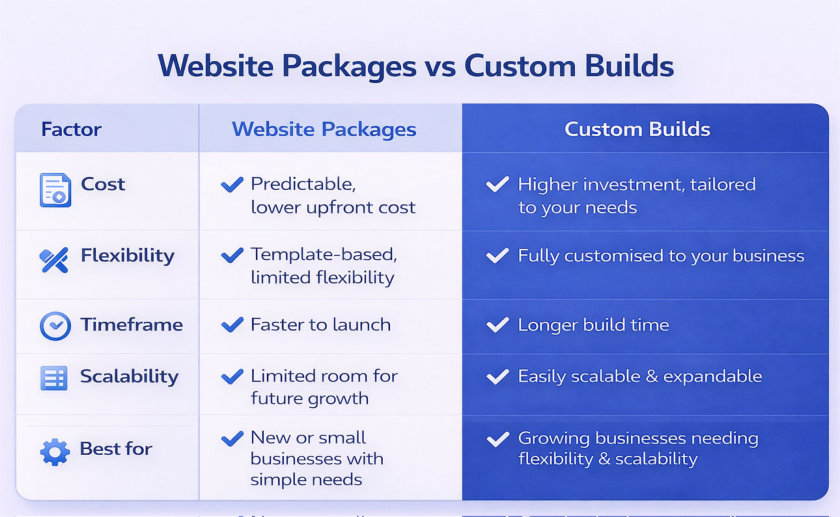
Website Packages vs Custom Builds
What Website Packages Typically Include
Website packages follow a structured approach with predefined layouts, inclusions, and a clear scope. This makes them faster to deliver and more cost-effective, as much of the planning and design framework has already been established.
Packages are designed to cover the most common needs of small businesses, including core pages, contact forms, and basic integrations. They remove unnecessary complexity and provide a streamlined path to getting online.
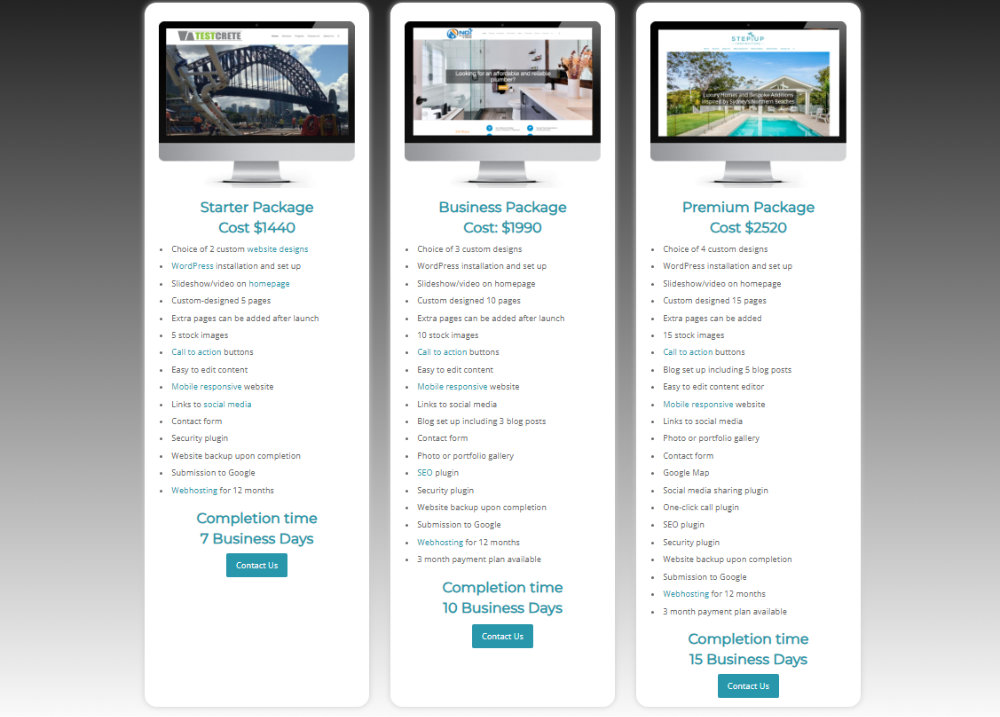
If you want to see how this works in practice, you can review our Website Design Packages to understand what is included at different levels.
- Predefined layouts and structure
- Fixed scope and inclusions
- Faster turnaround times
- More predictable pricing
What Custom Website Builds Involve
Custom website builds are designed from the ground up to match the specific needs of a business. This includes tailored layouts, flexible functionality, and a structure that aligns closely with how the business operates and grows.
Unlike packages, custom builds require more planning, more decision-making, and more refinement throughout the process. Every element is considered individually, from page structure to feature requirements, which increases both the time and investment involved.
Custom builds are typically suited to businesses with more complex offerings, multiple services, or specific functionality requirements that cannot be achieved within a predefined framework.
- Fully tailored layout and structure
- Flexible functionality and integrations
- More planning and revision stages
- Higher investment and longer timelines
When a Website Package Makes More Sense
Website packages are often the better option for businesses that need a professional online presence without unnecessary complexity. They provide a clear structure, predictable cost, and faster delivery, which is ideal for getting online efficiently.
For new or early-stage businesses, a package allows you to establish a solid foundation without overcommitting budget or time. It ensures your website is functional, structured, and ready to grow, without adding features that are not yet needed.
If you’re weighing up whether to build it yourself or invest in a structured solution, reviewing Professional Website vs DIY Website vs No Website can help clarify what each option involves.
- New or early-stage businesses
- Clear and simple service offering
- Limited or controlled budget
- Need to launch quickly and efficiently
When a Custom Website Build is the Better Option
A custom website build is more appropriate when your business has outgrown a standard structure or requires greater flexibility. This is often the case for established businesses with multiple services, complex offerings, or specific functionality that cannot be achieved within a package.
Custom builds allow for deeper alignment between your website and how your business operates. This includes tailored page structures, advanced integrations, and a design that reflects a more refined brand presence. It also provides the flexibility to scale without needing to rebuild the site in the near future.
Understanding the cost implications of a more advanced website is important before making this decision. You can explore typical pricing considerations in How Much Will It Cost To Design a Website? to see how different requirements impact investment.
- Established or growing business
- Multiple services or complex offerings
- Advanced functionality or integrations required
- Long-term scalability is a priority
Choosing the Right Approach for Your Business
The right choice between a website package and a custom build depends on your current business stage, goals, and level of complexity. A structured package is often the most practical starting point, while a custom build becomes more relevant as your business grows and your requirements become more specific.
Choosing based purely on price often leads to the wrong outcome. A solution that is too basic may need to be rebuilt sooner than expected, while an overly complex build can create unnecessary cost without delivering additional value.
A more effective approach is to focus on what your business needs now, while ensuring the website can evolve over time. This allows you to invest strategically without overcommitting or underbuilding your foundation.
For a deeper look at how different cost decisions impact long-term results, you can also review 9 Costly Mistakes To Avoid When Designing Your Website.
- Match your website to your current business stage
- Avoid choosing based on price alone
- Focus on structure and long-term flexibility
- Plan for growth without overbuilding early
Website Cost Breakdown (Realistic Ranges)
Starter Websites ($1,000 – $2,000)
Starter websites are designed for businesses that need a simple and professional online presence without advanced functionality. These typically include a small number of pages, basic layouts, and standard features such as contact forms.
This level is suitable for new businesses or those testing an idea, where the priority is getting online quickly without a large upfront investment. The structure is straightforward, and design flexibility is usually limited to keep costs controlled.
For businesses considering whether to invest at this level or build something themselves, reviewing Professional Website vs DIY Website vs No Website can help clarify the differences in time, cost, and outcome.
- Typically 3–5 core pages
- Template-based design
- Basic functionality and integrations
- Faster turnaround time
Growth Websites ($2,000 – $5,000)
Growth websites are designed for businesses that are ready to strengthen their online presence and present themselves more professionally. This level typically includes more pages, improved structure, and a more refined design that better reflects the business.
At this stage, there is a stronger focus on clarity, usability, and how information is presented. The website is no longer just about being online, but about supporting business growth and making it easier for potential clients to understand what you offer.
This is also where businesses begin to invest more deliberately in content and layout. Reviewing How Much Does a Coaching Website Cost? provides a practical example of what is typically included at this level.
- Typically 5–15 pages
- More refined and consistent design
- Improved content structure and layout
- Additional functionality where needed
Custom Websites ($5,000+)
Custom websites are built for businesses that require a more tailored approach, both in design and functionality. This level goes beyond standard layouts and involves creating a structure that closely aligns with how the business operates and delivers its services.
These projects typically involve more detailed planning, more collaboration, and a higher level of refinement throughout the process. Design, content, and functionality are all considered together to ensure the website supports long-term growth rather than needing to be rebuilt later.
Costs at this level vary depending on complexity, integrations, and the level of customisation required. Reviewing How Much Will It Cost To Design a Website? can provide further insight into how different requirements influence pricing.
- Tailored structure and layout
- Advanced functionality and integrations
- Higher level of planning and collaboration
- Designed for long-term scalability
Ecommerce and Advanced Functionality Costs
Websites that include ecommerce or advanced functionality require significantly more setup, configuration, and testing. Unlike standard websites, these builds involve product management, payment systems, user flows, and ongoing operational considerations.
The complexity increases with the number of products, variations, integrations, and automation required. Even a small online store can involve multiple moving parts that need to work together seamlessly. This is why ecommerce websites often sit at the higher end of the pricing range.
Many of these additional costs are not obvious at the beginning. Reviewing 7 Often Overlooked Costs of eCommerce Business Development highlights the areas that are commonly missed when budgeting for this type of website.
- Product setup and management systems
- Payment gateway configuration
- Shipping, tax, and automation rules
- Ongoing maintenance and updates
Additional Services and Supporting Costs
Website pricing often focuses on the build itself, but there are additional services that can significantly influence the overall investment. These are not always included in base pricing and should be considered when planning your budget.
Services such as copywriting, branding, and SEO setup all contribute to how effective your website is once it goes live. While they may be optional, they play a key role in how clearly your business is presented and how easily your audience understands what you offer.
Many small business owners underestimate these costs early on. Reviewing What Are All the Small Business Website Costs You Might Incur? provides a broader view of what to expect beyond the initial build.
- Copywriting and content creation
- Branding and visual identity
- SEO setup and optimisation
- Ongoing content and updates
Budgeting for a Website the Smart Way
Start with Your Current Business Stage
Your website budget should align with where your business is right now, not where you think it should be. A new business does not need the same level of investment as an established one, and trying to match that too early often leads to unnecessary cost.
At the same time, underinvesting can limit your ability to present your business clearly. The goal is to choose a level that supports your current needs while allowing room to grow. This creates a balance between being practical and being prepared.
Understanding how website costs scale across different stages can help guide your decision. Reviewing How Much Does a Coaching Website Cost? provides a useful benchmark for what is realistic at each level.
- Match your budget to your current business stage
- Avoid overinvesting too early
- Avoid underinvesting in your foundation
- Focus on clarity and usability first
Build in Stages Rather Than All at Once
A website does not need to include everything on day one. Trying to build every feature, page, and idea upfront often leads to higher costs and unnecessary complexity. A staged approach allows you to launch with a solid foundation and expand over time.
This approach keeps the initial investment manageable while still allowing your website to grow alongside your business. It also gives you the opportunity to refine your content, understand what works, and make improvements based on real use rather than assumptions.
Many businesses find that starting with a structured build and adding to it later results in a more effective website overall. If you’re weighing up whether to build everything now or start smaller, reviewing Professional Website vs DIY Website vs No Website can help clarify the trade-offs.
- Launch with essential pages and features
- Add functionality as your business grows
- Reduce upfront cost without sacrificing structure
- Make improvements based on real usage
Prioritise Structure Over Extra Features
One of the most common mistakes in website budgeting is focusing on features before structure. While advanced functionality can be useful, it does not compensate for a poorly organised website. Clear navigation, logical page flow, and well-structured content should always come first.
A strong structure makes your website easier to use, easier to manage, and easier to expand over time. Features can always be added later, but fixing a poorly structured site often requires significant rework. This is why prioritising structure from the beginning leads to better long-term results.
Many costly mistakes happen when features are added without a clear foundation. Reviewing 9 Costly Mistakes To Avoid When Designing Your Website highlights how these decisions impact cost and performance.
- Focus on navigation and page flow first
- Ensure content is clear and well organised
- Add features only when they serve a purpose
- Avoid building complexity too early

Avoid Overbuilding Too Early
It is common for businesses to want everything included from the start. While this may seem efficient, it often leads to unnecessary cost and complexity. Features that are not yet needed can slow down the build process and add little value in the early stages.
A more effective approach is to focus on what your business needs right now. This keeps the project manageable and ensures your website is clear, functional, and aligned with your current goals. Additional features can always be added later as your business grows and your needs become more defined.
Overbuilding often results in paying for functionality that is rarely used or needs to be changed later. Understanding how to avoid these pitfalls is outlined in How Much Will It Cost To Design a Website?, which highlights common mistakes that increase costs unnecessarily.
- Focus on current business needs, not future ideas
- Avoid adding features “just in case”
- Keep the initial build simple and structured
- Add complexity only when it becomes necessary
Plan for Growth Without Needing to Rebuild
A well-planned website should support your business as it grows, without requiring a complete rebuild every time something changes. This means starting with a structure that is flexible enough to expand while still being simple enough to manage at the beginning.
Planning for growth does not mean building everything upfront. It means making smart decisions about structure, platform, and content so that future updates can be added without disrupting the entire site. This approach protects your initial investment and reduces long-term costs.
Many businesses end up rebuilding their websites because the original structure did not allow for expansion. Taking the time to plan properly from the start helps avoid this cycle and creates a more stable foundation for ongoing development.
- Choose a structure that allows additional pages and features
- Ensure your platform can scale with your needs
- Plan content so it can be expanded over time
- Avoid short-term decisions that limit future growth
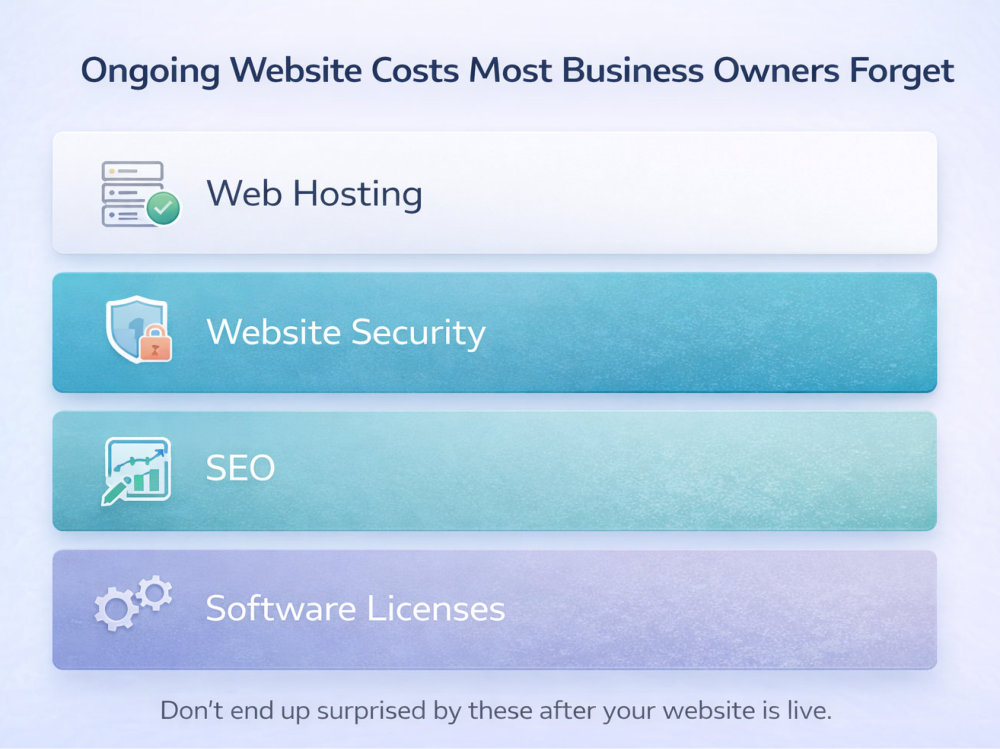
Ongoing Website Costs Most Business Owners Forget
Hosting, Domain and SSL Costs
Every website requires ongoing hosting, a domain name, and an SSL certificate to remain live and secure. These are not one-time costs and need to be renewed regularly. Without them, your website will either go offline or be flagged as insecure.
Hosting quality also affects performance, reliability, and security. Cheaper hosting options may seem appealing initially, but they often lead to slower load times, increased downtime, and limited support. Investing in reliable hosting helps ensure your website runs consistently and securely.
If you are unsure what to look for when choosing hosting, Web Hosting for Australian Startups: Performance, Security & Cost Considerations provides a practical breakdown of what matters.
- Annual domain registration
- Ongoing hosting fees
- SSL certificate for security
- Performance and reliability considerations
Maintenance and Software Updates
Websites require regular updates to keep them secure, stable, and compatible with the latest technologies. This includes updating the content management system, themes, and plugins that power your site. These updates are not optional, as outdated software can create security vulnerabilities and functionality issues.
Maintenance also involves monitoring your website to ensure everything continues to work as expected. Without regular checks, small issues can go unnoticed and turn into larger problems over time. This can lead to downtime, broken features, or even loss of data.
Keeping your website maintained ensures it remains reliable and reduces the risk of unexpected disruptions. It also extends the lifespan of your website, delaying the need for major fixes or rebuilds.
- Regular CMS, theme, and plugin updates
- Ongoing monitoring for issues
- Fixing bugs and compatibility problems
- Reducing security risks and downtime
Backups and Website Security
Backups and security are essential parts of maintaining a website, yet they are often overlooked until a problem occurs. Regular backups ensure that your website can be restored quickly if something goes wrong, whether due to a technical issue, user error, or security breach.
Security measures help protect your website from hacking attempts, malware, and vulnerabilities. This includes firewalls, security plugins, and monitoring systems that identify and block threats before they cause damage. Without proper security, even a small issue can result in lost data or downtime.
These systems require setup, monitoring, and ongoing management. While they may not be visible to users, they play a critical role in keeping your website stable and protected.
- Automated backups and restore points
- Security monitoring and threat detection
- Protection against malware and attacks
- Ongoing management and updates
Content Updates and Ongoing Improvements
A website is not a one-time project. Content needs to be updated regularly to keep your business relevant, accurate, and engaging. This includes updating services, adding new information, and refining messaging as your business evolves.
Without regular updates, websites quickly become outdated. This affects how your business is perceived and can make it harder for potential clients to understand what you offer. Even small updates can make a significant difference in maintaining clarity and credibility.
Ongoing improvements also include refining page layouts, adjusting content structure, and adding new sections over time. These updates ensure your website continues to support your business rather than becoming a static asset.
- Updating services and business information
- Refreshing content and messaging
- Adding new pages or sections
- Improving clarity and usability over time
Optional Marketing and Growth Costs
A website provides the foundation for your online presence, but it does not automatically generate traffic or enquiries. Ongoing marketing activities such as SEO, email marketing, and paid advertising are separate investments that support visibility and growth.
These costs vary depending on your strategy and how actively you promote your business. Some businesses choose to invest in ongoing SEO and content creation, while others focus on paid campaigns or email marketing to reach their audience.
It’s important to understand that these are not included in standard website builds. They are optional but often necessary if your goal is to actively grow your business online.
- Search engine optimisation (SEO)
- Email marketing platforms and campaigns
- Paid advertising (Google Ads, social media)
- Content creation and ongoing promotion
The Hidden Cost of Choosing the Wrong Option
Choosing Based on Price Alone
One of the most common mistakes is choosing a website solution based purely on price. While a lower upfront cost may seem appealing, it often comes at the expense of structure, flexibility, and long-term usability. This can result in a website that does not properly support your business.
When a website lacks clear structure or scalability, it typically needs to be rebuilt sooner than expected. This means paying for the same work twice, along with the additional time and disruption involved in starting again.
Understanding the long-term impact of cost-based decisions is outlined in 9 Costly Mistakes To Avoid When Designing Your Website, where common budgeting errors are explained in more detail.
- Lower upfront cost often means limited structure
- Short-term savings can lead to long-term expenses
- Rebuilds are more expensive than building properly once
- Price alone does not reflect value
Cheap Builds That Need Rebuilding
Low-cost websites often prioritise speed and price over structure and long-term usability. While they may look acceptable at launch, they frequently lack the foundation needed to support growth, updates, or additional functionality.
As the business evolves, limitations start to appear. Pages become difficult to expand, features cannot be added easily, and the overall structure no longer fits the direction of the business. At this point, the only viable option is often a full rebuild.
This creates a situation where the initial investment is effectively lost, and the business ends up paying again to build the website properly. In many cases, the total cost becomes higher than if the website had been planned correctly from the beginning.
- Limited flexibility and scalability
- Difficult to update or expand
- Structure does not support growth
- Full rebuild required sooner than expected
DIY Overwhelm and Incomplete Websites
Many business owners start building their own website with the intention of saving money. While this can work in some cases, it often leads to incomplete or inconsistent results due to the time and knowledge required to do it properly.
Building a website involves more than selecting a template. It requires planning structure, writing content, setting up functionality, and ensuring everything works across devices. Without a clear process, projects tend to stall or become more time-consuming than expected.
In many cases, the website is left unfinished or does not represent the business effectively. This results in lost time, frustration, and eventually the need to invest in a professional build anyway.
- Time investment is often underestimated
- Lack of structure leads to inconsistent results
- Projects are delayed or left incomplete
- Professional rebuild often required later

Poor Structure and Limited Visibility
A website that lacks clear structure does not support how users navigate or understand your business. When pages are poorly organised or content is unclear, visitors struggle to find what they need and often leave without taking action.
This also affects how your website performs in search results. Without a logical structure and well-organised content, it becomes harder for search engines to understand what your site is about. This limits your visibility and reduces the chances of being found online.
Even if the design looks good, a poorly structured website does not perform effectively. Fixing structural issues later often requires significant changes, which can increase costs and disrupt the existing site.
- Confusing navigation reduces usability
- Unclear content affects user understanding
- Poor structure limits search visibility
- Fixing structure later can be costly
Choosing the Wrong Provider
The provider you choose has a significant impact on the outcome of your website. A lack of process, experience, or clear communication can lead to inconsistent results, delays, and a website that does not meet expectations.
Without a structured approach, projects can become reactive rather than planned. This often results in multiple revisions, unclear direction, and a final product that lacks cohesion. Fixing these issues later can be time-consuming and costly.
A well-managed project involves clear scope, defined stages, and consistent communication. When these elements are missing, the risk of needing to redo parts of the website increases, along with the overall investment required.
- Lack of process leads to inconsistent results
- Poor communication creates delays and confusion
- Unclear scope increases revisions and cost
- Fixing issues later requires additional investment
Website Investment Planning Checklist
Define Your Business Goals
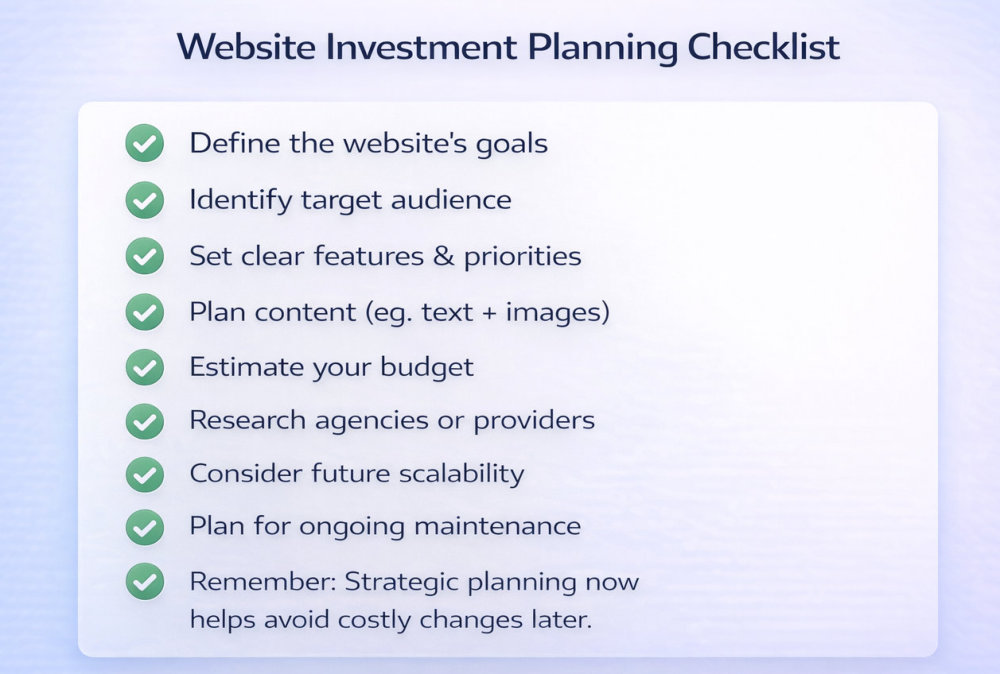
Before setting a budget or choosing a website type, it’s important to be clear about what your website is meant to achieve. This could include generating enquiries, presenting your services, or supporting existing clients. Without a clear goal, it becomes difficult to make informed decisions about structure, features, and investment.
Different goals require different levels of complexity. A simple informational website will have very different requirements compared to a site that includes bookings, integrations, or ongoing content updates. Defining your goal early helps avoid unnecessary features and keeps the project focused.
Clarity at this stage ensures that your website is built with purpose, rather than becoming a collection of pages without direction.
- Identify the primary purpose of your website
- Define what action you want users to take
- Align your website with your business model
- Avoid adding features that do not support your goal
Clarify Scope, Pages and Functionality
Clearly defining the scope of your website is one of the most important steps in controlling both cost and timeline. This includes identifying how many pages are required, what each page needs to include, and what functionality is necessary for your business.
Without a defined scope, projects tend to expand as new ideas are introduced during the build. This often leads to additional costs, delays, and a lack of clarity around what is actually being delivered. A clear scope keeps the project focused and predictable.
It also helps ensure that both you and your provider are aligned on expectations from the beginning. This reduces the likelihood of misunderstandings and keeps the process structured from start to finish.
- List required pages and their purpose
- Identify essential features and integrations
- Clarify what content is needed for each page
- Set clear boundaries for what is included
Clarify Scope, Pages and Functionality
Clearly defining the scope of your website is one of the most important steps in controlling both cost and timeline. This includes identifying how many pages are required, what each page needs to include, and what functionality is necessary for your business.
Without a defined scope, projects tend to expand as new ideas are introduced during the build. This often leads to additional costs, delays, and a lack of clarity around what is actually being delivered. A clear scope keeps the project focused and predictable.
It also helps ensure that both you and your provider are aligned on expectations from the beginning. This reduces the likelihood of misunderstandings and keeps the process structured from start to finish.
- List required pages and their purpose
- Identify essential features and integrations
- Clarify what content is needed for each page
- Set clear boundaries for what is included
Separate Must-Have vs Nice-to-Have Features
Not everything needs to be included in the first version of your website. Separating essential features from optional ones helps control both cost and complexity. This ensures your website launches with what is truly needed, without being overloaded from the start.
Must-have features are those required for your website to function effectively, such as core pages, contact forms, and clear navigation. Nice-to-have features can enhance the site but are not critical for launch and can be added later.
This approach allows you to prioritise your budget and avoid spending on functionality that may not deliver immediate value. It also keeps the project focused and easier to manage.
- Identify essential features required for launch
- List optional features for future development
- Avoid adding unnecessary complexity early
- Prioritise clarity and usability over extras
Plan the Next 12 Months of Website Growth
Your website should be treated as an evolving part of your business, not a one-time project. Planning the next 12 months helps you make better decisions about what to include now and what can be added later.
This includes thinking about future content, additional pages, potential features, and how your business may expand. Having a simple roadmap ensures your website can grow without needing to be rebuilt or significantly restructured.
A clear plan also helps you allocate budget more effectively over time. Instead of investing everything upfront, you can spread your investment across updates, improvements, and new additions as your business develops.
- Identify future pages or content you may need
- Plan potential feature additions over time
- Allocate budget for updates and improvements
- Ensure your website can scale without rebuilding
Frequently Asked Questions
How much should a small business spend on a website?
A small business should spend based on its current stage, not what others are doing. For most businesses, a realistic range sits between $1,500 and $8,000 depending on complexity, number of pages, and functionality.
Starter websites are suitable for getting online quickly with basic structure. Growth websites provide more clarity, better layout, and stronger presentation. Custom websites are typically reserved for established businesses with more complex requirements.
The key is not choosing the lowest price, but choosing a level that supports your business without needing a rebuild within the next 12–18 months.
Why do website quotes vary so much?
Website quotes vary because they are based on completely different scopes. Two websites may look similar on the surface but differ significantly in structure, content, functionality, and level of customisation.
Key factors that influence pricing include:
- Number of pages and complexity
- Content readiness
- Design requirements
- Integrations and features
- Level of planning and strategy involved
Lower quotes often exclude key elements such as structure, content support, or scalability, which can lead to additional costs later.
What is the difference between a website package and a custom build?
A website package follows a structured approach with predefined layouts and inclusions. It is faster to deliver and more cost-effective, making it suitable for businesses with straightforward requirements.
A custom website build is tailored specifically to your business. It involves more planning, more flexibility, and a higher level of refinement. This makes it more suitable for businesses with complex services or long-term growth plans.
Choosing the right option depends on your current needs. A package is often the best starting point, while custom builds are more appropriate once your business requires greater flexibility.
Is it better to start with a cheaper website and upgrade later?
In some cases, starting small is a smart decision, especially if you are early in your business. However, choosing a website that is too limited can lead to a full rebuild sooner than expected.
A better approach is to start with a structured foundation that allows for growth. This avoids paying twice for the same work and ensures your website can evolve without major disruption.
The goal is not to spend more, but to invest in a solution that will last longer.
What ongoing costs should I expect after my website is built?
Ongoing costs are a normal part of running a website and should be planned for from the beginning.
These typically include:
- Hosting, domain, and SSL
- Maintenance and software updates
- Backups and security monitoring
- Content updates and improvements
- Optional marketing activities such as SEO or advertising
These costs ensure your website remains secure, functional, and relevant over time.
Why doesn’t my website automatically generate traffic or leads?
A website is a foundation, not a marketing system on its own. Once your site is live, additional activities such as SEO, content creation, email marketing, or paid advertising are required to attract visitors.
Without these, your website may look professional but remain largely unseen. This is why it is important to separate website build costs from ongoing marketing investment.
Understanding this distinction helps set realistic expectations and avoids disappointment after launch.
What are the biggest mistakes small business owners make when budgeting for a website?
Common mistakes include:
- Choosing based on price alone
- Trying to include everything upfront
- Underestimating content requirements
- Ignoring ongoing costs
- Not defining scope clearly
These mistakes often lead to delays, increased costs, or the need for a rebuild. A structured approach to planning helps avoid these issues and keeps the project focused.
How do I know if a website quote is reasonable?
A reasonable quote should clearly outline what is included, including pages, features, and any limitations. It should also align with your business stage and the level of complexity required.
If a quote seems unusually low, it may exclude important elements such as planning, structure, or scalability. If it is higher, it should reflect a more tailored or comprehensive approach.
Comparing quotes is less about the number and more about what is actually being delivered.
Can I build my own website and upgrade later?
Yes, but it depends on your time, skills, and expectations. DIY websites can work for simple projects, but they often require more time than expected and may lack structure.
Many business owners start this way but later choose to invest in a professional build to improve clarity and usability. If you choose DIY, it’s important to understand the limitations and plan for potential upgrades in the future.
What is the real cost of choosing the wrong website solution?
The biggest cost is often not financial, but time and lost opportunity. A poorly built website can delay your ability to present your business clearly and attract clients.
Financially, it can lead to:
- Paying for a rebuild
- Fixing structural issues
- Reworking content and design
In many cases, the total cost ends up being higher than if the website had been planned correctly from the start.
How should I plan my website investment properly?
Start by defining your goals and understanding what your website needs to achieve. Then set a realistic budget range based on your business stage.
From there:
- Clarify scope (pages, features, content)
- Separate must-have from nice-to-have
- Plan for ongoing costs
- Think about how your site will grow over time
This structured approach ensures your investment is aligned with your business and reduces the risk of costly mistakes.
Planning Your Website Investment with Clarity
Understanding website costs is not about finding the cheapest option, but about making informed decisions based on your business stage, goals, and long-term plans. When you know what you are paying for, what influences cost, and what to prioritise, it becomes much easier to invest with confidence.
A well-planned website avoids unnecessary rebuilds, reduces ongoing issues, and provides a stable foundation for growth. By focusing on structure, clear scope, and realistic budgeting, you create a website that supports your business rather than holding it back.
If you are ready to move forward with a structured and practical approach, explore our Website Design Services to build a website that aligns with your business now and as it grows.
Award Winning WordPress Website Designer in Sydney for Small Businesses and Professionals


Connect


