
SEO for Small Business Websites
Without the Overwhelm

This guide forms part of our complete resource on Small Business Website Content & Visibility.

Search engine optimisation, or SEO, is one of the most misunderstood parts of running a website. Many small business owners know they “should be doing it,” but are not sure what it actually involves or where to start.

Some believe SEO is highly technical and complicated. Others assume it is something that delivers quick results. In reality, it sits somewhere in between.

SEO is not about shortcuts or tricks. It is about building a website that is clear, structured, and useful over time, which is why approaches like those outlined in SEO Made Easy focus on simplicity and consistency rather than quick wins.

It is about building a website that is clear, structured, and easy for both people and search engines to understand.

At its core, SEO is closely connected to your content. The way your website is written, structured, and linked together plays a major role in how visible it becomes over time. This is why it works alongside your website messaging and your content strategy, rather than existing as a separate task.

It also connects to how your website performs as a whole. A well-structured site with clear messaging and useful content is easier for visitors to navigate and easier for search engines to interpret. This improves both visibility and engagement, creating a stronger foundation for your online presence.

One of the biggest challenges with SEO is unrealistic expectations. It is often seen as something that should produce fast results, but in most cases, it takes time to build momentum. Content needs to be indexed, pages need to be understood, and authority needs to develop gradually.

When approached correctly, SEO becomes part of a long-term strategy rather than a quick fix. It supports your visibility, strengthens your website, and helps attract visitors who are actively searching for what you offer.

In this guide, we will break down SEO in a practical and straightforward way. The focus will be on what actually matters for small businesses, how different elements work together, and how to approach SEO without overcomplicating it.
Understanding How SEO Works

What SEO actually means in simple terms

Search engine optimisation, or SEO, is often presented as something complex or highly technical, but at its core, it is quite simple. SEO is about helping search engines understand what your website is about and when it should appear in search results.

When someone searches for something on Google, the search engine looks for pages that are relevant, clear, and useful. It evaluates content, structure, and signals across the website to determine which pages are most likely to answer the user’s question.

This means SEO is not about manipulating rankings or using shortcuts. It is about creating content that genuinely matches what people are searching for and presenting it in a way that is easy to understand. This is why SEO works closely with your website messaging and your overall content structure.

How search engines understand your website

Search engines do not see your website the way a visitor does. They rely on content, structure, and links to interpret what each page is about. This includes the words you use, the way your pages are organised, and how they connect to each other.

Clear headings, well-structured content, and logical navigation all help search engines make sense of your website. When your pages are connected through internal links, it reinforces the relationship between different topics and strengthens your overall authority.

This is why your blogging and content strategy plays an important role in SEO. Each piece of content adds context and depth, making it easier for search engines to recognise your expertise in a particular area.

The role of content, structure, and links

SEO is built on three core elements: content, structure, and links. Each of these works together to improve how your website is understood and ranked.

Content provides the information that search engines use to match your website to search queries. Structure determines how that content is organised, making it easier to navigate and interpret. Links, both internal and external, help establish relationships between pages and signal credibility.

When these elements are aligned, your website becomes easier to understand and more likely to appear in relevant searches. This is also why SEO should not be treated as a separate task. It is built into how your website is created and maintained.

This connection is particularly important when combined with your website structure and user experience, as both influence how users and search engines interact with your site.

Why SEO is not instant and requires consistency

One of the most common misconceptions about SEO is that it produces quick results. In reality, SEO takes time. Search engines need to discover your content, understand it, and build confidence in your website before it starts to rank consistently.

This process does not happen overnight. It often takes weeks or months to see noticeable improvements, depending on your industry and competition. This is why consistency is so important. Regular updates, new content, and ongoing improvements all contribute to long-term results.

When SEO is approached as a one-time task, it rarely delivers meaningful outcomes. When it is treated as an ongoing process, it becomes a reliable way to improve visibility over time.

Common misconceptions about SEO

There are many misconceptions around SEO that can lead to confusion or unrealistic expectations. One of the most common is the belief that SEO is purely technical. While technical elements do play a role, the foundation of SEO is content and clarity.

Another misconception is that using more keywords will improve rankings. In reality, overusing keywords can make content harder to read and less effective. Search engines now prioritise relevance and quality over repetition.

There is also a tendency to expect immediate results. As mentioned earlier, SEO is a long-term strategy. It builds gradually as your website becomes more established and your content becomes more connected.

Understanding these misconceptions helps set realistic expectations and allows you to focus on what actually matters.

It is also common to expect SEO to deliver fast results, but this rarely reflects reality. As explained in the painful truth about getting to the top of search engines, building visibility takes time, consistency, and a clear strategy rather than short-term tactics.

How SEO fits into your overall website strategy

SEO is not something that sits separately from your website. It is part of how your website is built, structured, and maintained. It works alongside your messaging, your content, and your overall user experience.

When all of these elements are aligned, your website becomes more effective as a whole. Visitors can find your content more easily, understand your services more clearly, and move through your site with less friction.

This is where SEO connects directly to your lead generation and enquiry process. Visibility brings visitors to your site, but clear messaging and strong structure are what turn that visibility into action.

By approaching SEO as part of a broader strategy, rather than a standalone task, you create a more cohesive and effective website that supports both visibility and business growth.

Choosing the Right Keywords

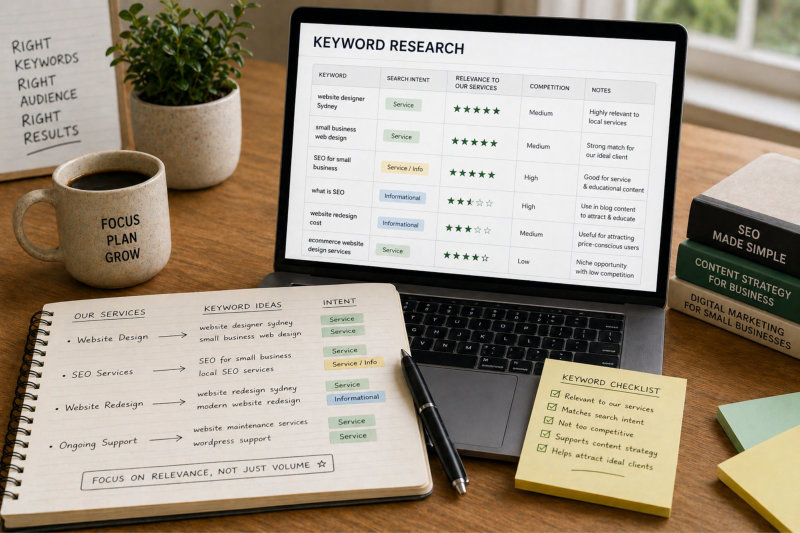
What keywords actually represent your services

Keywords are not just words you want to rank for. They are the terms people use when they are trying to find a solution to a problem. The most effective keywords are the ones that closely match what your business actually offers.

Many small business owners make the mistake of choosing keywords based on what they think sounds good, rather than how their audience searches. This often leads to targeting phrases that are either too broad, too competitive, or not aligned with their services.

Strong keyword selection starts with clarity. What do you do? Who do you help? What problems do you solve? The answers to these questions should guide your keyword choices. When your keywords reflect your services accurately, your content becomes more relevant and more effective.

This is also where keyword strategy connects directly to your website messaging. If your messaging is unclear, your keywords will be unclear as well. Clear messaging leads to clearer, more targeted keyword selection.

Understanding search intent and why it matters

Not all searches have the same purpose. Some people are looking for information, while others are actively looking for a service. This difference is known as search intent, and it plays a key role in how you choose your keywords.

For example, someone searching “what is SEO” is likely looking for general information, while someone searching “SEO services for small business” is closer to making a decision. Both types of searches can be valuable, but they serve different purposes within your content strategy.

Understanding intent helps you create content that matches what the user is expecting to find. This improves both your chances of ranking and how visitors engage with your content once they arrive.

This is why your keyword strategy should work alongside your blogging and content planning, ensuring that you are targeting a mix of informational and service-related topics.

Avoiding broad and overly competitive keywords

One of the most common mistakes in SEO is targeting keywords that are too broad. Phrases like “web design” or “SEO” may seem appealing because they have high search volume, but they are also highly competitive and difficult to rank for, especially for small businesses.

Broad keywords also tend to attract a wide audience, many of whom are not relevant to your services. This can lead to traffic that does not convert into enquiries.

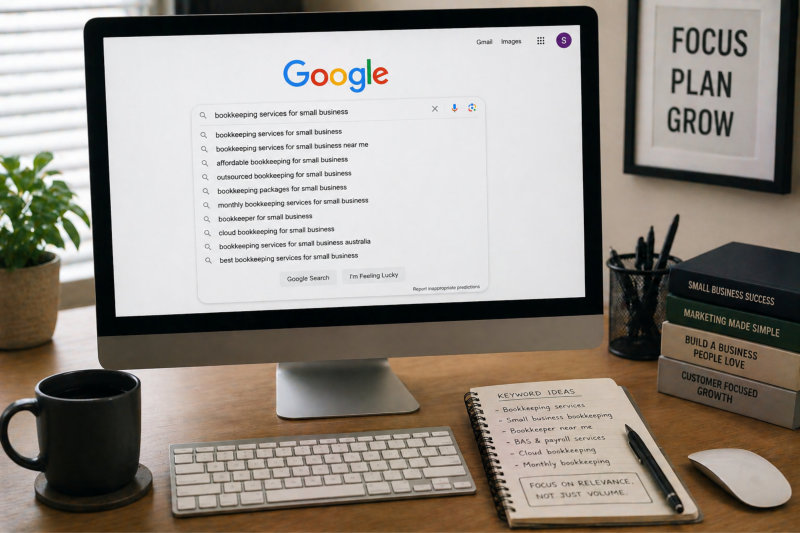
A more effective approach is to focus on more specific, targeted keywords. These often have lower search volume but higher relevance. They are easier to rank for and more likely to attract visitors who are genuinely interested in what you offer.

This approach supports long-term growth, as multiple targeted keywords can collectively generate more meaningful traffic than a single broad term.

Focusing on relevance rather than volume is one of the most important principles in SEO. Many common mistakes come from chasing high-traffic keywords without considering intent or competition, which is why guides like the top do’s and don’ts of SEO emphasise choosing keywords that align with your actual services.

Choosing the right keywords

Using location and specificity to your advantage

For many small businesses, location plays an important role in how services are delivered. Including location-based keywords can help you attract visitors who are searching for services in your area.

This might include phrases that combine your service with a location, such as “website designer in Sydney” or “small business SEO in Melbourne.” These types of keywords are often more targeted and easier to rank for than general terms.

Specificity can also apply beyond location. The more clearly your keywords describe your service and your audience, the more relevant your content becomes. This helps both search engines and visitors understand exactly what you offer.

Over time, this level of specificity strengthens your overall visibility and supports how your website performs across different types of searches.

How keywords connect to your website pages

Keywords are not something you apply randomly across your website. Each page should have a clear focus, supported by keywords that match its purpose. This helps search engines understand what each page is about and when it should appear in search results.

For example, your service pages should target keywords related to what you offer, while your blog posts can target more specific questions or related topics. This creates a structured approach where different pages support different parts of your overall strategy.

This is also where internal linking becomes important. By connecting pages that target related keywords, you reinforce the relationship between them and strengthen your overall site structure.

When keywords, content, and structure are aligned, your website becomes easier to understand, easier to navigate, and more effective at supporting both visibility and enquiries.

On-Page SEO That Supports Visibility

What on-page SEO actually involves

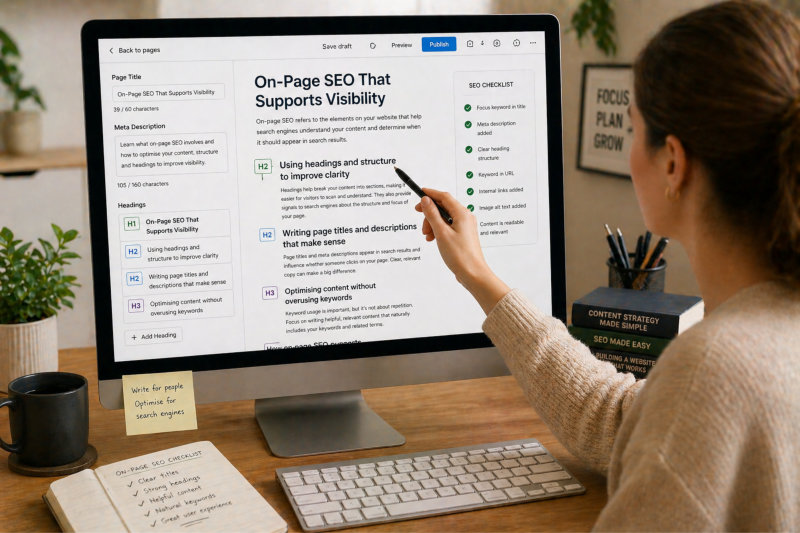
On-page SEO refers to the elements on your website that help search engines understand your content and determine when it should appear in search results. While it often sounds technical, most of it comes down to how clearly your content is written and how well it is structured.

This includes your headings, page titles, content layout, and how your information is organised. When these elements are aligned, they make it easier for both visitors and search engines to understand what your page is about.

On-page SEO is not about adding more content or forcing keywords into your pages. It is about making sure your content is clear, relevant, and easy to interpret. This is why it works closely with your website messaging and overall content structure.

When done properly, on-page SEO strengthens your visibility without compromising the quality of your content.

Small improvements can also make a significant difference over time. Even simple adjustments, such as refining headings or improving clarity, can strengthen your visibility, as shown in these time-saving SEO tips that focus on practical changes rather than complex strategies.

Using headings and structure to improve clarity

Headings play a key role in both readability and SEO. They help break your content into sections, making it easier for visitors to scan and understand. At the same time, they provide signals to search engines about the structure and focus of your page.

Each page should have a clear hierarchy, with one main heading followed by supporting sections. This creates a logical flow that guides the reader through the content without confusion.

Well-structured content also improves engagement. Visitors are more likely to stay on the page and read further when the information is organised clearly. This supports your overall website performance and works alongside your user experience.

Clear structure is one of the simplest ways to improve both usability and SEO without adding complexity.

On-page SEO Visibility

Writing page titles and descriptions that make sense

Page titles and meta descriptions are often treated as technical SEO elements, but they are simply short summaries of your content. They appear in search results and influence whether someone clicks on your page.

A strong page title clearly reflects what the page is about and includes relevant keywords naturally. It should be specific enough to stand out while still being easy to understand.

Meta descriptions provide additional context. While they do not directly impact rankings, they play an important role in attracting clicks. A clear, relevant description can make the difference between someone choosing your page or scrolling past it.

These elements should align with the content on your page. If they are misleading or too vague, visitors may leave quickly, which can negatively affect engagement.

Optimising content without overusing keywords

Keyword usage is an important part of on-page SEO, but it is often misunderstood. Adding the same keyword repeatedly does not improve rankings and can actually make your content harder to read.

Search engines now focus on context and relevance rather than repetition. This means your content should include keywords naturally, supported by related terms and clear explanations of the topic.

The goal is to write for people first, while still giving search engines enough context to understand your content. Following clear principles like those outlined in SEO writing rules for optimised content helps ensure your pages remain readable, relevant, and effective.

This also aligns with your broader content strategy, where quality and relevance are more important than volume or repetition.

How on-page SEO supports long-term visibility

On-page SEO is not something you apply once and forget. It is part of how your website evolves over time. As you add new content, refine existing pages, and improve structure, your overall visibility strengthens.

Each improvement contributes to a clearer, more connected website. This helps search engines understand your content more effectively and increases your chances of appearing in relevant searches.

It also improves how visitors interact with your site. Clear, well-structured content encourages them to stay longer, explore further, and engage with your services.

When combined with consistent content creation and internal linking, on-page SEO becomes a key part of your long-term strategy. It supports both visibility and user experience, creating a stronger foundation for your website as it grows.

Internal Linking and Website Structure for SEO

Why internal linking is one of the most powerful SEO tools

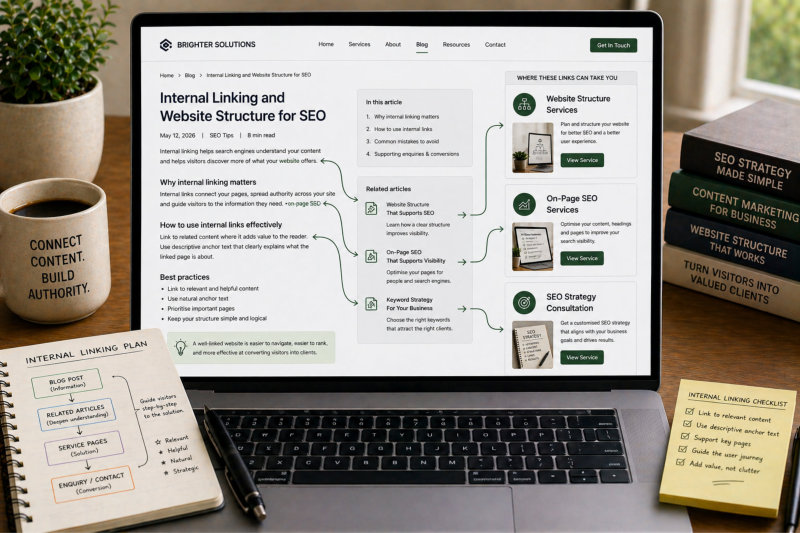
Internal linking is one of the most effective ways to improve your website’s SEO, yet it is often overlooked. Many websites contain useful content, but the pages are not properly connected. As a result, both visitors and search engines struggle to move through the site and understand how different topics relate to each other.

When internal links are used strategically, they create clear pathways between your pages. This helps visitors explore your content more easily and encourages them to stay on your site longer. It also signals to search engines that your content is connected and relevant across multiple areas.

Internal linking is not just about adding links. It is about guiding the user journey. Each link should help the reader move to the next logical piece of information, building a stronger understanding of your services and your expertise.

This approach supports your overall content strategy, turning individual pages into part of a larger, connected system.

How a clear website structure improves SEO

Your website structure determines how your content is organised and how easily it can be navigated. A clear structure helps both visitors and search engines understand where information is located and how different pages are related.

When your site is well organised, visitors can move from general information to more detailed content without confusion. This improves their experience and increases the likelihood that they will stay engaged with your website.

Search engines also rely on structure to interpret your content. When pages are grouped logically and connected through internal links, it becomes easier to understand your website’s focus and authority in specific areas.

This is why structure should be considered alongside your user experience, ensuring that your website is both easy to navigate and easy to interpret.

Connecting related topics to build authority

One of the key benefits of internal linking is the ability to connect related topics. Instead of having isolated pages, your content becomes part of a network that reinforces your expertise.

For example, a blog post can link to related articles, supporting pages, and relevant services. This helps visitors build a deeper understanding of the topic while also strengthening the connections between your pages.

Over time, this approach builds authority. Search engines recognise that your website covers a topic in depth, which can improve your visibility for related searches.

This is particularly effective when combined with your website messaging, as it ensures that your content remains clear and consistent across different pages.

Internal linking

Avoiding common internal linking mistakes

While internal linking is powerful, it can also be misused. One common mistake is adding too many links without clear purpose. This can overwhelm the reader and reduce the impact of each link.

Another issue is linking pages that are not closely related. This can create confusion and weaken the overall structure of your website. Each link should feel natural and relevant to the content being discussed.

It is also important to avoid neglecting important pages. Service pages, in particular, should be supported by internal links from relevant blog content. Without these connections, they may not receive the visibility they need.

Being selective and intentional with your links ensures that they add value rather than clutter.

Using internal links to support enquiries and conversions

Internal linking is not just about SEO. It also plays a role in guiding visitors toward taking action. By connecting your content to your services, you create a pathway from information to enquiry.

For example, a visitor reading a blog post may follow a link to a related service page once they have a better understanding of the topic. This transition feels natural because it is based on the information they are already engaging with.

This is where internal linking connects directly to your lead generation strategy. It helps move visitors through your website in a structured way, increasing the likelihood of meaningful enquiries.

When used effectively, internal linking supports both visibility and conversion, making it one of the most valuable tools within your overall website strategy.

Technical Basics That Affect Your SEO

Why technical SEO matters even if you are not technical

Technical SEO often sounds complex, which is why many small business owners avoid it altogether. However, you do not need to understand every technical detail to benefit from it. What matters is knowing that these elements exist and that they play a role in how your website performs.

Technical SEO focuses on how your website functions behind the scenes. It affects how easily search engines can access your content, how quickly your pages load, and how well your site performs across different devices.

If these elements are not set up properly, even strong content can struggle to perform. This is why technical SEO supports everything else on your website, including your messaging and your content strategy.

The goal is not to master technical SEO yourself, but to ensure your website is built on a solid foundation.

Website speed and why it impacts visibility

Website speed is one of the most important technical factors in SEO. Slow-loading pages create a poor experience for visitors, which can lead to higher bounce rates and lower engagement.

Search engines take this into account when ranking pages. If your website is slow, it may be less likely to appear in search results, even if the content itself is strong.

Speed is influenced by several factors, including image sizes, hosting quality, and how your website is built. While some of these elements are technical, their impact is very real. A faster website is easier to use, keeps visitors engaged, and supports better overall performance.

Improving speed is often one of the quickest ways to improve both user experience and SEO.

Performance is now a key ranking factor, which is why elements like loading speed and stability are important. Google measures this through metrics such as Core Web Vitals, which are explained in more detail in this guide to Google’s Core Web Vitals, highlighting how technical performance affects both user experience and SEO.

Technical SEO basics that affect SEO

Mobile-friendly design and user experience

Most people now browse websites on their phones, which means your website needs to perform well on smaller screens. A mobile-friendly design ensures that your content is easy to read, navigate, and interact with, regardless of the device being used.

Search engines prioritise mobile-friendly websites because they provide a better experience for users. If your site is difficult to use on mobile, it may rank lower in search results.

This is why mobile design is closely connected to your user experience. Clear layout, readable text, and easy navigation all contribute to both usability and visibility.

Ensuring your website works well across devices is no longer optional. It is a basic requirement for both SEO and engagement.

Making sure search engines can access your content

For your website to appear in search results, search engines need to be able to access and understand your content. This involves ensuring that your pages are properly indexed and that there are no barriers preventing them from being crawled.

Issues such as broken links, incorrect settings, or missing pages can make it harder for search engines to interpret your site. These problems are often invisible to visitors but can have a significant impact on your visibility.

This is where a well-structured website becomes important. Clear navigation, logical page hierarchy, and strong internal linking all help search engines move through your site more effectively.

While these elements are technical in nature, they are closely tied to your overall website structure and should be considered as part of your broader SEO strategy.

Why technical SEO supports everything else on your website

Technical SEO is not a separate layer that sits on top of your website. It is the foundation that supports everything else. Without it, your content, messaging, and structure may not perform as well as they should.

When your technical setup is strong, it allows your content to be discovered, your pages to load quickly, and your website to function smoothly. This creates a better experience for both visitors and search engines.

This is why technical SEO works alongside your lead generation strategy. A well-performing website makes it easier for visitors to engage with your content and take the next step.

In most cases, technical SEO does not require constant attention, but it does need to be set up correctly. Once the foundation is in place, it supports your website as it grows and evolves over time.

Measuring SEO Results Without Getting Overwhelmed

Why SEO results can feel unclear at first

One of the biggest frustrations with SEO is that results are not always immediate or obvious. Unlike paid advertising, where you can see clicks and enquiries quickly, SEO builds gradually over time. This can make it difficult to know whether your efforts are working, especially in the early stages.

In many cases, progress is happening in the background before it becomes visible. Pages are being indexed, content is being evaluated, and your website is slowly building authority. These changes are not always obvious day to day, which is why SEO can feel uncertain if you are expecting quick feedback.

Understanding this process helps set realistic expectations. SEO is not designed to deliver instant results, but when it gains momentum, it can provide consistent visibility over time.

What metrics actually matter for small businesses

There are many SEO metrics available, but not all of them are useful for small business owners. Focusing on too many numbers can quickly become overwhelming and distract from what actually matters.

The most relevant metrics are those that relate to your business goals. This usually includes organic traffic, the types of keywords your website is appearing for, and most importantly, enquiries or conversions generated through your website.

Tracking how visitors interact with your site is also valuable. Are they staying on your pages? Are they exploring further? These signals can indicate whether your content is clear and engaging.

This is where SEO connects directly to your lead generation process. Visibility is important, but it only becomes meaningful when it leads to action.

Avoiding the trap of checking rankings too often

It is easy to become focused on rankings, especially when you are trying to improve your visibility. However, checking rankings too frequently can create unnecessary stress and lead to the wrong conclusions.

Search rankings fluctuate regularly based on a wide range of factors. A page may move up or down without any real change in its long-term performance. Focusing too closely on these short-term movements can make it feel like your efforts are not working, even when they are.

A more effective approach is to monitor trends over time rather than daily changes. This allows you to see whether your overall visibility is improving and whether your content is gaining traction.

SEO is a long-term process, and your measurement approach should reflect that.

Measuring SEO

How to track progress in a simple, practical way

You do not need complex tools or detailed reports to understand whether your SEO is improving. A simple approach is often the most effective.

Start by reviewing your website traffic regularly to see if it is increasing over time. Look at which pages are attracting visitors and whether those pages align with your content strategy.

You can also track which keywords your site is appearing for, even if they are not yet in top positions. This can indicate that your content is being recognised and is starting to gain visibility.

Most importantly, pay attention to enquiries. Are you receiving more relevant enquiries? Are visitors referencing your content when they contact you? These are strong indicators that your SEO is working.

This practical approach helps you stay focused on meaningful progress rather than getting lost in data.

Understanding how SEO supports long-term growth

SEO is not just about improving rankings. It is about building a website that continues to attract and engage visitors over time. As your content grows and your structure improves, your website becomes more visible and more effective.

This growth is gradual, but it is also sustainable. Unlike short-term marketing efforts, SEO continues to provide value as long as your content remains relevant and well structured.

Over time, your website can become a consistent source of traffic and enquiries, supporting your business without relying solely on paid advertising or constant promotion.

When you focus on long-term progress rather than short-term fluctuations, SEO becomes easier to manage and far more effective as part of your overall strategy.

Google Basics Every Business Should Know

How Google finds and understands your website

Before your website can appear in search results, Google needs to discover it, access it, and understand what each page is about. This process happens through what is known as crawling and indexing. Google scans your website, follows links between pages, and stores information about your content so it can be shown in relevant searches.

If your website is clearly structured, easy to navigate, and contains useful content, this process becomes much easier. Google can quickly understand what your pages are about and when they should appear in search results.

This is why your content and structure matter so much. Clear messaging, well-organised pages, and strong internal linking all support how Google interprets your site. These elements work alongside your SEO strategy, helping your website become more visible over time.The way Google processes and presents information is also evolving. With the rise of AI-driven search, understanding how your content is interpreted is becoming increasingly important. This shift is explored in Google’s AI and the future of SEO, which outlines how search behaviour is changing.

What Google Search Console tells you about your site

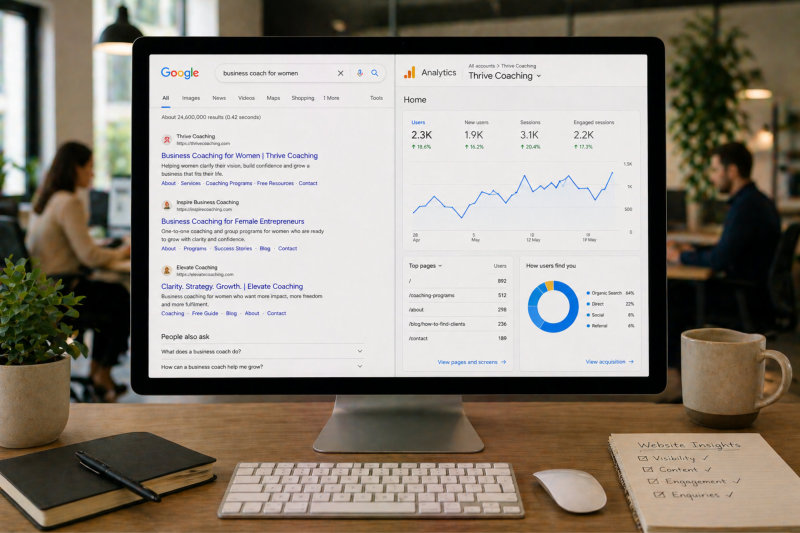
Google Search Console is one of the most useful tools available for understanding how your website is performing in search. It shows which pages are being indexed, which keywords your site is appearing for, and whether there are any issues affecting your visibility.

You do not need to analyse every detail, but understanding the basics can be very helpful. For example, you can see which pages are gaining impressions, which queries are bringing visitors to your site, and whether there are any technical issues that need attention.

This information helps you make informed decisions about your content. Instead of guessing what is working, you can see which topics are gaining traction and build on them.

Search Console also highlights problems, such as pages that are not being indexed or errors that may affect how your site is accessed. Addressing these issues helps ensure your content is visible and performing as it should.

Google Basics

Understanding how people find your website

One of the key benefits of using Google tools is understanding how visitors are finding your website. This includes the search terms they use, the pages they land on, and how they interact with your content.

This insight allows you to refine your content strategy. If certain topics are attracting more attention, you can expand on them. If some pages are not performing well, you can review and improve them.

Understanding how people find your site also helps you align your content with real search behaviour. This connects directly to your blogging strategy, ensuring that your content is based on what your audience is actually looking for.

Over time, this creates a feedback loop where your content becomes more targeted, more relevant, and more effective.

How Google Analytics helps you understand behaviour

While Search Console focuses on visibility, Google Analytics helps you understand what happens after someone arrives on your website. It shows how visitors move through your pages, how long they stay, and where they leave.

This information can highlight areas for improvement. For example, if visitors are leaving quickly from a particular page, it may indicate that the content is unclear or not meeting their expectations.

You can also see which pages are attracting the most engagement and which ones lead to enquiries. This helps you identify what is working and where to focus your efforts.

Used together, Analytics and Search Console provide a clearer picture of your website’s performance. One shows how people find you, and the other shows what they do once they arrive.

Why you don’t need to track everything to benefit

One of the biggest challenges with Google tools is the amount of data available. It can be tempting to track everything, but this often leads to confusion rather than clarity.

For most small businesses, it is enough to focus on a few key insights. Are your pages being indexed? Are you appearing in search results? Are visitors engaging with your content? Are you receiving enquiries?

These questions provide a clear overview of your website’s performance without requiring detailed analysis. This approach keeps things manageable and ensures you are focusing on what actually matters.

This is why Google basics should be seen as a support tool rather than a separate task. They help you understand what is happening, but they work best when combined with strong content, clear structure, and a consistent strategy.

Common SEO Mistakes That Hold Websites Back

Focusing on SEO without clear messaging

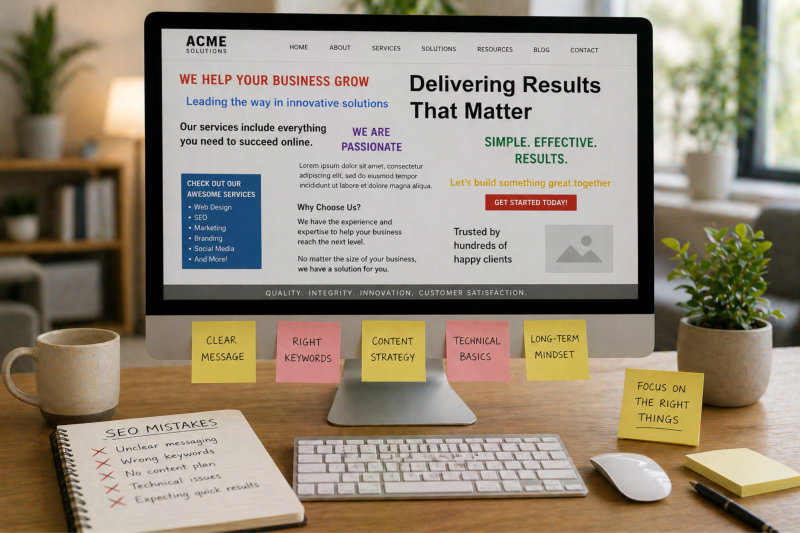
One of the most common mistakes is focusing on SEO before the core message of the website is clear. Business owners often try to optimise pages for search engines without first making sure their content clearly explains what they do and who they help.

If your messaging is unclear, no amount of SEO will fix it. Visitors may find your website, but they will not stay or take action if they do not understand your offer. This leads to traffic without enquiries, which can be frustrating and confusing.

SEO should support your content, not replace it. This is why it needs to work alongside your website messaging, ensuring that your content is both visible and meaningful.

Targeting the wrong keywords

Choosing the wrong keywords is another common issue. Many websites target broad, highly competitive terms that are difficult to rank for and do not attract the right audience.

This often results in either low visibility or traffic that does not convert. Visitors may land on your site, but they are not looking for what you offer, which reduces the likelihood of enquiries.

Effective keyword selection focuses on relevance rather than volume. Targeting more specific, service-related keywords leads to better alignment with your audience and stronger long-term results.

Creating content without structure or consistency

Publishing content without a clear plan can limit its impact. Blog posts may be written occasionally, but without a structured approach, they remain disconnected and do not contribute to a larger strategy.

This makes it harder for search engines to understand your website and for visitors to navigate your content. Over time, the blog becomes a collection of unrelated posts rather than a cohesive resource.

This is why a structured approach, such as your content strategy, is essential. It ensures that each piece of content supports your overall goals.

Common SEO mistakes

Ignoring technical and structural issues

Technical issues are often overlooked because they are not immediately visible. Problems such as slow loading speeds, broken links, or poor mobile performance can affect how your website is ranked and how users experience it.

Even strong content can struggle if these elements are not addressed. Visitors may leave quickly if the site is difficult to use, and search engines may not prioritise pages that perform poorly.

This is why technical basics and website structure need to be considered as part of your overall SEO strategy, not treated as an afterthought.

Expecting fast results from a long-term strategy

SEO is often approached with the expectation of quick results. When improvements are not immediate, it can lead to frustration or the assumption that SEO is not working.

In reality, SEO builds over time. Content needs to be indexed, authority needs to develop, and your website needs to demonstrate consistency before results become more visible.

Expecting fast outcomes can lead to abandoning the process too early or constantly changing direction. A more effective approach is to focus on steady progress and long-term growth.

When SEO is treated as an ongoing strategy rather than a one-time effort, it becomes a reliable way to improve visibility and support your business over time.This expectation of quick results is one of the biggest reasons businesses abandon SEO too early. In reality, as highlighted in the reality of ranking in search engines, consistent effort and structured content are what lead to long-term success.

Frequently Asked Questions

SEO, or search engine optimisation, is the process of improving your website so it appears in search results when people are looking for your services. It works by helping search engines understand your content, structure, and relevance. For small businesses, this means creating clear content, using the right keywords, and building a website that is easy to navigate and understand.

SEO is a long-term strategy, and results are usually not immediate. It can take several weeks or months for content to be indexed and begin ranking. The timeframe depends on factors such as competition, content quality, and consistency. While progress can feel slow at first, well-structured SEO builds momentum over time and can deliver consistent visibility.

The most important SEO factors include clear and relevant content, proper keyword usage, strong website structure, internal linking, and a good user experience. Technical elements such as page speed and mobile responsiveness also play a role. These factors work together to help search engines understand your site and improve its visibility.

Basic SEO can be done yourself, especially when it comes to writing clear content and structuring your website properly. However, many business owners find it difficult to manage consistently or miss important details. Working with someone experienced can help ensure your SEO is implemented correctly and aligned with your business goals.

There can be several reasons why a website is not appearing in search results. Common issues include lack of content, poor keyword targeting, technical problems, or the website not being indexed yet. It may also be due to strong competition. Reviewing your structure, content, and indexing status can help identify the cause.

The best keywords are those that reflect what your business offers and what your audience is searching for. This usually involves focusing on specific, service-related terms rather than broad or highly competitive keywords. Understanding search intent and aligning your content with real queries is key to effective keyword selection.

Yes, blogging is one of the most effective ways to improve SEO. It allows you to target a wider range of search queries, build authority, and create more entry points into your website. When blog content is structured and connected to your services, it can also support enquiries and long-term growth.

SEO focuses on improving your organic visibility over time, while paid ads provide immediate visibility through advertising. SEO is a long-term strategy that builds ongoing traffic, while paid ads stop generating results once you stop paying. Both can be effective, but SEO provides more sustainable growth.

You can track SEO performance by looking at trends over time, such as increases in organic traffic, visibility for relevant keywords, and enquiries coming through your website. Tools like Google Search Console and Google Analytics can provide useful insights, but the most important indicator is whether your website is attracting the right audience and generating results.

Yes, when done properly, SEO can help attract visitors who are actively searching for your services. When combined with clear messaging and strong website structure, this increases the likelihood of turning those visitors into enquiries. SEO brings the right people to your site, but your content is what converts them.

Making SEO Work as Part of Your Website Strategy

SEO is not a standalone task or a one-time fix. It is part of how your website is built, structured, and maintained over time. When approached correctly, it works alongside your content, your messaging, and your overall user experience to improve visibility and support business growth.

Many small business websites struggle with SEO because they focus on isolated elements rather than the bigger picture. Keywords are chosen without clear direction, content is created without structure, and technical aspects are overlooked. This often leads to inconsistent results and frustration.

By focusing on clarity, structure, and consistency, SEO becomes far more manageable. Your website becomes easier for search engines to understand and easier for visitors to navigate. This improves both visibility and engagement, creating a stronger foundation for your online presence.

It is also important to approach SEO with realistic expectations. Results take time, and progress is often gradual. However, when your website is structured properly and supported by consistent content, SEO becomes a reliable source of long-term visibility.

This is where everything connects. Your messaging, your content strategy, and your SEO all work together to support your website as a whole.

If your website is not performing as well as it should, the issue is rarely just one thing. It is usually a combination of factors that need to be aligned. Taking a structured approach to SEO helps bring these elements together in a way that supports both visibility and enquiries.

If you would prefer to have your website set up properly from the start, you can explore our website design service. This ensures your content, structure, and SEO are aligned to support your business as it grows.

Ready to Build or Redesign Your Website?

If you’re reading this and thinking, “This explains exactly what’s wrong with my site,” you’re not alone.

Most small business websites don’t fail because of effort. They fail because they were built without a clear structure, proper planning or long-term thinking.

If you want a website that reflects your business properly, feels organised, and gives you confidence to send people to it, then it might be time for a proper redesign or rebuild.

You can see how I approach website projects here:

Website Design Services for Small Business

View recent website design projects

Whether you’re starting from scratch or improving what you already have, the goal is the same – clarity, structure and a site you’re proud to share.

Ivana Katz - Website designer