
Blogging & Content Strategy
for Long Term Website Visibility

This guide forms part of our complete resource on Small Business Website Content & Visibility.

Publishing blog posts is easy. Building content that actually supports your business over time is where most small business owners struggle.

Many websites have a blog, but very few have a clear content strategy behind it. Posts are written occasionally, often based on what comes to mind at the time, with no real connection to the services offered or the overall structure of the website. While this can still add some value, it rarely leads to consistent visibility or meaningful enquiries.

Blogging, when done properly, is not about posting frequently or chasing trends. It is about creating content that helps people find your business, understand what you offer, and build confidence before they even contact you. This is where blogging shifts from being a task to becoming a long-term business asset.

Strong blog content supports your entire website. It helps search engines understand what your business does, strengthens your SEO strategy, and creates more entry points for potential clients to discover your services. Over time, this builds visibility in a way that is difficult to achieve through static pages alone.

It also connects directly to your website messaging. While your main pages focus on clarity and structure, your blog allows you to go deeper. You can answer specific questions, explain your approach, and demonstrate your expertise in a way that builds trust. This works alongside your website copywriting and messaging, reinforcing your positioning across your entire site.

One of the biggest misconceptions about blogging is that it should deliver immediate results. In reality, blogging is a long-term strategy. Individual posts may not generate enquiries straight away, but together they create a network of content that supports your visibility, authority, and credibility over time.

This is where structure becomes important. Without a clear plan, blog content often becomes disconnected and difficult to maintain. With the right structure, your blog becomes part of a larger system that supports your services, your website, and your long-term growth.

In this guide, we will break down how to approach blogging in a way that is practical, sustainable, and aligned with your business goals. Instead of focusing on volume, the focus will be on creating the right content, structuring it properly, and connecting it back to your website in a way that actually works.

Why Blogging Still Matters for Small Business

Why blogging is often misunderstood or overlooked

Blogging is often dismissed because many business owners have tried it before without seeing results. They may have published a handful of posts, received little traffic, and concluded that it does not work. In most cases, the issue is not blogging itself, but the way it was approached.

Without a clear strategy, blog posts become isolated pieces of content. They may provide value on their own, but they are not connected to the rest of the website or aligned with the business’s goals. This makes it difficult to build momentum or see meaningful outcomes.

When blogging is treated as a structured system rather than a one-off activity, it becomes far more effective. Each post contributes to a larger framework, supporting your overall visibility and strengthening your website over time.

How blogging supports long-term visibility

Unlike static website pages, blog content allows you to target a wide range of topics and questions that your audience is already searching for. This creates multiple entry points into your website, increasing the chances of being discovered through search.

Over time, as more content is added and properly connected, your website becomes more visible across a broader range of searches. This is particularly important for small businesses competing in crowded markets, where a single page is unlikely to rank for everything.

This is where blogging works alongside your SEO strategy. Each post helps reinforce your overall relevance, making it easier for search engines to understand what your business is about and when to show your content.

The role of blogging in building trust and authority

Blogging is not just about being found. It also plays a key role in building trust. When potential clients read your content, they are forming an impression of your expertise, your approach, and your understanding of their needs.

Well-written blog content allows you to explain concepts, answer questions, and demonstrate your knowledge in a way that your main service pages cannot. It gives visitors a deeper insight into how you think and how you work.

This supports your overall positioning and complements your website messaging, helping your business feel more credible and established before any direct contact is made.

Why blogs help both Google and AI understand your website

Search engines and AI tools rely on content to understand what your website is about. While your main pages provide a foundation, your blog expands on that foundation by covering related topics in more detail.

Each blog post adds context, reinforces key themes, and strengthens the overall structure of your site. This helps both Google and AI platforms recognise your website as a useful source of information within your area of expertise.

As AI-driven search becomes more prominent, having a strong base of clear, well-structured content increases your chances of being referenced or surfaced in responses. This makes blogging not just relevant, but increasingly important for long-term visibility.

How blogging connects to your services and enquiries

One of the biggest missed opportunities with blogging is failing to connect it back to your services. Many blog posts provide useful information but do not guide visitors toward what the business actually offers.

When your blog content is aligned with your services, it becomes part of your enquiry process. Visitors can move from learning about a topic to understanding how you can help them solve that problem.

This connection supports your lead generation strategy, turning your blog from a passive resource into an active part of your website’s conversion system.

Setting realistic expectations for blogging results

Blogging is not a quick win. It takes time for content to be indexed, ranked, and discovered. Individual posts may take weeks or months to gain traction, and results are rarely immediate.

However, this is also what makes blogging valuable. Unlike short-term marketing tactics, blog content continues to work over time. A well-written post can attract visitors long after it is published, contributing to your visibility on an ongoing basis.

The key is consistency and structure. By building content strategically and connecting it across your website, you create a system that grows stronger over time, rather than relying on short bursts of activity.

Planning Content Topics That Attract the Right Audience

Why choosing the right topics matters more than writing more content

One of the biggest mistakes small business owners make with blogging is focusing on how often to publish rather than what they are publishing. It is easy to assume that more content will automatically lead to more traffic, but without the right topics, even consistent blogging can produce very little impact.

The effectiveness of your blog comes down to relevance. If your topics do not align with what your audience is searching for, or if they are too broad to attract the right people, your content will struggle to gain traction. This often leads to frustration, as it feels like a lot of effort with little return.

Choosing the right topics ensures that your content is working toward a clear goal. Instead of publishing randomly, you are creating content that directly supports your services, your visibility, and your long-term growth. This is also what strengthens your overall SEO strategy, because your content becomes more focused and easier for search engines to understand.

How to identify what your audience is actually searching for

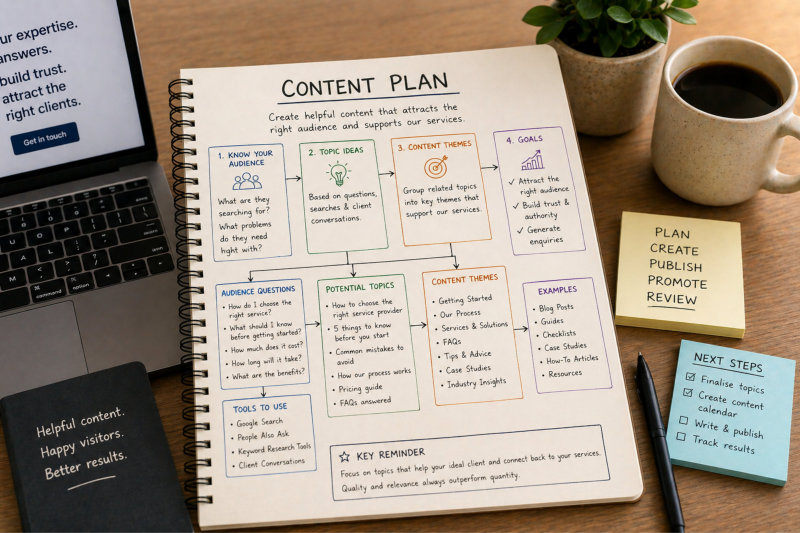
Effective content planning starts with understanding your audience. This goes beyond general demographics and focuses on the specific questions, concerns, and problems they are trying to solve. These are the topics that have the highest potential to attract relevant traffic.

A practical way to approach this is to look at the questions you are already being asked by clients or potential clients. These often translate directly into strong blog topics. If someone is asking you something in a conversation, it is likely that others are searching for the same information online.

You can also use search tools, Google suggestions, and related searches to identify common queries in your industry. Over time, this helps you build a list of topics that are grounded in real demand rather than guesswork.

When these topics are structured properly across your website, they contribute to a stronger content framework that supports both users and search engines.

Aligning your blog topics with your services

Not all traffic is valuable. One of the most common issues with blogging is attracting visitors who are not a good fit for your services. This often happens when topics are chosen based on popularity rather than relevance.

Your blog should support your business, not distract from it. This means choosing topics that are closely related to what you offer. Each post should connect, directly or indirectly, to your services, helping visitors understand how your expertise applies to their situation.

This alignment is what turns your blog into part of your enquiry process. Instead of simply providing information, your content helps visitors move toward understanding your services and how you can help them.

Without this connection, your blog may still generate traffic, but it is less likely to lead to meaningful outcomes for your business.

Planning content topics for your blog

Avoiding topics that bring the wrong audience

It is just as important to avoid the wrong topics as it is to choose the right ones. Content that is too general, too broad, or not closely related to your services can attract visitors who have no intention of becoming clients.

For example, writing about topics that are only loosely connected to your business may increase traffic, but that traffic is unlikely to convert. Over time, this can create the impression that your blog is working, while in reality it is not supporting your business goals.

Being selective with your topics helps maintain focus. It ensures that the traffic you attract is more relevant and more likely to engage with your content. This also supports how visitors move through your website, guiding them toward related pages such as your website messaging and content or service pages.

Building a content plan that is structured and sustainable

A strong content plan is not about creating a long list of ideas and trying to work through them randomly. It is about organising your topics in a way that makes sense and supports your overall website structure.

This often involves grouping related topics together and building content around key themes. Each theme can then connect back to your main pages, reinforcing your expertise and creating a more cohesive experience for visitors.

Structure also makes your content easier to maintain. Instead of constantly trying to come up with new ideas, you are building on an existing framework. This makes blogging more manageable and reduces the risk of inconsistency or burnout.

Over time, this approach transforms your blog into a connected system that supports your visibility, strengthens your positioning, and contributes to your long-term business growth.

Creating Content That Builds Authority

What makes content feel credible and worth reading

Not all content builds authority. Many blog posts exist, but very few leave a lasting impression or position the business as a trusted source. Authority comes from content that feels useful, relevant, and grounded in real understanding rather than surface-level advice.

Visitors can quickly tell the difference between content that is written to fill space and content that is written to genuinely help. The more specific and practical your content is, the more credible it feels. This is especially important for small businesses, where trust plays a major role in decision-making.

Strong content also supports how your website is perceived overall. It reinforces your expertise and complements your website messaging, helping your business feel more established and confident in its positioning.

Going deeper instead of publishing more

One of the most common misconceptions about blogging is that success comes from publishing as much content as possible. In reality, depth is far more valuable than volume. A smaller number of well-structured, in-depth posts will almost always outperform a large number of short or generic ones.

Deeper content allows you to explore topics properly, answer real questions, and provide meaningful insights. This not only improves the reader’s experience but also strengthens your visibility in search. Search engines increasingly prioritise content that demonstrates expertise and covers topics in a comprehensive way.

This is why focusing on quality over quantity is a more effective long-term strategy. It aligns with how successful blogs are built and is reinforced in resources like how to succeed in business blogging, where consistency and depth are key factors.

Creating content that builds authority

Answering real questions instead of writing generic posts

Authority is built when your content directly addresses the questions your audience is already asking. Generic topics often attract broad interest but do little to position your business as a specialist.

When you focus on specific, relevant questions, your content becomes more targeted and more useful. It helps visitors feel understood and shows that you have experience dealing with their type of situation.

This approach also improves how your content performs in search. Targeting real questions increases your chances of appearing in relevant searches and being surfaced in AI-driven responses. It also connects naturally with your overall SEO strategy, strengthening the relevance of your website.

Structuring blog content so it is easy to read and follow

Even the most valuable content can lose its impact if it is difficult to read. Long blocks of text, unclear headings, or poor structure can make it harder for visitors to engage with your content, even if the information itself is useful.

Clear structure is what makes content accessible. This includes using headings to break up sections, writing shorter paragraphs, and guiding the reader through the topic in a logical way. When content is easy to scan, visitors are more likely to stay engaged and continue reading.

This also supports your broader website structure and helps connect your blog to other areas of your site, such as your enquiry and lead generation process. A well-structured post naturally encourages visitors to explore further.

Why authority builds trust before you ever speak to a client

One of the biggest advantages of strong content is that it allows potential clients to build trust in your business before any direct interaction takes place. By the time someone reaches out, they may already feel familiar with your approach and confident in your expertise.

This changes the dynamic of the enquiry process. Instead of starting from zero, you are already positioned as someone who understands the problem and can provide a solution. This often leads to better-quality enquiries and more productive conversations.

Blogging plays a key role in this process. It allows you to demonstrate your knowledge over time and reinforce your positioning. This is why blogging is not just about visibility, but also about building credibility, as explored in why every business needs a blog.

When your content consistently provides value and clarity, your website becomes more than just a source of information. It becomes a trusted resource that supports your business long before a potential client gets in touch.

Writing Blog Content That Is Actually Useful

Why most blog content gets ignored

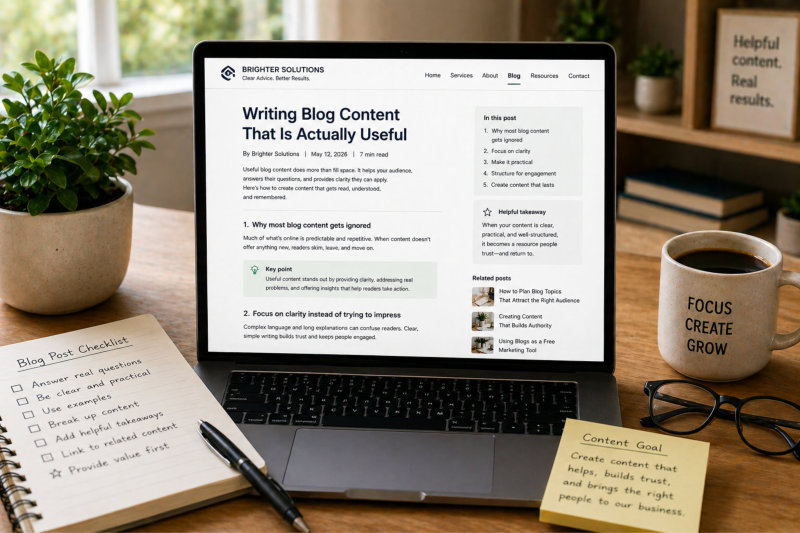
There is no shortage of blog content online, but much of it is overlooked because it does not offer anything new or genuinely helpful. Many posts repeat the same general advice, use similar structures, and provide surface-level information that does not move the reader forward.

When content feels predictable or generic, visitors quickly lose interest. They may skim the page, take nothing from it, and leave without exploring further. This creates the impression that blogging “doesn’t work,” when in reality the issue is the quality and usefulness of the content itself.

Useful content stands out because it goes beyond the obvious. It provides clarity, addresses real problems, and offers insights that help the reader understand something more clearly than before. This is what keeps people engaged and encourages them to trust your expertise.

Focusing on clarity instead of trying to impress

One of the biggest mistakes in blog writing is trying to sound impressive rather than being clear. Complex language, long explanations, and unnecessary detail can make content harder to follow, even if the intention is to sound more professional.

Clarity is far more effective. When your content is easy to read and easy to understand, it creates a better experience for the reader. It also increases the likelihood that they will stay on the page, engage with your content, and explore further.

This approach aligns with how strong website content is built overall, supporting your website messaging and ensuring consistency across your site.

Making your content practical and actionable

Useful blog content does not just explain ideas. It helps the reader take action. This does not mean overwhelming them with steps, but it does mean providing clear guidance that they can apply to their own situation.

For example, instead of simply describing a concept, you can explain how it works in practice, what to look out for, and what common mistakes to avoid. This makes your content more valuable and more memorable.

Content that is practical also builds stronger authority. It shows that you are not just repeating information, but that you understand how it applies in real situations. This is one of the key differences highlighted in resources like how to succeed in business blogging, where useful, actionable content is a consistent theme.

Writing useful blog content

Structuring posts so readers stay engaged

Even valuable content can lose its impact if it is not structured properly. Readers tend to scan before they commit to reading, so the way your content is presented plays an important role in how it is received.

Clear headings, logical flow, and manageable sections make it easier for readers to engage with your content. Each section should build on the previous one, guiding the reader through the topic without confusion.

This structure also supports how your content performs in search. Well-organised posts are easier for search engines to understand and more likely to be surfaced for relevant queries. It also improves how your content connects to other areas of your site, including your traffic and visibility strategy.

Creating content that keeps working over time

One of the advantages of useful blog content is that it continues to provide value long after it is published. Unlike short-term marketing efforts, a well-written post can attract visitors for months or even years.

This is why it is worth investing time in creating content that is thorough and well-structured. Instead of focusing on quick wins, you are building a resource that contributes to your visibility over time.

This long-term value is what makes blogging such a powerful tool when used correctly. As outlined in using blogs as a free marketing tool, each piece of content becomes part of a larger system that supports your business on an ongoing basis.

When your content is genuinely useful, it not only attracts visitors but also encourages them to stay, explore, and return. This is what turns blogging from a simple activity into a long-term asset for your business.

Staying Consistent Without Burning Out

Why consistency matters more than frequency

One of the biggest misconceptions about blogging is that you need to publish constantly to see results. This often leads to unrealistic expectations, where business owners try to post frequently, struggle to keep up, and eventually stop altogether.

Consistency is far more important than frequency. Publishing one well-structured, valuable post every few weeks is far more effective than publishing several rushed or low-quality posts in a short period of time. Consistency builds momentum. It signals to both your audience and search engines that your website is active, relevant, and worth paying attention to.

When content is published inconsistently, that momentum is lost. It becomes harder to build visibility, and each new post feels like starting from scratch again. A steady, manageable approach creates a stronger foundation and leads to better long-term results.

This also supports your broader SEO strategy, where ongoing, consistent content helps reinforce your authority and relevance over time.

Setting a realistic content schedule you can actually maintain

Many content plans fail because they are based on ideal scenarios rather than realistic ones. It is easy to commit to publishing weekly or even multiple times per week, but maintaining that pace alongside running a business quickly becomes difficult.

A more effective approach is to choose a schedule that fits your capacity. For many small businesses, this might mean publishing one post every two to four weeks. While this may seem slow, it is sustainable. Over time, it allows you to build a consistent body of work without creating unnecessary pressure.

The key is to treat your content as part of your business, not an optional extra. Scheduling time for content creation, even in small blocks, helps ensure it continues to move forward. This approach aligns with long-term blogging strategies outlined in resources like how to succeed in business blogging, where consistency is a core factor.

It is better to commit to a slower pace and maintain it than to start strong and stop after a few weeks. Consistency builds trust and visibility, even when progress feels gradual.

Avoiding the start-stop cycle that kills momentum

The start-stop cycle is one of the most common patterns in blogging. A business owner becomes motivated, publishes several posts, then gets busy with other priorities and stops. Months later, they return, start again, and repeat the same cycle.

This approach makes it difficult to see results because momentum is constantly interrupted. Each time you stop, your content loses traction, and your visibility slows down. When you restart, you are often rebuilding from a weaker position.

Breaking this cycle requires a shift in mindset. Blogging should not be treated as a short-term project or something you “catch up on” when you have time. It works best when it is integrated into your ongoing business activities.

Even small, consistent actions can make a difference. Planning topics in advance, working on content in stages, and maintaining a steady pace all help create continuity. This is what turns blogging into a reliable part of your marketing rather than an occasional effort.

Repurposing content instead of constantly starting from scratch

Creating new content does not always mean starting with a blank page. One of the most effective ways to stay consistent is to repurpose existing ideas, expand on previous posts, or revisit topics from a different angle.

For example, a blog post can be broken down into smaller sections, expanded into more detailed guides, or connected to related topics. This allows you to build depth without constantly generating entirely new ideas.

Repurposing also strengthens your overall content structure. It helps connect your posts and reinforces key themes across your website. This supports your website messaging and ensures that your content feels cohesive rather than scattered.

Over time, this approach reduces pressure and makes content creation more manageable. Instead of feeling like you are always starting from zero, you are building on what already exists.

Building a system that makes content easier to manage

The most effective way to stay consistent is to create a simple system for managing your content. This does not need to be complicated, but it does need to be intentional.

A basic system might include a list of planned topics, a rough schedule, and a process for moving content from idea to published post. Breaking the process into smaller steps – such as outlining, drafting, editing, and publishing – makes it easier to manage alongside other responsibilities.

When content creation is unstructured, it often feels overwhelming. When it is broken down into clear steps, it becomes far more manageable. This reduces resistance and makes it easier to maintain consistency over time.

Ultimately, consistency is not about discipline alone. It is about creating a system that supports your workflow and makes it easier to keep moving forward, even when your schedule is busy.

Why a steady approach leads to better long-term results

Blogging is a long-term strategy, and the results reflect that. A steady, consistent approach allows your content to build over time, creating a network of pages that support your visibility and authority.

Each post adds to this network, increasing the number of ways people can find your website and engage with your content. As your content grows, it becomes easier for search engines to recognise your expertise and surface your pages in relevant searches.

This is how blogging shifts from being a task to becoming a long-term asset. Instead of relying on short bursts of activity, you are building something that continues to work for your business over time.

When approached this way, consistency becomes less about pressure and more about progress. Even small, regular contributions can lead to meaningful results when they are part of a structured, long-term strategy.

Building a Long-Term Content Strategy

Why a long-term approach is essential for real results

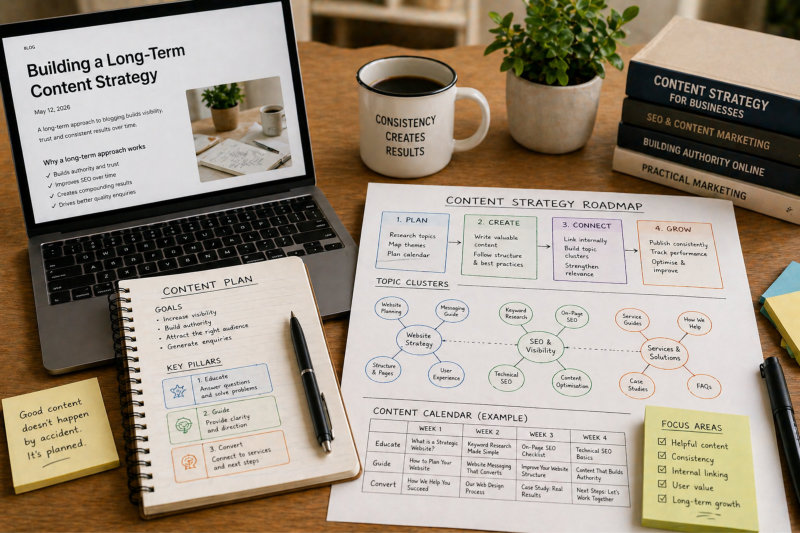
Blogging only becomes effective when it is treated as a long-term strategy rather than a short-term experiment. Many business owners give up too early because they expect quick results, but content needs time to be discovered, indexed, and trusted.

Each piece of content you publish contributes to your overall visibility, but its impact builds gradually. A single post is unlikely to generate significant results on its own. However, when multiple posts are connected and aligned, they begin to reinforce each other, creating a stronger presence across your website.

This is what separates random blogging from a structured content strategy. Instead of relying on individual posts to perform, you are building a system that grows in value over time. This also supports your SEO efforts, where consistency and depth play a key role in long-term performance.

Creating connected content instead of isolated posts

One of the most effective ways to strengthen your content strategy is to ensure that your posts are connected rather than standalone. When content is created in isolation, it may still provide value, but it does not contribute to a larger structure.

Connected content is built around key themes or topics. Each post explores a different aspect of the same subject, linking back to related pages and reinforcing your expertise. This creates a network of content that is easier for both visitors and search engines to navigate.

This approach aligns with your broader website structure, including your website messaging and how your services are presented. It ensures that your content supports your business rather than sitting alongside it without purpose.

Connecting website to blog content

Using internal linking to strengthen your website

Internal linking is a key part of any long-term content strategy. It allows you to guide visitors between related topics, helping them build a deeper understanding of your services and how they connect.

When internal links are used effectively, they also improve how your website performs in search. Search engines use these links to understand the relationships between your pages and identify which topics your site covers in depth.

This is why each piece of content should link to relevant pages, whether that is another blog post, a related topic, or a service page. For example, a blog post can naturally guide visitors toward your services once they have a clearer understanding of the problem you solve.

Over time, this creates a stronger, more connected website that supports both user experience and visibility.

Turning your blog into a structured content system

A blog becomes far more powerful when it is treated as part of a structured system rather than a collection of individual posts. This means organising your content around key topics, linking related pages, and ensuring that each piece contributes to a larger goal.

This type of structure makes your content easier to manage and easier to expand. New posts can be added without disrupting the overall flow, because they fit into an existing framework. This also reduces the pressure of constantly coming up with new ideas, as you are building on what is already in place.

It also strengthens how your content supports your business. Instead of simply attracting traffic, your blog becomes part of your overall strategy, helping visitors move from learning about a topic to understanding how your services can help.

This is what transforms blogging into a practical business tool, as highlighted in using blogs as a free marketing tool, where structure and consistency are key to long-term success.

How a strong content strategy supports growth over time

A well-structured content strategy does not just improve visibility. It also supports the overall growth of your business. As your content expands, it increases the number of ways potential clients can discover your website and engage with your services.

It also improves the quality of your enquiries. Visitors who have read multiple pieces of your content are more likely to understand your approach, trust your expertise, and feel confident reaching out. This often leads to more meaningful conversations and better outcomes.

Over time, your content becomes an asset that continues to work for your business. It supports your visibility, reinforces your positioning, and helps guide potential clients through your website in a more structured way.

This is the real value of a long-term content strategy. It is not about individual posts, but about building a system that supports your business consistently and grows stronger with every piece of content you add.

Connecting Blog Content to Your Services and Website

Why blog content needs to connect to your business

One of the biggest mistakes with blogging is treating it as something separate from the rest of your website. Content is created, published, and left to sit on its own without any clear connection to the services the business actually offers.

While this type of content can still attract visitors, it often fails to support real business outcomes. Visitors may read a post, find it helpful, and then leave without taking any further action. The opportunity to turn that interest into an enquiry is lost.

Blog content should not exist in isolation. It should support your overall website strategy, helping visitors move from learning about a topic to understanding how your business can help them. This is what transforms blogging from a passive activity into a practical tool for growth.

When content is aligned with your services, it reinforces your positioning and strengthens how your website performs as a whole.

Creating natural pathways from content to services

Effective blog content does not push visitors toward your services. It guides them there naturally. This means creating clear, logical connections between the information you are providing and the solutions you offer.

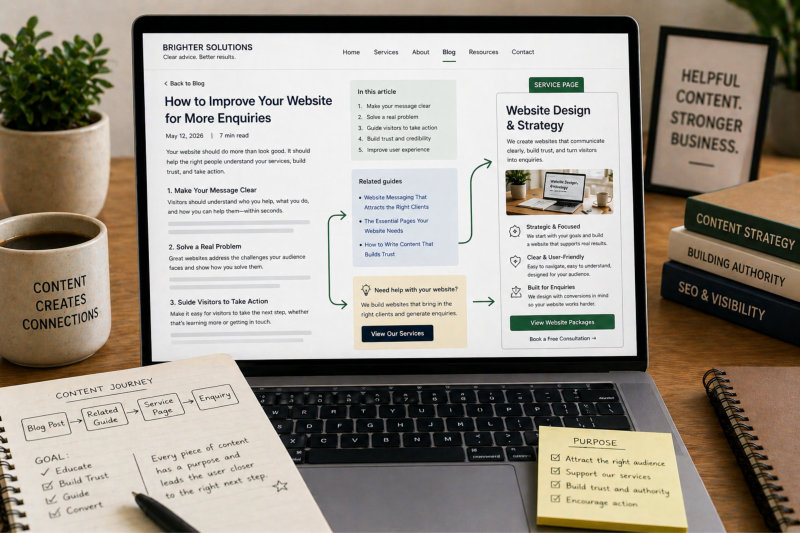
For example, if a blog post explains a common problem, it can also introduce how that problem is typically solved. From there, it becomes easy to link to a relevant service page where visitors can explore that solution in more detail.

This approach works because it feels helpful rather than sales-driven. Visitors are already engaged with the content, and the next step makes sense within the context of what they are reading.

These connections are also strengthened through your call-to-action strategy, ensuring that your content supports both engagement and action without feeling forced.

Using internal links to guide the user journey

Internal linking plays a key role in connecting your blog content to the rest of your website. It allows you to guide visitors through related topics, helping them build a deeper understanding of your services and how they apply to their situation.

Instead of reading a single post and leaving, visitors are encouraged to explore further. They may move from a blog post to a related guide, then to a service page, and eventually to your enquiry process. Each step feels like a natural progression rather than a jump.

This is where your content structure becomes powerful. By linking strategically to pages such as your website messaging or your services, you create a connected experience that supports both understanding and action.

From an SEO perspective, these internal links also help search engines understand how your content fits together, strengthening your overall authority and visibility.

Building a long term content strategy

Turning educational content into a pre-sales system

Well-structured blog content does more than attract visitors. It prepares them. By the time someone has read several pieces of your content, they should have a clearer understanding of their problem, the available solutions, and how your business fits into that picture.

This is what turns your blog into a pre-sales system. Instead of starting from scratch during a consultation, potential clients already have context. They understand your approach, they trust your expertise, and they are more confident in reaching out.

This approach also filters your enquiries. Visitors who engage with your content are more likely to be aligned with your services, leading to more relevant and productive conversations.

Over time, this reduces the need for constant explanation and positions your website as a valuable resource rather than just a point of contact.

Making sure every piece of content has a purpose

Every blog post should serve a clear purpose within your website. It should either attract the right audience, support your services, or strengthen your overall content structure. If it does not contribute to one of these goals, it may not be adding real value to your business.

This does not mean every post needs to sell. It means every post should connect. Whether that connection is through internal links, supporting topics, or guiding the reader toward the next step, it should be intentional.

This level of clarity is what separates effective content strategies from scattered blogs. It ensures that your content is not just being published, but actively contributing to your business over time.

When every piece of content has a role to play, your website becomes a cohesive system that supports visibility, builds trust, and encourages action in a natural and structured way.

Frequently Asked Questions

You should focus on topics your audience is already searching for, especially questions related to your services. This includes common problems, how-to guidance, and explanations of your process. The most effective blog topics are closely aligned with what you offer, so they attract the right type of visitor rather than general traffic.

There is no ideal frequency that applies to every business. Consistency matters more than how often you post. Publishing one well-written, useful article every few weeks is more effective than publishing frequently and stopping. The key is choosing a schedule you can maintain over time.

Yes, blogging remains one of the most effective ways to improve your website’s visibility. It allows you to target a wide range of search queries, build topical authority, and create more entry points into your website. When blog content is structured and connected properly, it supports both search rankings and long-term traffic growth.

Blogging is a long-term strategy. It can take several weeks or months for content to be indexed, ranked, and start attracting traffic. Results are usually gradual rather than immediate, but over time, consistent content builds momentum and contributes to ongoing visibility.

Blogging can generate enquiries when it is connected to your services and structured properly. If blog posts are purely informational with no clear connection to what you offer, they are more likely to generate traffic only. When aligned with your services, blogging becomes part of your enquiry process.

Length is less important than usefulness. A post should be long enough to explain the topic clearly and answer the reader’s questions. In most cases, longer, more detailed posts perform better because they provide more value and demonstrate expertise, but only if they are well structured and relevant.

AI can be a helpful tool for generating ideas, outlining posts, or drafting content, but it should not replace your understanding of your audience and your services. Content still needs to be refined to ensure it is accurate, relevant, and aligned with your tone of voice. AI works best as a support tool, not a complete solution.

If your blog is not getting traffic, it is usually due to one or more of the following: topics that are not being searched, lack of consistency, weak SEO structure, or content that is too general. Improving topic selection, structure, and internal linking can significantly increase visibility over time.

A website without a blog has limited opportunities to be found in search. A blog allows you to expand on topics, answer specific questions, and attract visitors who may not be ready to engage with your services yet. It plays an important role in building visibility and authority over time.

Blog readers become clients when your content is connected to your services. This means guiding visitors from the topic they are reading about toward relevant service pages or next steps. Clear messaging, internal links, and subtle calls to action help move readers from learning to enquiring.

Turning Your Blog Into a Long-Term Business Asset

Blogging is not just about publishing content. When approached strategically, it becomes a structured system that supports your visibility, strengthens your authority, and helps guide potential clients toward your services.

Many small business blogs never reach this point because they are treated as isolated posts rather than part of a larger framework. Content is created without clear direction, connections are missing, and the overall impact remains limited. With the right structure, each piece of content builds on the next, creating a network that works together over time.

By focusing on the right topics, writing content that is genuinely useful, and connecting it back to your website, your blog becomes far more than a collection of articles. It becomes part of your overall business strategy, supporting both your SEO visibility and your enquiry process.

This approach also improves the quality of your enquiries. Visitors who engage with your content arrive with a clearer understanding of what you offer, making conversations more focused and more productive. Instead of starting from zero, your content has already done much of the groundwork.

If your blog currently feels inconsistent, disconnected, or difficult to maintain, it is usually a sign that the structure needs refining rather than more content being added. Small changes in how your content is planned and connected can make a significant difference over time.

If you would prefer to have your website content structured and aligned properly from the start, you can explore our website design service. This ensures your blog, messaging, and overall website work together as a cohesive system that supports your business as it grows.

Ready to Build or Redesign Your Website?

If you’re reading this and thinking, “This explains exactly what’s wrong with my site,” you’re not alone.

Most small business websites don’t fail because of effort. They fail because they were built without a clear structure, proper planning or long-term thinking.

If you want a website that reflects your business properly, feels organised, and gives you confidence to send people to it, then it might be time for a proper redesign or rebuild.

You can see how I approach website projects here:

Website Design Services for Small Business

View recent website design projects

Whether you’re starting from scratch or improving what you already have, the goal is the same – clarity, structure and a site you’re proud to share.

Ivana Katz - Website designer