
Landing Pages & Sales Pages
Turning Interest into Action

This guide forms part of our complete resource on Small Business Website Conversion & Growth.

Not every page on your website is designed to do the same job. Some pages inform, some build trust, and others are designed to drive a specific action.

Landing pages and sales pages fall into that second category. They are focused, intentional, and built to guide visitors toward a clear outcome without distraction.

Many small business websites rely too heavily on general pages and miss the opportunity to create targeted experiences for specific offers, campaigns, or services. This often results in lost enquiries and lower conversion rates.

This guide forms part of our complete resource on Website Conversion & Growth: Website Conversion & Growth.

You’ll learn what landing pages are, how they differ from standard website pages, and how to structure them so they actually convert. You’ll also see when to use them, what to include, and the common mistakes that reduce their effectiveness.

If your website is not converting as well as it should, landing pages are often one of the most overlooked opportunities to improve results.
Not every page on your website is designed to do the same job. Some pages inform, some build trust, and others are designed to drive a specific action.

Landing pages and sales pages fall into that second category. They are focused, intentional, and built to guide visitors toward a clear outcome without distraction.

Many small business websites rely too heavily on general pages and miss the opportunity to create targeted experiences for specific offers, campaigns, or services. This often results in lost enquiries and lower conversion rates.

This guide forms part of our complete resource on Website Conversion & Growth: Website Conversion & Growth.

You’ll learn what landing pages are, how they differ from standard website pages, and how to structure them so they actually convert. You’ll also see when to use them, what to include, and the common mistakes that reduce their effectiveness.

If your website is not converting as well as it should, landing pages are often one of the most overlooked opportunities to improve results.
What Is a Landing Page (And When You Need One)

Understanding the Purpose of a Landing Page

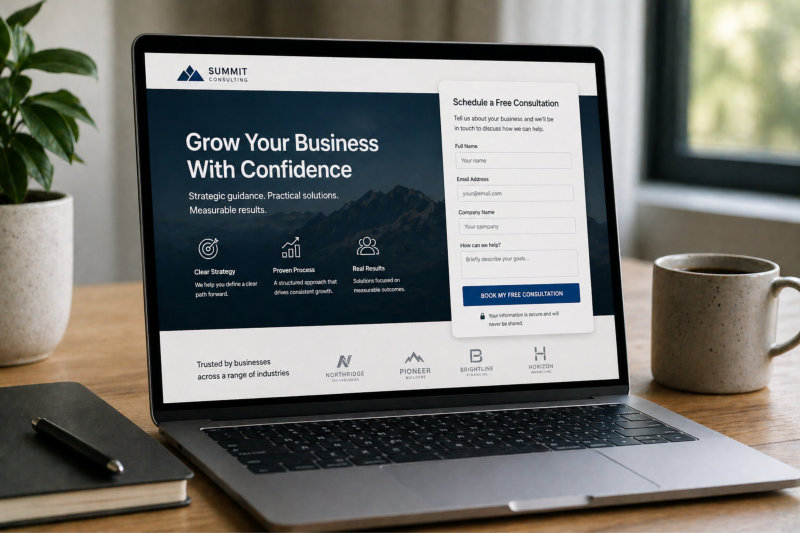
A landing page is a focused page designed to guide visitors toward a single, specific action. Unlike general website pages, which often serve multiple purposes, a landing page removes distractions and keeps the user’s attention on one clear goal.

This goal might be generating enquiries, capturing leads, promoting a service, or supporting a specific campaign. Everything on the page is structured to support that outcome.

Landing pages are not about providing every possible piece of information. They are about delivering the right information in the right order to move users toward action.

When used correctly, they create a more direct and effective path to conversion.

How Landing Pages Differ from General Website Pages

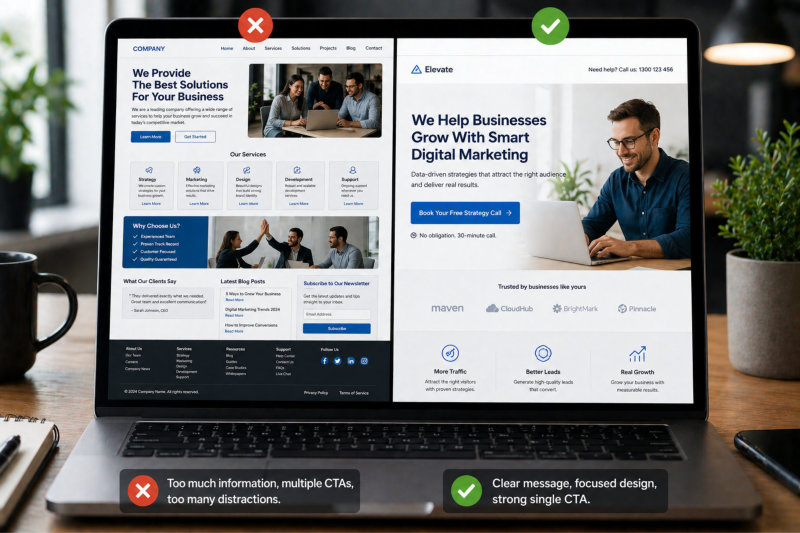
Standard website pages often include navigation menus, multiple links, and a range of content designed to help users explore. While this is useful for overall browsing, it can reduce focus when the goal is to generate a specific action.

Landing pages take a different approach. They minimise distractions by limiting navigation and removing unnecessary elements that could pull users away from the intended action.

This focused structure helps keep users engaged and increases the likelihood of conversion.

The difference is not just in design, but in intent. A landing page is built with a clear outcome in mind.

When a Landing Page Becomes Necessary

Landing pages are most effective when you are promoting a specific offer, campaign, or service that requires focused attention. This might include paid advertising campaigns, lead magnets, or targeted service promotions.

In these situations, sending users to a general page often leads to lower conversion rates because the message is too broad or the path is unclear.

A dedicated landing page allows you to tailor the message, structure, and call to action to match the specific intent of the visitor.

This alignment between message and intent is what makes landing pages so effective.

Using Landing Pages to Support Marketing Efforts

Landing pages work best when they are part of a broader marketing strategy. Whether you are running ads, promoting content, or sharing links on social media, a landing page provides a focused destination for those efforts.

Instead of sending traffic to a general page and hoping users find their way, you are guiding them directly to a page designed to convert.

This improves both user experience and overall campaign performance.

When paired with clear messaging and strong calls to action, landing pages become a powerful tool for generating enquiries.

Building Landing Pages That Align With Your Website

While landing pages are more focused, they should still feel consistent with your overall website. Design, tone, and messaging should align so that users feel they are in the right place.

A disconnected experience can reduce trust and create hesitation. Even if the page is designed for a specific purpose, it still needs to reflect your brand clearly.

If you are unsure how to structure an effective landing page, How to Create a Landing Page – The Ultimate Guide provides a detailed breakdown of what to include and how to approach it.

Consistency combined with focus is what makes a landing page both effective and trustworthy.

Landing Page vs Website Page: Key Differences

Different Purpose, Different Structure

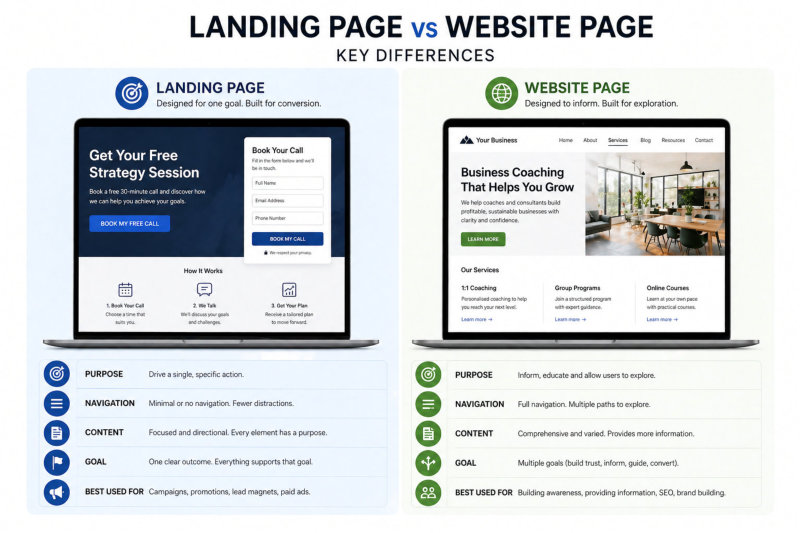
The most important difference between a landing page and a standard website page is purpose. A website page is usually designed to inform, educate, and allow users to explore. A landing page is designed to drive a single, specific action.

This difference in purpose changes how the page is structured. Website pages often include navigation menus, multiple links, and various pathways for users to follow. Landing pages remove these options to keep the user focused.

Instead of encouraging exploration, a landing page guides users step by step toward a clear outcome.

When the purpose is clear, the structure becomes much more effective.

Navigation vs Focus

Standard website pages typically include full navigation, allowing users to move freely across the site. While this is useful for general browsing, it can also create distractions when the goal is conversion.

Landing pages take the opposite approach by limiting or removing navigation. This reduces the chances of users clicking away before completing the intended action.

The goal is not to restrict users, but to remove unnecessary choices that dilute focus.

By keeping attention on one objective, landing pages create a more controlled and effective user experience.

Content Depth vs Content Direction

Website pages often aim to provide comprehensive information. They may include multiple sections, detailed explanations, and links to related content. This is useful for building understanding but can sometimes slow down decision-making.

Landing pages focus on direction rather than volume. The content is carefully structured to guide users toward a decision, using a clear sequence of information that builds confidence and leads to action.

This does not mean landing pages lack depth. Instead, every piece of content has a purpose and supports the overall goal.

Clarity and progression are more important than quantity.

Multiple Goals vs Single Outcome

Most website pages support multiple goals. A homepage, for example, might introduce services, build trust, and guide users to different sections of the site. While this is necessary, it can also dilute focus.

Landing pages are built around a single outcome. Whether it is generating enquiries, capturing leads, or promoting a specific service, everything on the page supports that one objective.

This singular focus makes it easier for users to understand what is expected and take action.

When a page tries to do too many things, conversion rates often suffer.

When to Use Each Type of Page

Both landing pages and standard website pages are important, and they work best when used together. Website pages provide the broader structure and help users explore your business, while landing pages support specific campaigns and targeted actions.

For example, your main website might explain your services and build trust, while a landing page is used for a specific promotion or advertising campaign.

Understanding when to use each type allows you to create a more effective overall strategy.

If you are structuring your website and unsure which pages are essential, What Pages Should a Coaching Website Include? provides a practical overview of how different pages work together.

What Makes a High-Converting Landing Page

A Clear and Specific Headline That Matches Intent

The headline is one of the most important elements on a landing page because it is the first thing visitors see and the moment where they decide whether to stay or leave. A strong headline clearly communicates what the page is about and confirms that the visitor is in the right place.

For a landing page to convert effectively, the headline must align with the source of the traffic. If someone arrives from an ad, email, or social post, the message they see on the page should match what they expected. Any disconnect between expectation and reality creates doubt and increases the likelihood of them leaving.

Vague or overly clever headlines often underperform because they require interpretation. Visitors should not have to work to understand what you offer. The value should be obvious and immediate.

A clear, specific headline sets the tone for the entire page and creates the foundation for everything that follows.

A Structured Flow That Builds Understanding and Confidence

A high-converting landing page is not just a collection of sections. It follows a deliberate structure that guides the visitor through a logical progression, moving from awareness to understanding and then toward action.

This usually begins with a clear introduction, followed by sections that explain the offer, highlight benefits, address potential concerns, and build trust. Each part of the page has a purpose and contributes to the overall goal.

If the structure is unclear or the flow feels disjointed, users may lose interest or become confused. This often leads to drop-offs before they reach the call to action.

When the flow is well planned, the page feels easy to follow, and the decision to take action becomes much more natural.

Strong, Relevant Calls to Action Throughout the Page

Calls to action play a central role in how a landing page performs. A high-converting page does not rely on a single CTA but includes multiple opportunities for users to take action at different stages of the page.

These CTAs should be consistent, clearly worded, and aligned with the purpose of the page. They should appear at key points where users are likely to make a decision, such as after explaining the offer or addressing common questions.

The wording of the CTA also matters. It should be direct and focused on the outcome, helping users understand exactly what will happen when they click.

When CTAs are placed strategically and supported by the surrounding content, they become a natural part of the user journey rather than an interruption.

Trust Signals That Reduce Hesitation

Even when a visitor is interested in your offer, hesitation can prevent them from taking action. Trust signals help reduce this hesitation by reinforcing credibility and demonstrating that your business is reliable.

This can include testimonials, case studies, examples of past work, or any content that shows real-world results. The goal is to provide reassurance that others have had a positive experience and that the offer delivers value.

Trust signals should be integrated naturally into the page rather than placed as an afterthought. When they appear at the right moments, they support the decision-making process and build confidence.

Without these elements, even a well-structured landing page may struggle to convert.

Minimal Distractions and a Focused Environment

One of the defining characteristics of a high-converting landing page is its ability to maintain focus. Unlike standard website pages, landing pages reduce distractions by limiting navigation, removing unnecessary links, and keeping the user’s attention on the primary goal.

Every additional option creates an opportunity for users to leave the page without converting. By simplifying the environment, you make it easier for them to stay engaged and complete the intended action.

This does not mean the page should feel restrictive. It should still provide enough information to support decision-making, but without overwhelming the user or pulling them in different directions.

Clarity and focus are what allow a landing page to perform at a higher level than a general website page.

Alignment Between Message, Design and User Expectation

A landing page performs best when its message, design, and structure all work together seamlessly. If any of these elements are out of alignment, it can create friction and reduce conversion rates.

For example, strong messaging combined with poor design can make the page difficult to navigate. A well-designed page with unclear messaging can leave users confused about the offer.

The experience should feel consistent from the moment the user arrives. The visual design, tone of voice, and content should all reinforce the same message and support the same goal.

If you want to explore this in more detail, How to Create a Landing Page – The Ultimate Guide breaks down how these elements come together to improve performance.

Sales Pages for Services: What to Include

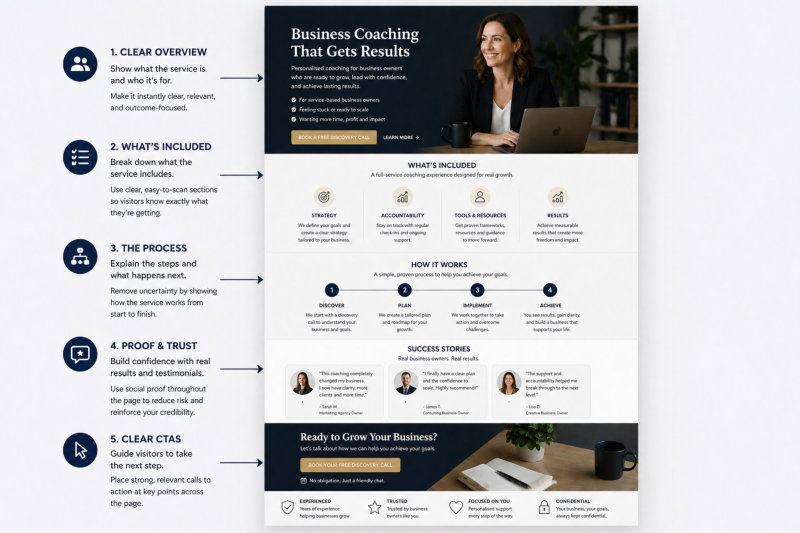
A Clear Overview of Your Service and Who It Is For

A high-performing sales page for services starts with clarity. Visitors need to immediately understand what the service is, who it is designed for, and whether it is relevant to their situation. If this is not clear within the first few seconds, they are unlikely to continue reading.

This means avoiding vague descriptions and instead being specific about the outcome your service provides. The focus should be on helping the user recognise themselves in what you are describing, rather than trying to appeal to everyone.

When your messaging clearly reflects the needs and challenges of your audience, it creates a stronger connection and keeps users engaged.

A well-defined service overview sets the foundation for the rest of the page and ensures that the right people continue reading.

A Structured Breakdown of What the Service Includes

Once the visitor understands what the service is, the next step is to explain what is actually included. This helps remove uncertainty and gives users a clearer picture of what they are getting.

A strong sales page breaks the service down into logical sections, outlining key components, deliverables, or stages of the process. This makes the offer feel more tangible and easier to understand.

Rather than presenting everything as one block of information, structuring it clearly allows users to absorb the details without feeling overwhelmed.

This level of transparency also builds trust, as users can see exactly what is involved before making a decision.

Explaining the Process and What Happens Next

One of the biggest barriers to conversion is uncertainty around what happens after someone takes action. If users are unsure about the process, they may hesitate or delay making an enquiry.

A strong sales page removes this uncertainty by clearly explaining the steps involved. This might include how the service begins, what the timeline looks like, and what the user can expect at each stage.

By outlining the process, you make the experience feel more predictable and manageable.

When users understand what will happen next, they are far more likely to feel comfortable moving forward.

Building Trust Through Proof and Real Examples

Even with clear messaging and structure, visitors still need reassurance that your service delivers results. This is where trust signals become essential.

Including testimonials, case studies, or real examples helps demonstrate that others have benefited from your service. This reduces perceived risk and strengthens confidence in your offer.

Trust elements should be placed throughout the page rather than grouped in one section. This ensures they support the user journey at multiple points.

If your page lacks proof, users may remain uncertain even if they are interested.

Clear and Well-Placed Calls to Action

A sales page should guide users toward a clear next step, and this is where calls to action play a critical role. These should be placed at key points throughout the page, not just at the end.

As users move through the content and build understanding, they should be given opportunities to act when they are ready. This might include booking a call, requesting more information, or starting the process.

The wording of the CTA should be clear and aligned with the service being offered. It should remove uncertainty and make the next step feel straightforward.

If your CTAs are unclear or poorly placed, even a strong sales page will struggle to convert.

If you want to go deeper into structuring service-based pages, Service Page Content: How to Create a Killer “Services” Page provides a detailed breakdown of what to include and how to approach it.

When to Use Dedicated Campaign Pages

When Running Paid Advertising Campaigns

Dedicated campaign pages are essential when you are running paid advertising, whether through Google Ads, social media, or other platforms. Sending paid traffic to a general website page often leads to poor results because the message is too broad and the user journey is not aligned with the ad.

A campaign page allows you to match the message of the ad exactly. The headline, content, and call to action can all be tailored to reflect what the user clicked on, creating a consistent and relevant experience.

This alignment is critical. When users arrive on a page that feels disconnected from the ad, trust drops and bounce rates increase. A dedicated page removes that disconnect.

By creating a focused destination for your campaigns, you improve both user experience and return on your advertising investment.

When Promoting a Specific Offer or Service

If you are promoting a particular service, package, or limited-time offer, a dedicated campaign page provides the focus needed to present it effectively. General website pages often include multiple services and competing information, which can dilute the message.

A campaign page allows you to isolate the offer and present it in a clear, structured way. This includes outlining the benefits, explaining the details, and guiding users toward a single action.

This level of focus helps users understand the value more quickly and reduces the likelihood of distraction.

When the goal is to generate enquiries for a specific service, a dedicated page is far more effective than relying on a broader page.

When Targeting a Specific Audience or Niche

Different audiences have different needs, priorities, and expectations. A single website page cannot always address all of these effectively without becoming too generic.

Dedicated campaign pages allow you to tailor your messaging to a specific audience. This might include different industries, demographics, or stages of business.

By speaking directly to a particular group, you can create stronger relevance and connection. The content can reflect their specific challenges and goals, making the page feel more personalised.

This targeted approach often leads to higher engagement and better conversion rates.

When Testing and Improving Performance

Campaign pages are also valuable for testing different approaches and improving performance over time. Because they are focused on a single goal, it is easier to measure what is working and what is not.

You can test variations in headlines, content structure, calls to action, and layout to see how they impact results. This provides clear insights that can be applied to future campaigns or even your main website.

Without dedicated pages, it becomes much harder to isolate these variables and understand what is driving performance.

Testing and refining campaign pages is one of the most effective ways to improve conversion rates without making major changes to your entire website.

When Your Main Website Is Too Broad

Many business websites are designed to cover a wide range of services and information. While this is useful for general browsing, it can make it harder for users to focus on a specific action.

Dedicated campaign pages solve this by removing unnecessary content and narrowing the focus. Instead of asking users to navigate through multiple sections, you present a clear and direct path.

This is particularly useful when your main website is complex or when users are arriving with a specific intent.

If your current pages are not converting as expected, it may not be a traffic issue but a focus issue. How to Create a Landing Page – The Ultimate Guide explains how to structure pages that are designed specifically for conversion.

Common Landing Page Mistakes That Kill Conversions

Trying to Say Too Much on One Page

One of the most common mistakes with landing pages is trying to include too much information. When a page attempts to explain every service, answer every question, and appeal to every type of user, it quickly loses focus.

This often results in long, cluttered pages where the main message becomes diluted. Instead of guiding users toward a clear action, the page overwhelms them with content.

A high-converting landing page is focused and intentional. It presents the right amount of information in a structured way, leading users toward a specific outcome.

When the message is simplified and clearly prioritised, users are more likely to stay engaged and take action.

Weak or Unclear Calls to Action

A landing page can have strong content and still fail if the call to action is weak or unclear. If users do not understand what to do next, or if the CTA does not stand out, they are unlikely to convert.

Common issues include vague wording, poor placement, or CTAs that blend into the design rather than drawing attention. In some cases, the CTA is only placed at the bottom of the page, missing earlier opportunities for action.

A strong CTA should be clear, visible, and aligned with the purpose of the page. It should appear at key points where users are ready to take the next step.

Without this, even interested visitors may leave without converting.

Lack of Trust and Credibility

Even if a landing page is well structured, users may hesitate if there are no clear trust signals. Without proof that your service delivers results, visitors may feel uncertain about taking action.

This is especially important for service-based businesses, where the outcome is not immediately visible. Testimonials, case studies, and examples of past work help reduce this uncertainty.

When trust elements are missing, users are left relying on assumptions, which often leads to inaction.

Including relevant proof throughout the page builds confidence and supports the decision-making process.

Poor Alignment Between Traffic Source and Page Content

A major cause of low conversion rates is a mismatch between where users come from and what they see on the page. If the messaging on the landing page does not align with the ad, email, or link that brought them there, it creates confusion.

Users expect continuity. If they click on something promising a specific outcome and land on a page that feels different, trust is immediately reduced.

This often results in high bounce rates and lost opportunities, even if the page itself is well designed.

Ensuring consistency between your traffic source and landing page content is critical for maintaining engagement and improving conversions.

Too Many Distractions and Exit Points

Landing pages are designed to focus attention, but many include unnecessary distractions such as full navigation menus, multiple unrelated links, or competing offers. These elements give users easy ways to leave the page before completing the intended action.

Every additional option increases the chance that a visitor will click away instead of converting. This is why high-performing landing pages minimise distractions and keep the focus on a single goal.

This does not mean removing all content, but rather being intentional about what is included and what is not.

By reducing exit points and maintaining a clear focus, you create an environment where users are more likely to stay engaged and follow through.

If your landing pages are not performing as expected, Writing Product Pages That Convert: The Ultimate Guide provides additional insight into how structure and focus impact conversion.

Frequently Asked Questions

A landing page is designed to guide visitors toward a single, specific action, such as making an enquiry, booking a call, or downloading a resource. Unlike general website pages, which often serve multiple purposes, a landing page removes distractions and focuses entirely on conversion. This makes it more effective for campaigns, promotions, and targeted offers.

A landing page is a broad term for any page designed to capture a specific action, while a sales page is a more detailed version focused on selling a service or offer. Sales pages typically include more in-depth content, such as benefits, process, proof, and FAQs, to build trust and move users toward a decision. Both are focused on conversion, but sales pages usually go deeper.

You may not need a landing page for every part of your website, but they are highly valuable when promoting specific services, running advertising campaigns, or targeting a particular audience. If you are sending traffic to a general page and not getting results, a dedicated landing page can significantly improve performance.

Low conversion rates are often caused by unclear messaging, weak calls to action, poor structure, or a mismatch between the traffic source and the page content. Other common issues include lack of trust signals, too many distractions, or asking users to take action before they are ready. Reviewing the structure and flow of your page usually highlights where the problem lies.

There is no fixed length for a landing page. It should be long enough to provide the information users need to make a decision, but not so long that it becomes overwhelming. More complex services often require longer pages to build trust and explain the offer, while simpler offers can be shorter and more direct.

In most cases, landing pages perform better with limited or no navigation. Removing navigation reduces distractions and keeps users focused on the primary goal. However, the page should still feel aligned with your overall website in terms of design and branding to maintain trust.

In some cases, a well-structured service page can function as a landing page, especially if it has a clear focus and strong calls to action. However, dedicated landing pages are usually more effective for campaigns because they can be tailored to a specific audience or offer without distractions.

Landing pages should work alongside your main website, not replace it. Your website provides the broader structure and helps users explore your business, while landing pages support specific campaigns and targeted actions. Together, they create a more effective system for attracting and converting visitors.

Using Landing Pages to Drive Focused Results

Landing pages and sales pages play a critical role in turning interest into action. While your main website provides structure and information, these pages create a focused environment where visitors can make clear decisions without distraction.

When designed properly, they guide users through a structured flow, build confidence, and present a clear next step. This makes them far more effective for campaigns, targeted offers, and specific services.

Many businesses rely on general website pages and miss the opportunity to create these focused experiences. As a result, traffic is lost, and conversion rates remain lower than they should be.

By using dedicated landing pages where they are needed, and ensuring they are aligned with your messaging, design, and user journey, you create a more effective system for generating enquiries.

If you want to build landing pages that are structured to perform and aligned with your overall website, you can explore our website design services.

You can also explore practical, step-by-step resources here: Guides.

When your landing pages are clear, focused, and aligned with your strategy, conversions become far more predictable and consistent.

Ready to Build or Redesign Your Website?

If you’re reading this and thinking, “This explains exactly what’s wrong with my site,” you’re not alone.

Most small business websites don’t fail because of effort. They fail because they were built without a clear structure, proper planning or long-term thinking.

If you want a website that reflects your business properly, feels organised, and gives you confidence to send people to it, then it might be time for a proper redesign or rebuild.

You can see how I approach website projects here:

Website Design Services for Small Business

View recent website design projects

Whether you’re starting from scratch or improving what you already have, the goal is the same – clarity, structure and a site you’re proud to share.

Ivana Katz - Website designer