
How to Build Authority Online and
Become the Go-To in Your Industry

This guide forms part of our complete resource on Small Business Website Content & Visibility.

Building authority online is not about being the loudest voice or constantly promoting yourself. It is about being recognised as someone who knows what they are doing and can be trusted to deliver results.

For small businesses, authority plays a critical role in how potential clients make decisions. When someone visits your website, they are not just looking at what you offer. They are assessing whether they feel confident choosing you over other options.

This is where authority makes a difference. It helps position your business as credible, capable, and worth considering. Without it, even a well-designed website can struggle to convert visitors into enquiries.

Authority is built through a combination of factors. Your content, your messaging, your website, and your overall online presence all contribute to how your business is perceived. It is not created through a single action, but through consistent signals over time.

This is why authority works closely with your messaging, your content, and your visibility strategy. Each of these elements supports how your business is seen and understood.

If you want to explore the foundations in more detail, you can review how to establish credibility and expertise or how to build a memorable brand, both of which highlight how perception plays a key role in attracting the right clients.

This guide focuses on practical ways to build authority without overcomplicating the process.

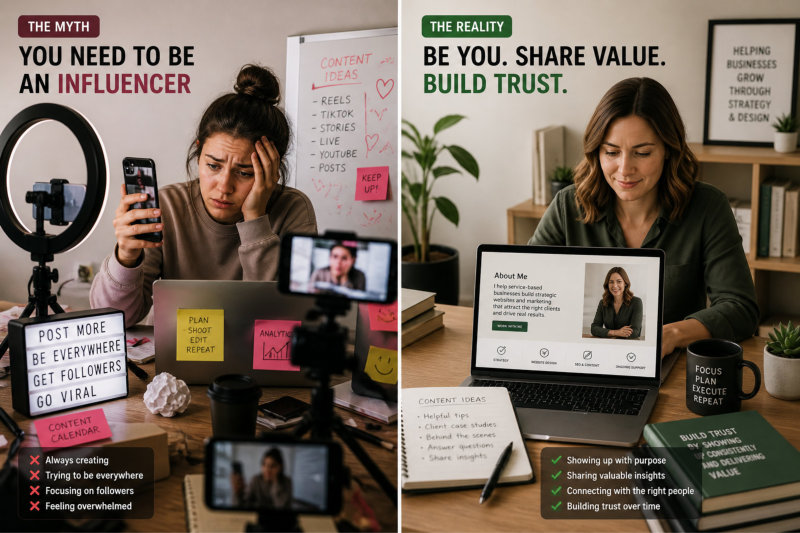
The goal is not to turn you into a personal brand influencer, but to help you create a clear, credible presence that supports your business and leads to more enquiries.
What Authority Means for Small Business

Why authority is not about being famous or highly visible

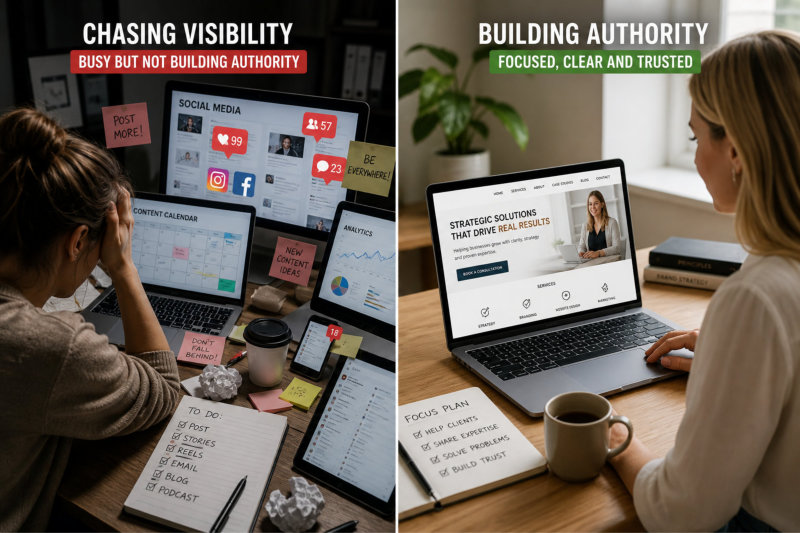
Authority is often misunderstood as needing a large following, frequent content, or high visibility across multiple platforms. While these can contribute, they are not what defines authority for most small businesses.

For a small business, authority is about being seen as credible and capable within a specific area. It is not about reaching everyone. It is about being trusted by the right people when they are considering your services.

This means you do not need to be everywhere or constantly producing content. What matters is how clearly you present your expertise and how consistently your message reflects what you do.

When authority is approached this way, it becomes far more achievable and far more relevant to your business.

How authority influences buying decisions

When someone is choosing between different businesses, they are not only comparing services. They are also assessing who they feel most confident working with. This decision is often influenced by perception rather than just facts.

Authority helps reduce uncertainty. When your website, content, and overall presence clearly demonstrate your experience and approach, it becomes easier for potential clients to trust you.

This is particularly important for services that involve a level of investment or ongoing work. The more confident someone feels in your expertise, the more likely they are to take the next step.

This is why authority is closely connected to your enquiry process, as it directly influences whether visitors move from interest to action.

The difference between authority and general credibility

Credibility and authority are related, but they are not the same. Credibility is about being believable. Authority goes a step further and positions you as someone who is trusted within your field.

For example, a business may appear credible by having a professional website and clear information. Authority is built when that business consistently demonstrates knowledge, experience, and a clear understanding of its audience.

This difference is important because credibility may get someone to consider your business, but authority is what helps them choose you over others.

Building authority requires more than just looking professional. It requires demonstrating value over time.

What authority means for small business

Why authority is built through consistency

Authority is not created through a single action. It develops gradually as people interact with your business across different touchpoints. Each piece of content, each page on your website, and each interaction contributes to how your business is perceived.

When your messaging is consistent and your content aligns with your services, it reinforces your expertise. Over time, this creates a stronger impression and builds familiarity with your audience.

Inconsistent messaging or disconnected content can weaken this perception. If your website says one thing and your content suggests another, it becomes harder for visitors to understand what you do and why they should trust you.

This is why consistency across your messaging and your content is essential in building authority.

How small businesses can build authority without overcomplicating it

Building authority does not require complex strategies or constant activity. It can be achieved through a clear and focused approach that aligns with your business.

This includes having a well-structured website, creating content that reflects your expertise, and maintaining a consistent presence across your platforms. Each of these elements contributes to how your business is perceived.

Simple, practical steps can often have the biggest impact. For example, clearly explaining your services, sharing useful insights, and ensuring your website reflects your level of experience can all strengthen your authority.

Approaches such as those outlined in ways to boost business credibility show that authority is built through a combination of small, consistent actions rather than a single strategy.

Positioning Yourself Clearly

Why unclear positioning weakens your authority

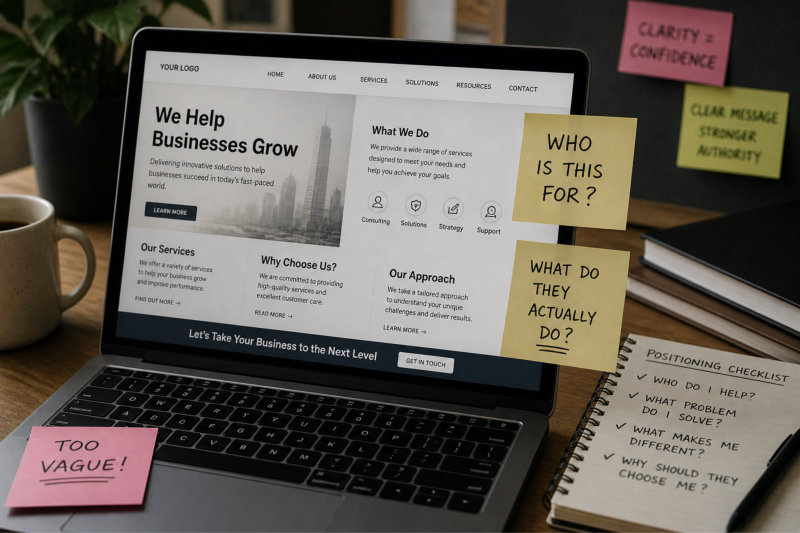
One of the biggest barriers to building authority is unclear positioning. When a business tries to appeal to everyone or describes its services in vague terms, it becomes difficult for visitors to understand what it actually does and who it is for.

This lack of clarity creates hesitation. Even if your skills and experience are strong, visitors may not feel confident moving forward if they are unsure whether you are the right fit. Authority depends on confidence, and confidence comes from clarity.

Clear positioning removes this uncertainty. It allows potential clients to quickly recognise whether your services are relevant to them and whether you understand their needs.

This is why positioning is closely tied to your website messaging, as it defines how your business is presented and understood.

Defining who you help and what you do

Strong positioning starts with clearly defining your audience and your services. This means being specific about who you help and what problems you solve, rather than using broad or generic descriptions.

For example, instead of saying you offer “web design services,” it is more effective to explain who those services are for and what outcomes they support. This creates a clearer picture for the visitor and makes your message more relevant.

Being specific does not limit your opportunities. It helps attract the right audience and makes your expertise easier to recognise. This is what strengthens your authority within a particular area.

When your positioning is clear, your content, your website, and your overall presence become more aligned and more effective.

Positioning yourself clearly

Communicating your value without overcomplicating it

Many businesses struggle to explain what makes them different. This often leads to overly complex messaging or generic statements that do not clearly communicate value.

Effective positioning focuses on clarity rather than complexity. It explains what you do in a way that is easy to understand and directly relevant to your audience.

This might involve highlighting your approach, your experience, or the way you solve specific problems. The goal is not to impress with technical language, but to make your value obvious.

Approaches such as those outlined in building a memorable and recognisable brand emphasise clarity and consistency as key factors in standing out.

Aligning your positioning across your website and content

Positioning is not limited to a single page on your website. It needs to be reflected across your entire online presence. This includes your homepage, your service pages, your blog content, and any external platforms you use.

When your positioning is consistent, it reinforces your authority. Visitors receive the same message regardless of where they interact with your business, which builds familiarity and trust.

Inconsistent positioning can create confusion. If your website presents one message and your content suggests another, it becomes harder for visitors to understand what you offer.

This is why alignment across your content strategy and your website is essential for building a clear and credible presence.

Positioning yourself without trying to appeal to everyone

A common mistake is trying to appeal to a wide audience in the hope of attracting more clients. In practice, this often has the opposite effect. When your message is too broad, it becomes less relevant and less compelling.

Clear positioning requires making choices about who you are targeting and how you present your services. This may feel limiting, but it actually strengthens your authority by making your message more focused.

When you speak directly to a specific audience, your content becomes more relevant and more engaging. This increases the likelihood that visitors will recognise your expertise and feel confident working with you.

Positioning is not about excluding people. It is about being clear enough that the right people can recognise you as the right choice.

Using Content to Build Credibility

Why content is one of the strongest signals of authority

Content plays a central role in how your business is perceived. When potential clients visit your website, they are looking for more than just a list of services. They are looking for evidence that you understand what you are doing and that you can help them achieve the outcome they are looking for.

Content provides that evidence. It allows you to demonstrate your knowledge, explain your approach, and show how you think about the problems your audience is facing. This builds confidence in your expertise without needing to rely on direct promotion.

Unlike short-term marketing tactics, content remains available on your website and continues to support your credibility over time. Each piece adds to your overall presence, creating a stronger impression of your expertise.

This is why content is often a key part of strategies such as establishing credibility and expertise, where consistent, useful information reinforces trust.

Creating content that reflects your real expertise

Credibility is built when your content reflects your actual experience and understanding. This means focusing on topics you genuinely know, rather than trying to cover everything or follow trends that are not directly relevant to your business.

When your content is grounded in real knowledge, it becomes more practical and more valuable. It answers questions clearly, provides useful insights, and helps your audience understand what to expect from working with you.

This approach is far more effective than producing generic content. Visitors can quickly recognise when content lacks depth or feels disconnected from real experience.

By focusing on what you know and how you work, your content becomes a natural extension of your services and strengthens your authority.

Using content to answer real questions and concerns

One of the most effective ways to build credibility is to address the questions and concerns your audience already has. This might include explaining how your services work, clarifying common misconceptions, or outlining what clients can expect.

When you answer these questions openly, it reduces uncertainty and helps potential clients feel more confident. It also shows that you understand their perspective and are willing to provide clear, useful information.

This type of content is particularly valuable because it aligns directly with what people are searching for. It supports both your credibility and your visibility at the same time.

Over time, consistently addressing real questions creates a library of content that reinforces your expertise and supports your overall authority.

Using content to build credibility

Demonstrating consistency across your content

Authority is strengthened when your content is consistent. This does not mean repeating the same information, but rather maintaining a clear message and a recognisable approach across different topics.

When visitors read multiple pieces of content and see the same level of clarity and insight, it reinforces their perception of your expertise. Each interaction builds on the previous one, creating a stronger overall impression.

Inconsistent content, on the other hand, can weaken credibility. If some content is detailed and useful while other pieces are vague or disconnected, it creates uncertainty about your level of expertise.

This is why consistency across your content strategy is important in building a reliable and credible presence.

Using content to support trust beyond your website

Content does not only exist on your website. It can also be shared, referenced, and discovered on other platforms. This extends your reach and reinforces your credibility beyond your own site.

For example, your content may be shared on social media, referenced by other websites, or included in discussions within your industry. Each of these interactions contributes to how your business is perceived.

Mentions and references from external sources can further strengthen your authority, as they act as additional signals of trust. This is why approaches such as using media mentions to build authority can enhance how your business is viewed.

When your content is both useful and visible, it becomes a powerful tool for building credibility across multiple channels.

Personal Branding Without Overdoing It

Why personal branding matters even if you are not trying to be an influencer

Personal branding is often associated with influencers or people who are constantly visible online, but for small business owners, it serves a different purpose. It helps put a face and personality behind the business, making it easier for potential clients to connect and build trust.

When someone is considering working with you, they are not only evaluating your services. They are also assessing whether they feel comfortable and confident dealing with you. Personal branding helps bridge that gap by making your business feel more human and approachable.

This does not require a large following or constant posting. It simply involves showing who you are, how you work, and what you stand for in a clear and consistent way.

Approaches such as building a personal brand emphasise that authenticity and clarity are more important than visibility alone.

Keeping your personal brand aligned with your business

A strong personal brand should support your business rather than distract from it. This means ensuring that what you share reflects your services, your values, and the type of clients you want to attract.

When your personal brand is aligned with your business, it reinforces your positioning. Your audience gains a clearer understanding of what you do and how you approach your work.

If there is a disconnect between your personal brand and your business, it can create confusion. Visitors may struggle to understand what you offer or how your content relates to your services.

Alignment ensures that your personal presence strengthens your authority rather than diluting it.

Personal branding without overdoing it

Sharing enough to build trust without oversharing

One of the common concerns with personal branding is knowing how much to share. While being visible can help build trust, sharing too much or focusing on unrelated topics can reduce the effectiveness of your message.

The goal is to share information that supports your credibility and helps your audience understand your expertise. This might include insights into your work, your experience, or your approach to solving problems.

It is not necessary to share every detail of your personal life. Instead, focus on what is relevant to your business and what adds value to your audience.

This balanced approach allows you to build a connection without losing focus on your professional role.

Using social platforms to reinforce your authority

Social media can be a useful channel for personal branding when used with intention. It allows you to share insights, highlight your work, and maintain visibility with your audience.

Rather than trying to be active on every platform, it is more effective to choose one or two channels that suit your audience and your style. This makes it easier to stay consistent without becoming overwhelmed.

Content shared on social platforms should connect back to your website and your services. This ensures that your visibility leads to meaningful engagement rather than just surface-level interaction.

Strategies such as using social media to build trust highlight the importance of consistency and relevance in strengthening your authority.

Building recognition through consistency over time

Personal branding is not built through one post or one piece of content. It develops over time as your audience repeatedly sees and interacts with your message.

Consistency plays a key role in this process. When your tone, your message, and your content remain aligned, it becomes easier for people to recognise and remember your business.

This recognition contributes to your authority. When potential clients are already familiar with your name and your approach, they are more likely to feel confident reaching out.

By maintaining a steady and focused presence, your personal brand becomes a natural extension of your business and supports your overall credibility.

Building Trust Through Your Website

Why your website is the foundation of your credibility

Your website is often the first place potential clients go when they are considering your business. Before they contact you, they are assessing whether you appear credible, professional, and capable of delivering what you promise.

This makes your website more than just an online presence. It becomes the central place where trust is either built or lost. Even if someone finds you through social media or a referral, they will usually visit your website before making a decision.

If your website feels unclear, outdated, or difficult to navigate, it can create doubt. On the other hand, a well-structured and thoughtful website reinforces your authority and makes it easier for visitors to feel confident in your business.

This is why your website plays such a critical role in strategies such as building trust through your website, where structure and clarity are key factors.

Using clear messaging to reduce uncertainty

When visitors arrive on your website, they are looking for clarity. They want to understand what you do, who you help, and how your services apply to their situation. If this information is not immediately clear, they are more likely to leave.

Clear messaging reduces uncertainty. It helps visitors quickly recognise whether your services are relevant to them and whether you understand their needs.

This is particularly important for building trust. When people understand what you offer and how it benefits them, they are more likely to feel confident moving forward.

This is why your website messaging is a core part of your credibility, as it directly influences how your business is perceived.

Showing proof that supports your expertise

Trust is strengthened when visitors can see evidence of your experience and results. This might include testimonials, case studies, examples of your work, or any form of social proof that demonstrates your capability.

Without proof, visitors are relying solely on what you say about your business. With proof, they can see that others have had positive experiences and that your services deliver results.

This type of content helps reduce risk from the client’s perspective. It reassures them that they are making a safe and informed decision.

Approaches such as those outlined in ways to build trust with website visitors highlight how different forms of proof can strengthen credibility across your site.

Building trust through your website

Design and structure as trust signals

Trust is not built through content alone. The design and structure of your website also play a significant role in how your business is perceived. A clean, well-organised layout makes it easier for visitors to navigate and understand your content.

Poor design, on the other hand, can create doubt, even if your services are strong. Visitors may question whether your business is professional or whether you pay attention to detail.

Structure is equally important. When information is easy to find and flows logically, it creates a smoother experience. This reduces friction and makes it easier for visitors to move through your site.

These elements work together to create a sense of reliability, which is essential for building trust.

Turning trust into action

Building trust is not the end goal. It is what enables visitors to take the next step. Once someone feels confident in your business, they are far more likely to enquire or engage with your services.

This is why your website needs to guide visitors towards action. Clear calls to action, accessible contact options, and a logical flow all help support this process.

Trust removes hesitation, but structure enables action. Both are needed for your website to perform effectively.

When your website combines clear messaging, strong proof, and thoughtful design, it becomes a powerful tool for turning visitors into enquiries and supporting your overall business growth.

Creating Consistency Across Your Online Presence

Why consistency strengthens your authority

Authority is not built through a single interaction. It develops as people encounter your business across different platforms and over time. When your message, tone, and presentation are consistent, it reinforces your credibility and makes your business easier to recognise.

Inconsistent messaging can have the opposite effect. If your website presents one version of your business while your social media or other platforms suggest something different, it creates confusion. Visitors may struggle to understand what you do or what to expect.

Consistency removes this uncertainty. It creates a clearer impression and helps your audience feel more confident in your business.

This is why consistency is a key part of building authority, as it ensures that every interaction supports the same message.

Aligning your messaging across all platforms

Your messaging should remain aligned across your website, social media, email communication, and any other platforms you use. This does not mean repeating the exact same words, but it does mean maintaining a consistent message about what you do and who you help.

When your messaging is aligned, it becomes easier for people to understand your business. Whether they find you through search, social media, or a referral, they receive the same core message.

This alignment reinforces your positioning and strengthens your authority. It ensures that your audience does not need to interpret different messages across different channels.

Consistency in messaging also supports your website content, as it connects your broader presence back to your core message.

Creating consistency with your brand

Maintaining a consistent tone and visual identity

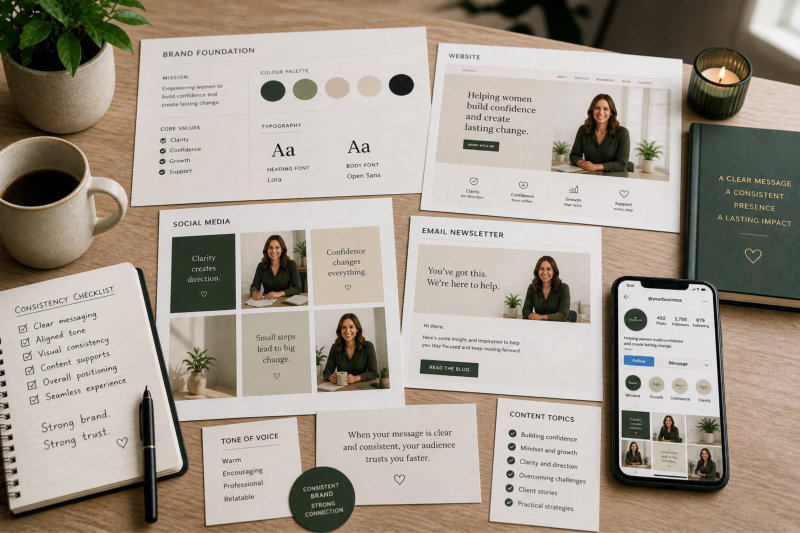
Beyond messaging, consistency also applies to your tone and visual presentation. The way you communicate, the style of your content, and the overall look of your brand all contribute to how your business is perceived.

A consistent tone helps your audience recognise your voice. Whether your style is formal, conversational, or somewhere in between, maintaining that tone across platforms creates familiarity.

Your visual identity, including colours, layout, and imagery, also plays a role. When these elements are consistent, your business becomes more recognisable and more memorable.

This is why approaches such as building a recognisable brand focus on consistency as a key factor in strengthening your presence.

Ensuring your content supports your overall positioning

Every piece of content you create contributes to how your business is perceived. This includes blog posts, social media updates, emails, and any other material you share.

When your content is aligned with your positioning, it reinforces your expertise and helps build a stronger overall impression. When it is not aligned, it can weaken your authority by creating mixed signals.

This does not mean all content needs to be highly structured, but it should still connect back to your core message and your services. This ensures that your efforts are contributing to your overall strategy rather than working in isolation.

Maintaining this alignment supports your content strategy and ensures that your content remains focused and relevant.

Creating a seamless experience for your audience

Consistency across your online presence creates a smoother experience for your audience. When someone moves from one platform to another, they should feel that they are interacting with the same business.

This continuity builds trust. It shows that your business is organised, reliable, and clear in its communication. It also makes it easier for visitors to move between platforms without confusion.

For example, someone might discover your business on social media, visit your website, and then subscribe to your email list. If each of these touchpoints feels consistent, it strengthens their confidence in your business.

When your online presence is aligned, it creates a cohesive system that supports both your authority and your ability to generate enquiries.

Turning Authority into Enquiries

Why authority alone is not enough

Building authority is important, but it does not automatically lead to enquiries. Many businesses invest time into content, branding, and visibility, yet still struggle to generate consistent leads. This is often because authority has not been connected to a clear path for action.

Authority creates confidence, but your website needs to guide visitors towards the next step. Without this connection, visitors may recognise your expertise but leave without engaging further.

This is why authority should be viewed as part of a larger system. It builds trust, but it needs to be supported by clear messaging, structure, and calls to action that encourage enquiries.

When these elements are aligned, authority becomes far more effective in supporting your business.

Making it easy for visitors to take the next step

Once a visitor feels confident in your business, the next step should be obvious and easy to take. If your website does not clearly guide them, they may hesitate or leave without enquiring.

This means having clear calls to action, visible contact options, and a logical flow through your pages. Visitors should not need to search for how to contact you or what to do next.

Simplicity is key. The easier it is to take action, the more likely visitors are to follow through.

This is why your enquiry process plays an important role in turning authority into results.

Using content to guide visitors toward your services

Your content is not only there to build credibility. It also helps guide visitors towards your services. Each piece of content should connect back to what you offer in a natural and relevant way.

For example, a blog post that explains a common problem can link to a service that provides a solution. This creates a logical progression from information to action.

When content and services are connected, it becomes easier for visitors to move through your website and understand how you can help them.

This approach ensures that your content supports both authority and enquiries rather than existing as a separate activity.

Turning authority into enquiries

Reinforcing trust at key decision points

Even when visitors are close to enquiring, they may still have doubts. This is where reinforcing trust becomes important. Testimonials, examples of your work, and clear explanations of your process can help remove hesitation.

These elements provide reassurance that your business is reliable and capable. They reduce perceived risk and make it easier for visitors to make a decision.

Positioning these trust signals at key points on your website, such as service pages or enquiry sections, increases their effectiveness.

Strategies such as boosting credibility highlight how these signals contribute to stronger decision-making.

Creating a system that supports consistent enquiries

Turning authority into enquiries is not about a single page or a single action. It is about creating a system where each element of your website supports the next.

Your content builds awareness and credibility. Your website structure guides visitors through your services. Your messaging clarifies your value. Your calls to action make it easy to take the next step.

When these elements work together, your website becomes more effective at generating consistent enquiries rather than relying on occasional results.

This is where your authority translates into real business outcomes. It is not just about being recognised, but about being chosen.

Frequently Asked Questions

Building authority online means being seen as a credible and trustworthy expert in your field. For small businesses, this is less about being widely known and more about being recognised by the right audience as someone who understands their needs and can deliver results.

You do not need a large audience to build authority. Clear messaging, useful content, a well-structured website, and consistent communication are often enough. Authority comes from how you present your expertise, not how many people follow you.

Credibility means your business appears professional and believable. Authority goes further by positioning you as someone trusted and recognised within your field. Credibility helps people consider you, while authority helps them choose you.

Yes, personal branding helps make your business more relatable and builds trust with your audience. It allows potential clients to connect with you as a person, which can influence their decision to work with you.

Content allows you to demonstrate your knowledge and provide value to your audience. By consistently sharing useful insights and answering common questions, you reinforce your expertise and build trust over time.

Your website is often the first place potential clients assess your business. It needs to clearly explain your services, demonstrate your expertise, and provide proof of your experience. A strong website supports your authority and helps turn visitors into enquiries.

Building authority takes time. It develops gradually as your content, messaging, and presence become more consistent. While results are not immediate, a structured approach creates long-term credibility and visibility.

Yes, when used correctly. Social media can support your authority by sharing insights, reinforcing your message, and directing people back to your website. It works best as a supporting channel rather than your main platform.

Content alone is not enough. Your website also needs clear positioning, strong messaging, and a clear path for visitors to take action. Authority builds trust, but structure and clarity are what turn that trust into enquiries.

To turn authority into clients, your website needs to guide visitors towards the next step. This includes clear calls to action, visible contact options, and content that connects to your services. When trust and structure are aligned, enquiries become more consistent.

Building Authority That Leads to Real Business Growth

Authority is not built through a single tactic. It develops over time as your messaging, content, website, and overall presence work together to create a clear and credible impression of your business.

When your positioning is clear, your content reflects your expertise, and your website reinforces trust, it becomes much easier for potential clients to feel confident choosing you. This confidence is what turns interest into enquiries.

The key is consistency. Each interaction someone has with your business should support the same message and the same level of quality. Over time, this creates familiarity and strengthens your authority within your space.

Your website plays a central role in this process. It connects your messaging, your content, and your visibility into one structured system. When these elements are aligned, your website becomes more than just an online presence. It becomes a foundation for building trust and generating enquiries.

If your business is not being recognised as clearly as it should be, it is often not due to a lack of ability. It is usually a matter of how that ability is presented. Taking a structured approach to your website and content can significantly improve how your business is perceived.

If you would like your website to better reflect your expertise and support your authority online, you can explore our website design service. This ensures your website works as a strong, credible foundation for your business.

Ready to Build or Redesign Your Website?

If you’re reading this and thinking, “This explains exactly what’s wrong with my site,” you’re not alone.

Most small business websites don’t fail because of effort. They fail because they were built without a clear structure, proper planning or long-term thinking.

If you want a website that reflects your business properly, feels organised, and gives you confidence to send people to it, then it might be time for a proper redesign or rebuild.

You can see how I approach website projects here:

Website design services for small business

View recent website design projects

Whether you’re starting from scratch or improving what you already have, the goal is the same – clarity, structure and a site you’re proud to share.

Ivana Katz - Website designer