
How Much Does Website Design Cost on the Northern Beaches?
If you’re still deciding whether you even need a website in the first place, this guide on whether your business really needs a website is a good place to start.
Let’s get straight to it. If you’ve ever tried to figure out how much a website costs, you’ve probably seen answers ranging from a few hundred dollars to “it depends”.
Helpful… not really.
So let’s break it down properly — using real numbers, real scenarios, and a bit of honesty about what actually drives the cost.
Let’s Start With the Honest Answer
Website pricing isn’t random, but it isn’t fixed either – and that’s where a lot of the confusion comes from.
Most people expect a clear, standard price, something similar to buying a product off the shelf. But a website isn’t a fixed product. It’s built around your business — what you offer, how you want to present it, and what you need it to actually do once it’s live.
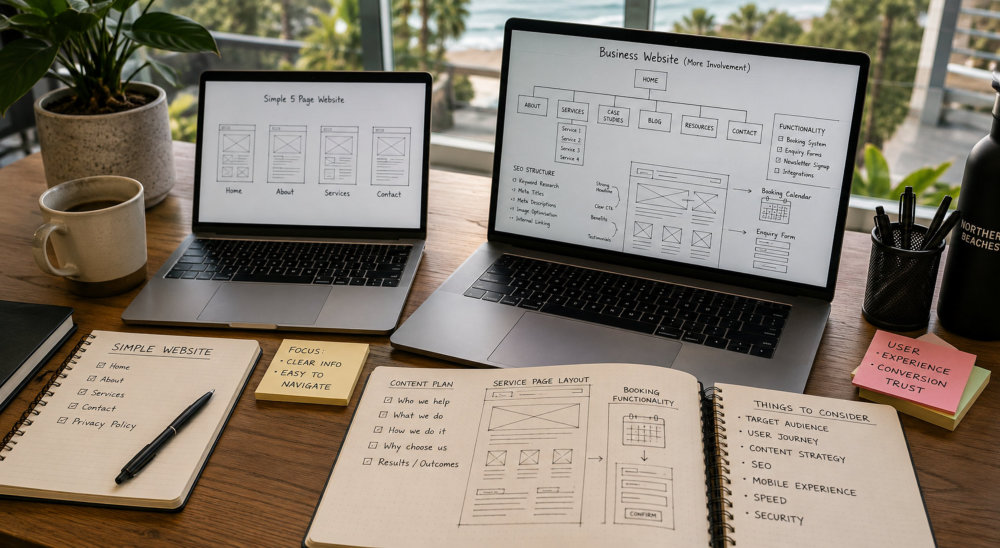
That’s why two websites can look similar on the surface, but have completely different costs behind the scenes. One might be a straightforward five-page site with basic information, while another might involve multiple service pages, custom content, integrations, or more thought around how everything is structured and presented.
The amount of content also plays a bigger role than most people expect. Writing, structuring, and refining what goes on each page often takes more time than the design itself — especially if you want the website to feel clear, consistent, and aligned with your business.
Then there’s the level of customisation. Some websites are built quickly using templates with minimal changes. Others are planned more carefully, with the layout, content, and structure shaped around the business rather than fitted into a pre-made design.
When you start to combine all of these factors — pages, content, functionality, and how tailored the build needs to be — the variation in pricing starts to make a lot more sense.
That’s why you’ll see such a wide range in website costs. And more importantly, it’s why understanding what goes into a website is far more useful than focusing on the number alone.
If you want to understand how long that process actually takes from start to finish, this breakdown of how long it takes to build a website will give you a clearer picture.
Typical Website Costs on the Northern Beaches (Real Numbers)
To give you something concrete, here’s what small business websites typically cost when working with me:
- Starter Website – from $1440
Best for businesses that need a clean, professional online presence without anything overly complex. - Business Website – from $1990
Ideal if you need more pages, stronger messaging, or want your website to properly represent your business. - Premium Website – from $2520
For businesses that want a more complete setup with additional pages, content, and flexibility as they grow.
The difference between these isn’t just design — it’s the amount of content, structure, and planning that goes into the site.
If you want to see exactly what’s included in each package, you can view the full breakdown of options, features, and pricing on our website design packages page.
What Actually Affects the Cost of a Website?
This is where things usually start to make more sense.
Website pricing isn’t random — it’s built up from a few key factors. The tricky part is that most people only think about one of them (usually design), when in reality it’s the combination that drives the cost.
And if you’re trying to figure out what your website actually needs before you even think about cost, this guide on what pages a small business website needs breaks it down clearly.
Let’s break it down properly.
Number of Pages
This is the most obvious one, but it’s also the most underestimated.
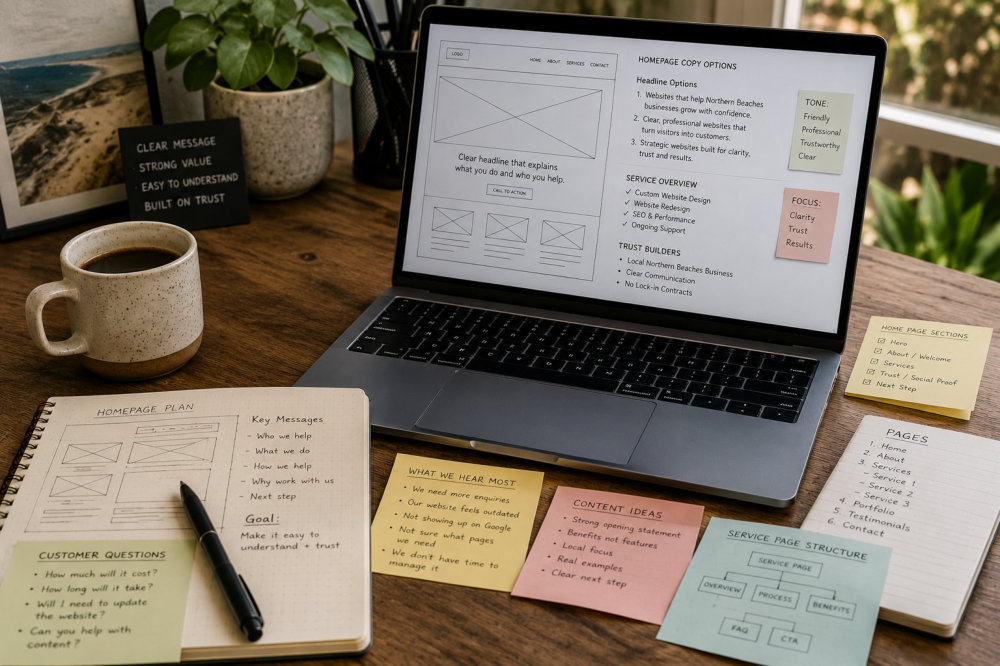
Every additional page isn’t just “another page”. It’s more structure, more layout decisions, more content, and more time spent making sure everything flows properly.
A simple 5-page website is relatively straightforward. But once you start adding separate service pages, location pages, or detailed sections, the scope grows quickly.
And that’s usually where the cost starts to shift.
Content Creation
This is the part almost everyone overlooks.
Writing content for a website takes time — not just typing words, but actually thinking through what you do, how to explain it clearly, and how to make it make sense to someone seeing your business for the first time.
It’s often the difference between a website that looks fine… and one that actually feels right.
Some clients come with everything written and ready to go. Others need help structuring and creating it. That alone can significantly impact the overall cost.
Functionality
This is where things move beyond a “basic website”.
Adding features like booking systems, enquiry forms, ecommerce, payment options, or integrations with other tools increases both the complexity and the build time.
Each feature needs to be set up, tested, and made to work properly — not just added and hoped for the best.
The more your website needs to do, the more time goes into building it properly.
Level of Customisation
Not all websites are built the same way.
Some are based on pre-made templates with light adjustments. Others are structured more carefully around the business itself — how it works, what it offers, and how it needs to be presented.
The more tailored the website is to your business, the more planning and thought goes into it.
And that’s usually where the difference between a “quick website” and a “proper website” becomes obvious.
How It All Adds Up
It’s rarely just one of these factors that increases the cost.
It’s the combination.
A website with more pages, custom content, added functionality, and a more tailored structure will naturally take longer to build — and that’s what affects the final price.
Once you understand that, the pricing starts to feel a lot less random… and a lot more logical.
Why Website Costs Can Blow Out (And How to Avoid It)
This is one of the most common scenarios I see.
It usually starts with:
“I just need a simple website…”
And then somewhere along the way:
- “Can we add another page?”
- “What about a blog?”
- “Oh, I’d also like to sell some products”
- “And maybe a booking form…”
Before you know it, that “simple website” has quietly turned into something much bigger.
No one’s done anything wrong — it’s just what happens when the scope isn’t clearly defined upfront.
The easiest way to avoid this is to decide early what your website actually needs to do, rather than building it as you go.
This is also where many people run into the same issues, which are covered in more detail in this article on common website mistakes.
What Other Costs Should You Expect (Beyond the Website Build)?
When people ask how much a website costs, they’re usually thinking about the build.
But there are a few ongoing costs that are worth knowing about upfront — nothing unexpected, just part of having a website that works properly.
| Item | What It Covers | Typical Cost (AUD) |
|---|---|---|
| Domain Name | Your website address (e.g. yourbusiness.com.au) | $20 – $40 per year |
| Web Hosting | Where your website is stored and runs from | $250 – $500+ per year |
| Maintenance & Support | Updates, backups, security, general upkeep | Optional / varies (some included) |
| Email Hosting | Professional email addresses (e.g. you@yourbusiness.com.au) | $110 per user/year |
| Content Updates | Ongoing changes, additions, improvements | Pay-as-you-go or included |
| SEO / Marketing | Getting traffic to your website (not part of build) | Optional / varies widely |
The key thing to understand is that the website build is usually a one-off cost, while these are ongoing costs that support your site over time.
You don’t need everything straight away — but it’s helpful to know what’s involved so you can plan properly.
What Pages Does Your Website Actually Need? (And Why This Changes the Cost)
One of the biggest cost factors is how many pages your website needs — and that depends on your type of business.
For Coaches and Consultants
These websites rely heavily on trust and connection, so they usually need more content.
- Home
- About (often more detailed)
- Services (generally multiple pages)
- Individual service or program pages
- Testimonials
- Case Studies
- Blog or resources
- Contact or booking page
Because these sites need to explain what you do clearly, they often require more content and structure.
For Trades (Plumbers, Electricians, Builders)
These websites are more action-focused.
- Home
- Services (often broken into specific jobs)
- Service areas or locations
- About
- Testimonials
- Contact (usually phone-first)
They’re generally simpler, but can expand quickly if you start targeting multiple services and suburbs.
For eCommerce Businesses
Online stores are naturally more complex.
- Home
- Shop / categories
- Product pages
- Cart and checkout
- Shipping and returns
- Policies
- Contact
Even a small store involves more moving parts, which is why ecommerce websites usually cost more.
For General Small Businesses
This is where most websites sit.
- Home
- About
- Services / Products
- Testimonials
- Gallery or portfolio
- Contact
- FAQs
- Terms & Conditions
The more detail you want to include, the more time goes into building it properly.
Why Some Websites Cost $500… and Others Cost $5,000+
This is where things can get a bit confusing.
You might see someone offering a website for a few hundred dollars — and at the same time, someone else quoting thousands.
The difference usually comes down to:
- Template vs tailored build
- DIY vs done-for-you
- Short-term vs long-term thinking
A cheaper website might look fine at first, but if it doesn’t reflect your business properly or needs constant fixing, it often ends up costing more in the long run.
Many DIY websites today are built using platforms like WordPress, which gives businesses flexibility but still requires clear structure and planning to use effectively.
What If You Already Have a Website and Need a Redesign?
Not everyone is starting from scratch.
In fact, a lot of small business owners already have a website — it just doesn’t feel right anymore. It might look outdated, not reflect the business properly, or simply not be something you feel confident sending people to.
And this is where things can get a bit confusing, because a redesign isn’t always as simple as “updating what’s already there”.
Sometimes parts of the existing site can be reused. Other times, it’s actually quicker and more effective to start fresh and build it properly from the ground up.
The cost of a redesign depends on what you’re working with.
If your current website has a solid structure and just needs improvements, the process can be more straightforward. But if the content is unclear, the layout isn’t working, or the site has been pieced together over time, it often makes more sense to rethink the structure entirely.
It’s also important to note Google places significant emphasis on helpful content and clear site structure when evaluating websites.
This is especially common with DIY websites or older builds that have been updated multiple times without a clear plan.
Another factor is content. Even if you already have a website, the content often needs refining, rewriting, or restructuring to better reflect your business as it is now — not how it was when the site was first created.
That’s why redesign projects can sometimes take just as much time as a new build.
The goal isn’t just to make the website look better. It’s to make sure it actually represents your business properly and supports where you’re heading next.
If your current website feels like something you’ve outgrown, that’s usually a sign it’s time to look at it properly rather than keep patching it.
DIY vs Hiring a Website Designer (What Most People Don’t Expect)
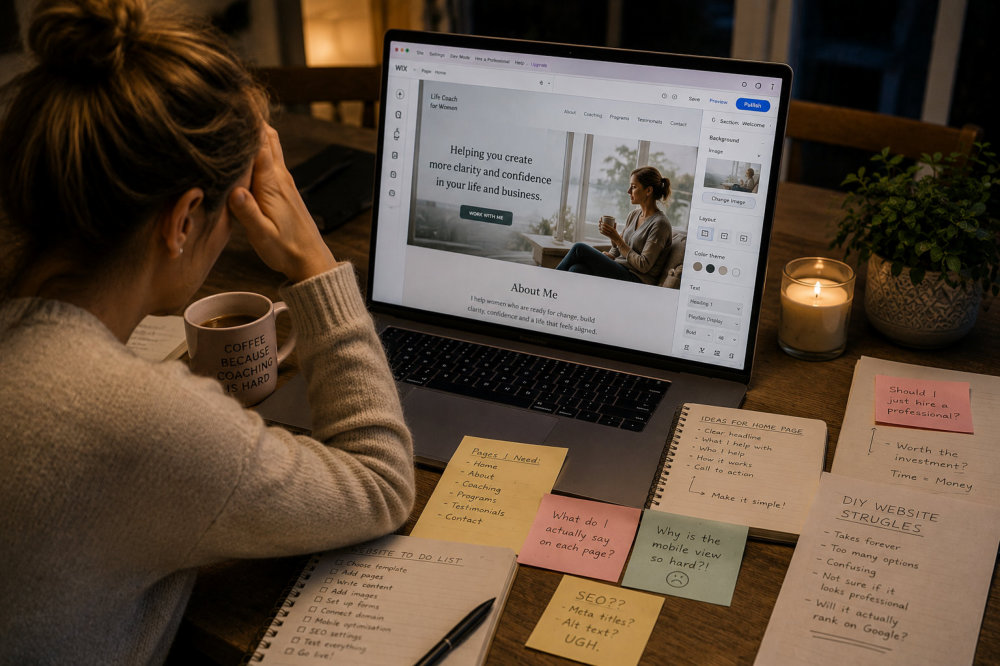
Building your own website sounds like a great idea. You’ve got the tools, the templates look good, and it feels like something you should be able to figure out.
And to be fair — you probably can.
Right up until you hit that point where something small doesn’t work… and suddenly you’re three hours deep trying to fix spacing, fonts, or a section that refuses to sit where it should.
That’s usually where things start to slow down.
Most DIY websites stall because of time, frustration, and not knowing what actually matters.
It’s not just about putting pages together. It’s about:
- knowing what pages you actually need
- figuring out what to say (and how to say it)
- making sure everything flows properly
- getting it to look right across different devices
- and then actually finishing it
That last part is the big one. Because what often happens is the website gets “almost there”… and then sits untouched for weeks or months. You tweak a few things here and there, but it never quite feels finished – and never quite feels right to share.
On the other hand, hiring a website designer isn’t just about getting a better-looking result. It’s about having someone guide the process, structure it properly, and take it from idea to something that’s actually done. You’re not starting from scratch, second-guessing every decision, or wondering if you’re missing something important.
You’re working with someone who already knows what needs to be in place – and how to bring it all together in a way that reflects your business properly.
For some people, DIY works. But for most small business owners, it comes down to this:
Do you want to spend the time figuring it all out… or would you rather have it done properly and move on?
If you’re weighing up both options, this guide on DIY vs professional website design breaks down what tends to work best in practice.
How to Know What You Actually Need (Before You Spend Anything)
Before you commit to anything, ask yourself:
- Do I just need an online presence?
- Do I need to explain my services clearly?
- Do I want my website to actually bring in enquiries?
The clearer you are on this, the easier it is to choose the right level of investment.
If you want to see what this looks like in practice, you can explore real examples from local businesses in this Northern Beaches website design portfolio.
What You Get With a Professionally Built Website
A good website isn’t just something that looks nice.
It should:
- Reflect your business properly
- Be easy for visitors to understand
- Work across all devices
- Be simple for you to manage
- Support your business as it grows
That’s what makes the difference between a website that sits there… and one you actually feel confident sharing.
So… What Should You Expect to Pay?
For most small businesses on the Northern Beaches, a realistic starting point is:
- Basic website: from around $1440
- More developed site: around $1990
- More complete build: $2520+
The right option depends on how much your website needs to do — not just how it needs to look.
Ready to Stop Putting It Off?
If your website has been sitting on your to-do list for a while, you’re definitely not the only one.
For most small business owners, it’s one of those things that keeps getting pushed back. There’s always something more urgent — client work, admin, day-to-day responsibilities — and the website ends up sitting in the background, half-done or not started at all.
And even when you do find the time, it’s rarely straightforward. You’re making decisions about structure, content, design, and functionality — often without being completely sure what actually matters or what’s worth investing in.
That’s usually the turning point. Not when the website is “perfectly planned”, but when you realise it’s easier to get it done properly than to keep circling back to it.
If you’re based on Sydney’s Northern Beaches and want a website that reflects your business properly and supports where you’re heading next, you can explore what working together looks like on our website design Northern Beaches page.
It will give you a clearer idea of what’s involved, what to expect, and how to move forward when you’re ready.

Website Designer Ivana Katz
If you’re ready to stop overthinking your website and just get it done properly, that’s where I can help.
I work with small business owners across Sydney’s Northern Beaches and beyond, creating websites that reflect your business clearly and give you something you feel confident sharing.
If you’d like to see how this could work for your business, you can explore the options and next steps on the website design Northern Beaches page.
Or if you prefer to talk it through, book a free website strategy call with me.
Frequently Asked Questions
How much does a small business website cost on the Northern Beaches?
For most small businesses, a professionally built website on the Northern Beaches will typically start from around $1440 and increase depending on what’s involved. A simpler website with a handful of pages and basic structure will sit at the lower end, while websites that require more pages, custom content, or additional features will usually fall into the $1990 to $2520+ range. The final cost isn’t just about how the website looks — it’s about how much content it needs, how it’s structured, and what it needs to do for your business.
Why is there such a big difference in website pricing?
Website pricing varies because no two businesses are exactly the same. A basic website might only need a few pages and minimal content, while another business might need multiple service pages, stronger messaging, or features like booking forms or ecommerce. The level of customisation also plays a role — some websites are built quickly using templates, while others are more carefully structured around the business. Once you understand that it’s a combination of pages, content, functionality, and planning, the difference in pricing starts to make more sense.
What’s included in a website design package?
Most website design packages include the setup of your pages, mobile responsiveness, contact forms, and the overall structure of your site. Depending on the package, this may also include help with content, images, and basic functionality. The key difference between packages usually comes down to how many pages are included, how much content support you need, and how customised the site is. It’s always worth reviewing what’s included so you understand exactly what you’re getting.
Are there ongoing costs after the website is built?
Yes, there are a few ongoing costs to keep your website running properly. These typically include your domain name, web hosting, and optional maintenance or support. These costs aren’t usually large, but they are important for keeping your website secure, updated, and accessible. Some businesses also choose to invest in content updates or marketing later on, but that’s optional and can be added as needed.
Can I build my own website instead of hiring a designer?
You can build your own website, and many people start that way. The challenge is usually not building the site itself, but finishing it and getting it to feel right. Most DIY websites stall because of time, frustration, or uncertainty about what actually matters. If you’re comfortable learning and have the time to invest, it can work. But for many business owners, it becomes something that gets delayed or never quite feels complete. Read about all the things you need to know if you want to DIY your own website.
How long does it take to build a website?
A typical small business website usually takes between one and three weeks, depending on the size of the project and how ready your content is. Simpler websites can be completed more quickly, while larger or more detailed sites take longer. Delays usually happen when content isn’t ready or when decisions change during the process, so having a clear direction from the start helps keep things moving smoothly.
Do I need SEO or marketing as well?
A website is the foundation of your online presence, but it doesn’t automatically bring traffic on its own. SEO and marketing help people find your website, but they are separate from the build itself. Some businesses start with just a website and add marketing later, while others plan both from the beginning. It really depends on your goals and how quickly you want to attract new enquiries.
 Ivana Katz from Websites 4 Small Business is an award winning web designer who builds websites that build your business. She provides unbeatable web design services to fit your budget. The end result? Professional, custom-made sites that give your business the extra oomph it needs to stand out from the competition and make an impact.
Whether you’re a brand-new business or an established one ready to improve your digital presence, Ivana makes it easy to get your business online very quickly. Her websites are professional, tailored to fit your budget, and give your business a serious boost.
Download your FREE copy of “Ultimate Website Design Secrets Blackbook – 10 Bulletproof Strategies for Designing an Outrageously Successful Website”