
Trust, Credibility & Social Proof:
The Missing Piece Behind More Conversions

This guide forms part of our complete resource on Small Business Website Conversion & Growth.

Before someone contacts you, books a call, or commits to working with you, they need to trust you.

This is one of the most overlooked parts of website performance. Many businesses focus on design, content, or traffic, but underestimate how much trust influences whether a visitor takes action.

Even if your service is strong, a lack of credibility or reassurance can stop users from moving forward. Small signals, both positive and negative, shape how your business is perceived within seconds.

You’ll learn what builds trust on a website, how to use testimonials effectively, and which signals actually influence decisions. More importantly, you’ll see how to remove doubt and create confidence at the moments that matter most.

If your website is not converting as well as it should, trust is often the missing piece.

Trust, credibility and social proof

Why Trust Matters More Than Design

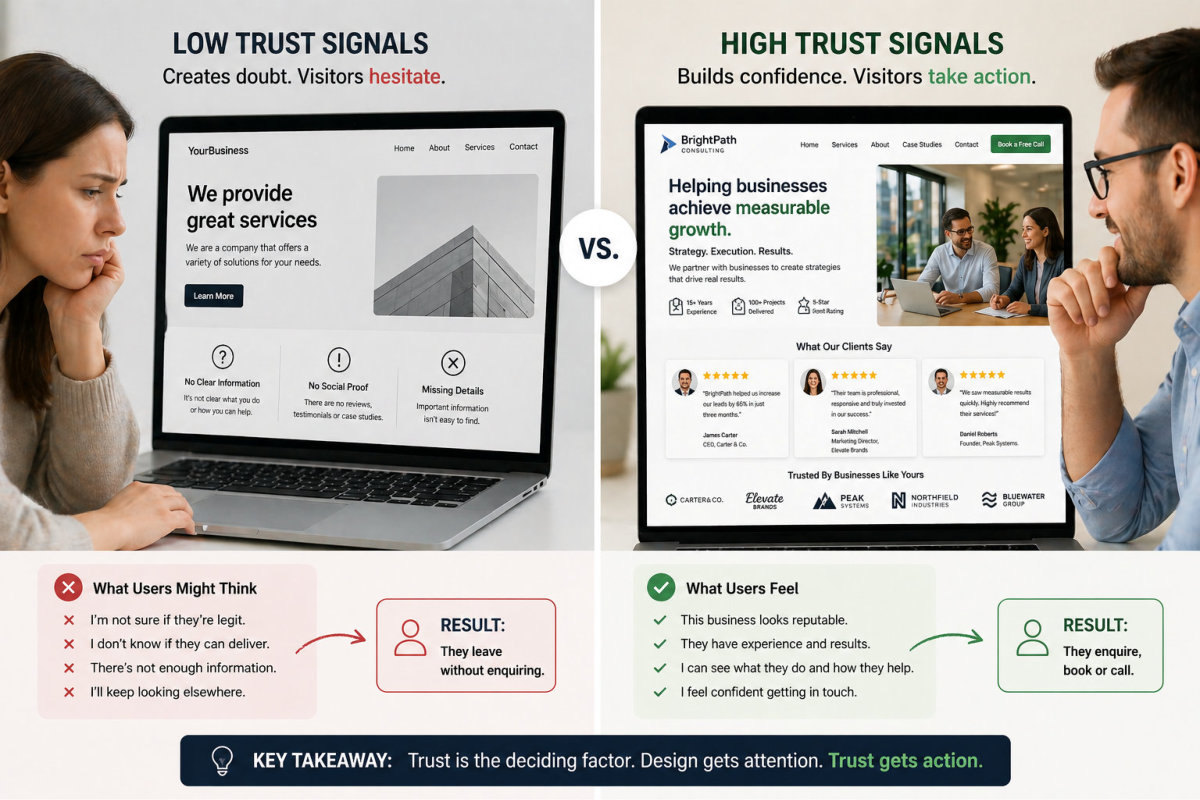
Design Attracts Attention, Trust Drives Action

A well-designed website can capture attention, but it is not what ultimately drives someone to take action. Visitors may appreciate how a website looks, but that alone is not enough to convince them to enquire, book, or commit.

Trust is what turns interest into action. Without it, even the most visually appealing website will struggle to convert. Users need to feel confident that your business is credible, reliable, and capable of delivering what it promises.

This is why design should support trust rather than replace it. A clean, professional layout creates a positive first impression, but it is the substance behind it that influences decisions.

When trust is missing, users hesitate, delay, or leave entirely.

How Visitors Make Trust Decisions Quickly

Trust is not built slowly over time on a website. It is often formed within seconds. Visitors scan your pages, looking for signals that indicate whether your business is legitimate and worth their attention.

This includes visual cues, messaging clarity, structure, and the presence of proof. Small details such as outdated content, inconsistent design, or missing information can quickly create doubt.

On the other hand, clear messaging, professional presentation, and strong supporting content create confidence almost immediately.

Understanding how quickly these decisions are made helps you prioritise the elements that matter most.

Why trust matters on a website

The Role of Credibility in Conversion

Credibility is what reassures users that your business can deliver results. Without it, even interested visitors may choose not to take the next step.

This is especially important for service-based businesses, where the outcome is not immediately visible. Users are making a decision based on perception, which is shaped by the information and signals on your website.

Elements such as testimonials, case studies, and clear explanations of your process all contribute to building credibility.

If your website lacks these elements, it creates uncertainty that can reduce conversions.

To explore this further, Building Unshakeable Trust: How Your Website Becomes Your Most Powerful Credibility Tool breaks down how trust is developed through your website.

Why “Looking Professional” Is Not Enough

Many businesses assume that a professional-looking website is enough to build trust. While this is important, it only addresses part of the problem.

Users are not just evaluating how your website looks. They are evaluating whether they believe what you are saying and whether they feel confident in your ability to deliver.

This requires more than design. It requires clear communication, relevant proof, and a structure that supports decision-making.

A visually strong website without these elements may attract attention but fail to convert.

Trust as the Foundation of Every Other Element

Trust influences every part of your website. Your calls to action, content, landing pages, and enquiry process all depend on whether the user feels confident enough to proceed.

Without trust, even well-written content and strategically placed calls to action will underperform. Users may read, understand, and still choose not to act.

This is why trust should not be treated as a separate element, but as a foundation that supports everything else.

If your website is not generating consistent enquiries, it is often worth reviewing how trust is being built across your pages. How to Establish Credibility and Expertise on Your Website provides practical ways to strengthen this foundation.

Why trust matters

What Builds Trust on a Website (Real Examples)

Testimonials That Feel Genuine and Specific

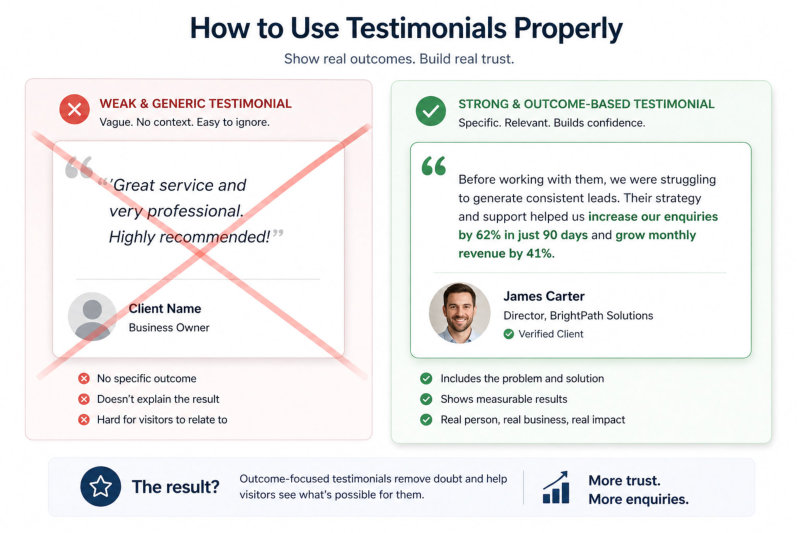
Testimonials are one of the most powerful trust signals on a website, but only when they feel real and specific. Generic statements such as “great service” or “highly recommended” have limited impact because they do not provide meaningful insight.

Strong testimonials describe the experience, the problem that was solved, and the result achieved. This helps potential clients see themselves in the situation and understand the value of your service.

Placement also matters. Testimonials should be integrated throughout your website rather than placed in a single section. This ensures they support the user journey at multiple decision points.

If you want to strengthen this area, The Power of Testimonials – What You Need To Know explains how to use them effectively, while How to Film Engaging Video Testimonials Remotely shows how to take this even further.

Clear About Page That Builds Connection

Your About page is often one of the most visited pages on your website, and it plays a key role in building trust. Visitors want to understand who they are dealing with, what your background is, and why they should feel confident choosing you.

A strong About page goes beyond basic information. It tells a story, explains your approach, and helps users connect with your business on a more personal level.

This is especially important for service-based businesses where relationships and trust are central to the decision-making process.

If your About page feels generic or underdeveloped, it can weaken your overall credibility. How To Design An “About Us” Page That Cultivates Consumer Trust provides a clear framework for improving it.

Trust Signals and Visual Credibility Cues

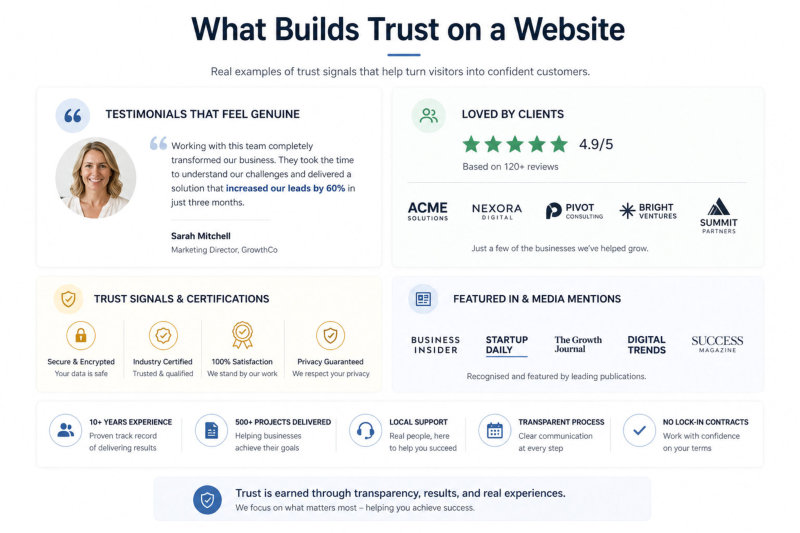
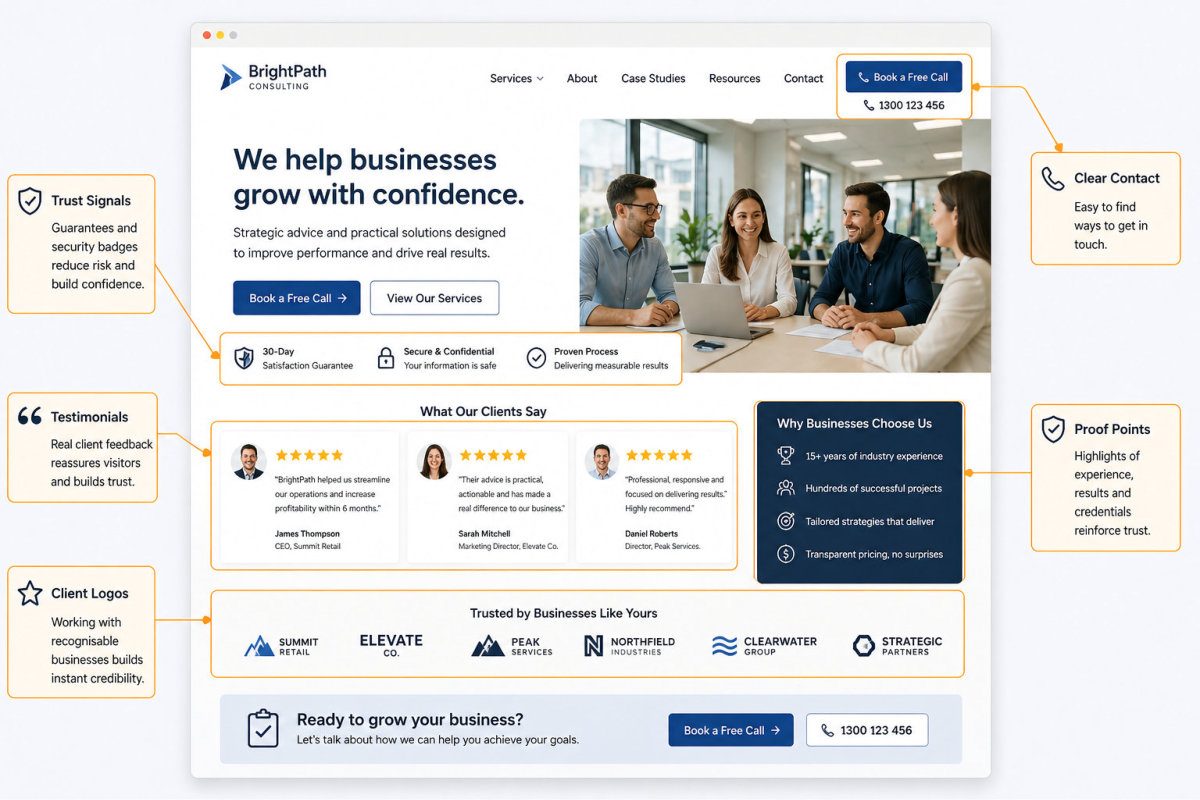
Trust signals are small but important elements that reinforce credibility. These include trust icons, certifications, memberships, media logos, and any visual indicators that show your business is legitimate and recognised.

While each individual element may seem minor, together they create a stronger overall impression. They help reduce doubt and provide reassurance that your business operates professionally.

These signals should be used strategically rather than excessively. Too many can feel overwhelming, while too few can leave gaps in credibility.

To understand how these elements work in practice, Trust Icons – Best Way to Boost Your Website’s Credibility explains how to use them effectively.

Media Mentions and External Validation

Being featured in media, publications, or recognised platforms adds a strong layer of credibility because it shows that your business has been acknowledged by external sources.

This type of validation is powerful because it is not self-generated. It provides an additional level of trust that goes beyond what you say about your own business.

Media mentions can be displayed through logos, quotes, or links to featured articles. Even a small number of credible mentions can have a significant impact.

If you have any form of external recognition, it should be visible on your website. Media Mentions – The Secret Weapon for Building Trust and Authority explores how to use this effectively.

Consistent Content That Demonstrates Expertise

Trust is also built through the content you create. When your website consistently provides useful, relevant information, it positions your business as knowledgeable and reliable.

This includes blog posts, guides, and educational content that helps your audience understand their challenges and potential solutions. Over time, this builds authority and reinforces credibility.

Consistency is key. A website with a few outdated articles does not create the same level of trust as one that is regularly updated with valuable insights.

If you want to strengthen this area, How Coaches and Consultants Can Build Authority Online in 2025 outlines how to use content to build long-term credibility.

For a broader view, Top Valuable Ways To Boost Your Business Credibility highlights additional strategies that can be applied across your website.

How to Use Testimonials Properly

Using Testimonials That Show Real Outcomes

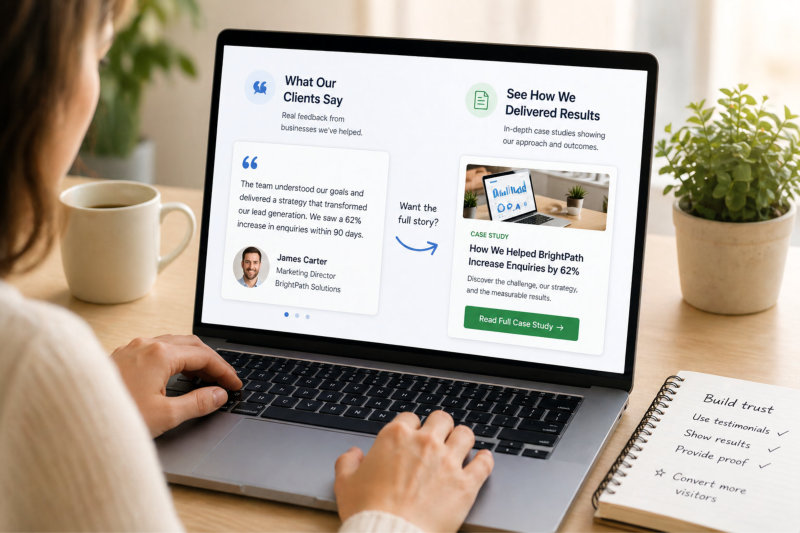
Testimonials are most effective when they go beyond general praise and clearly demonstrate the outcome of your service. Visitors are not just looking for reassurance that someone was happy, they want to understand what actually changed as a result of working with you.

A strong testimonial highlights the problem the client faced, the experience of working with you, and the result they achieved. This gives context and makes the testimonial more relatable to potential clients.

When testimonials include specific details, they feel more credible and useful. They help visitors see how your service applies to their own situation.

Generic testimonials, on the other hand, tend to be overlooked because they do not add meaningful insight.

Placing Testimonials Throughout the Website

One of the most common mistakes is grouping all testimonials on a single page and expecting users to navigate there. While having a dedicated testimonials page is useful, it should not be the only place they appear.

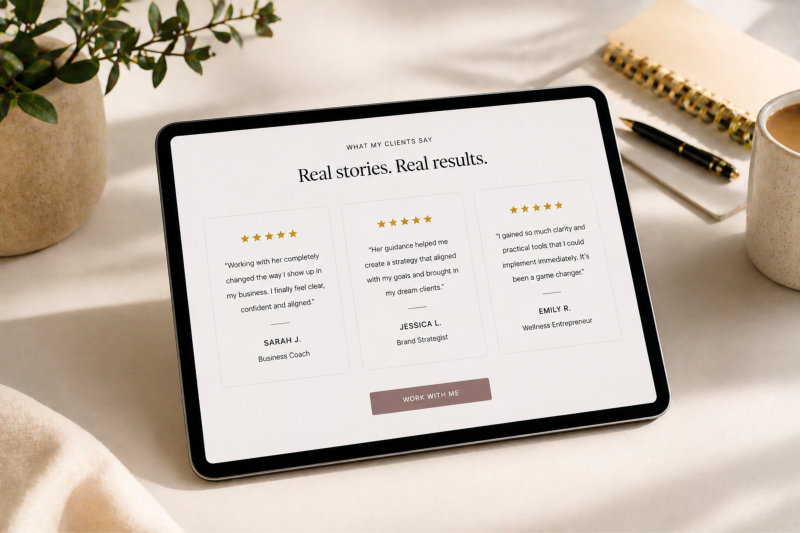
Testimonials should be placed strategically throughout your website, particularly on service pages, landing pages, and key decision points. This allows them to support the user journey at the moment they are most needed.

For example, placing a testimonial directly after explaining a service helps reinforce credibility at that exact point in the decision process.

This approach makes testimonials more impactful because they are seen in context rather than in isolation.

How to use testimonials properly on a website

Matching Testimonials to Relevant Services

Not all testimonials are equally relevant to every page. A testimonial about one service may not carry the same weight when placed on a page promoting something different.

Where possible, testimonials should be matched to the specific service or offering being presented. This creates stronger alignment and makes the message more convincing.

When users see proof that directly relates to what they are considering, it reduces doubt and increases confidence.

This level of relevance helps move users closer to taking action.

Using Different Formats to Strengthen Credibility

Testimonials can be presented in different formats, and using a mix of these can strengthen their impact. Written testimonials are common, but video testimonials, case studies, and detailed client stories often carry more weight.

Video testimonials, in particular, add a layer of authenticity because users can see and hear real clients sharing their experience. This makes the message feel more genuine and harder to dismiss.

Even simple variations in format can make your testimonials more engaging and memorable.

If you want to expand this further, How to Film Engaging Video Testimonials Remotely shows how to create more compelling testimonial content.

Avoiding Common Testimonial Mistakes

Testimonials can lose their effectiveness when they are poorly presented or overused. Common mistakes include using anonymous quotes, outdated feedback, or testimonials that are too short to be meaningful.

Another issue is overloading pages with too many testimonials, which can reduce their impact and make them feel repetitive.

It is more effective to use a smaller number of strong, relevant testimonials than to include a large volume of weak ones.

If your testimonials are not contributing to conversions, it may be worth reviewing how they are written, placed, and structured. 18 Ways to Prove Your Credibility and Convert Visitors into Paying Customers provides additional ideas for strengthening trust across your website.

Case Studies vs Testimonials: What’s Better

Understanding the Difference Between Testimonials and Case Studies

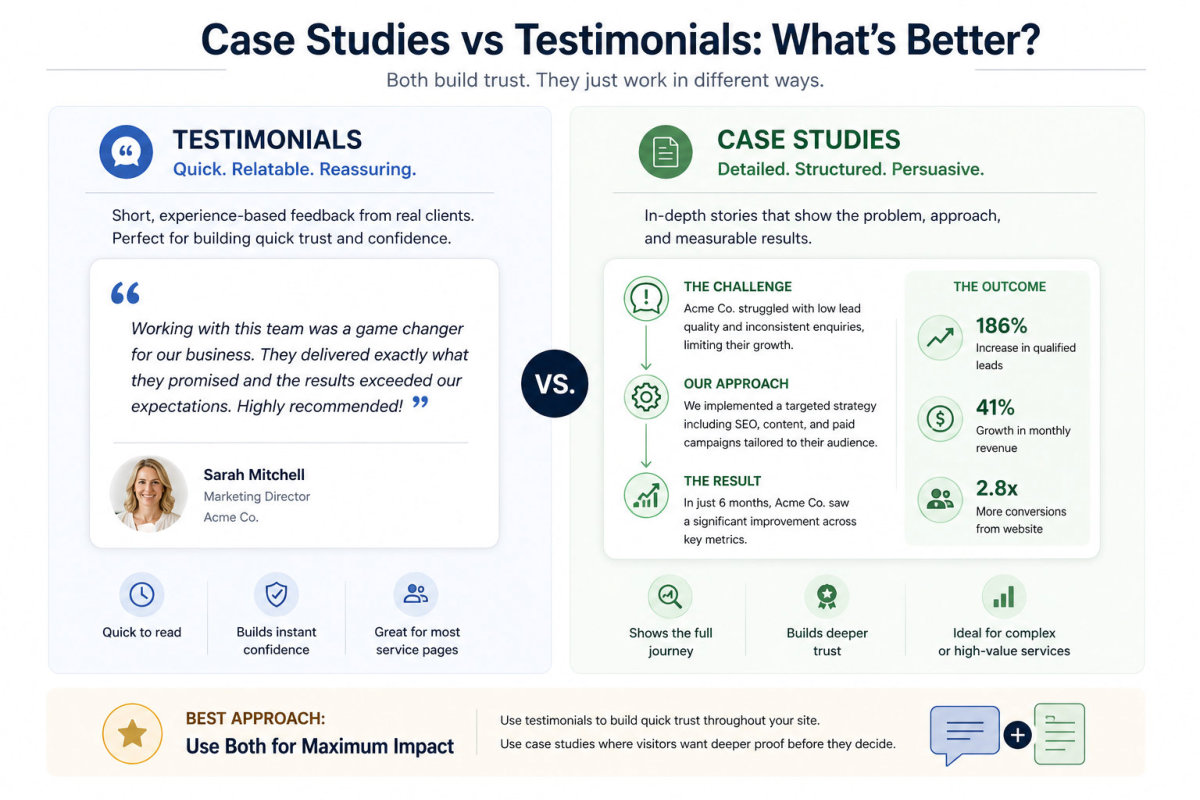
Testimonials and case studies both build trust, but they serve different purposes. Testimonials provide quick, experience-based feedback from clients, while case studies offer a deeper, structured look at how your service delivered results.

A testimonial is usually short and focused on the client’s experience. A case study goes further by outlining the problem, the approach taken, and the outcome achieved.

This additional detail makes case studies more informative and often more persuasive, particularly for higher-value or more complex services.

Understanding the role of each helps you use them more effectively across your website.

When Testimonials Are Enough

Testimonials work well when the decision is relatively straightforward and users are looking for reassurance rather than detailed proof. They are quick to read and easy to scan, making them effective at supporting the user journey without slowing it down.

For many service-based businesses, testimonials provide enough credibility to help users feel confident taking the next step.

They are particularly useful when placed throughout service pages, landing pages, and key sections where users are deciding whether to enquire.

When used correctly, testimonials reinforce trust without requiring significant time or effort from the user.

When Case Studies Become More Powerful

Case studies are more effective when the decision requires a higher level of trust or when the service involves a more significant investment. In these situations, users often want to see detailed examples of how your service works in practice.

A well-structured case study shows the full journey, including the client’s initial challenge, the steps taken, and the final result. This level of detail helps potential clients understand what to expect and how your service can apply to their own situation.

Case studies also demonstrate expertise, as they show not just what you did, but how you approached the problem.

This makes them particularly valuable for building confidence in more complex or high-value services.

Case studies vs testimonials

Using Both Together for Maximum Impact

The most effective websites use a combination of testimonials and case studies rather than choosing one over the other. Testimonials provide quick, accessible proof, while case studies offer deeper validation for users who need more information.

This layered approach allows you to cater to different types of users. Some will be ready to act after reading a testimonial, while others will want to explore a case study before making a decision.

By offering both, you create a more complete trust-building system that supports the entire user journey.

This combination strengthens credibility and improves conversion rates across your website.

Presenting Proof in a Way That Supports Conversions

Whether you are using testimonials, case studies, or both, how you present them is just as important as the content itself. They should be easy to find, clearly structured, and relevant to the page they appear on.

Testimonials can be integrated into key sections, while case studies can be linked or featured where users are likely to seek more detailed information.

The goal is to support decision-making without overwhelming the user. Too much information can be just as ineffective as too little.

If you are looking to strengthen how proof is presented across your website, 44 Powerful Ways to Build Trust With Your Visitors highlights additional strategies that can be applied alongside testimonials and case studies.

Case studies vs testimonials

Trust Signals That Instantly Increase Credibility

Visual Cues That Reinforce Professionalism

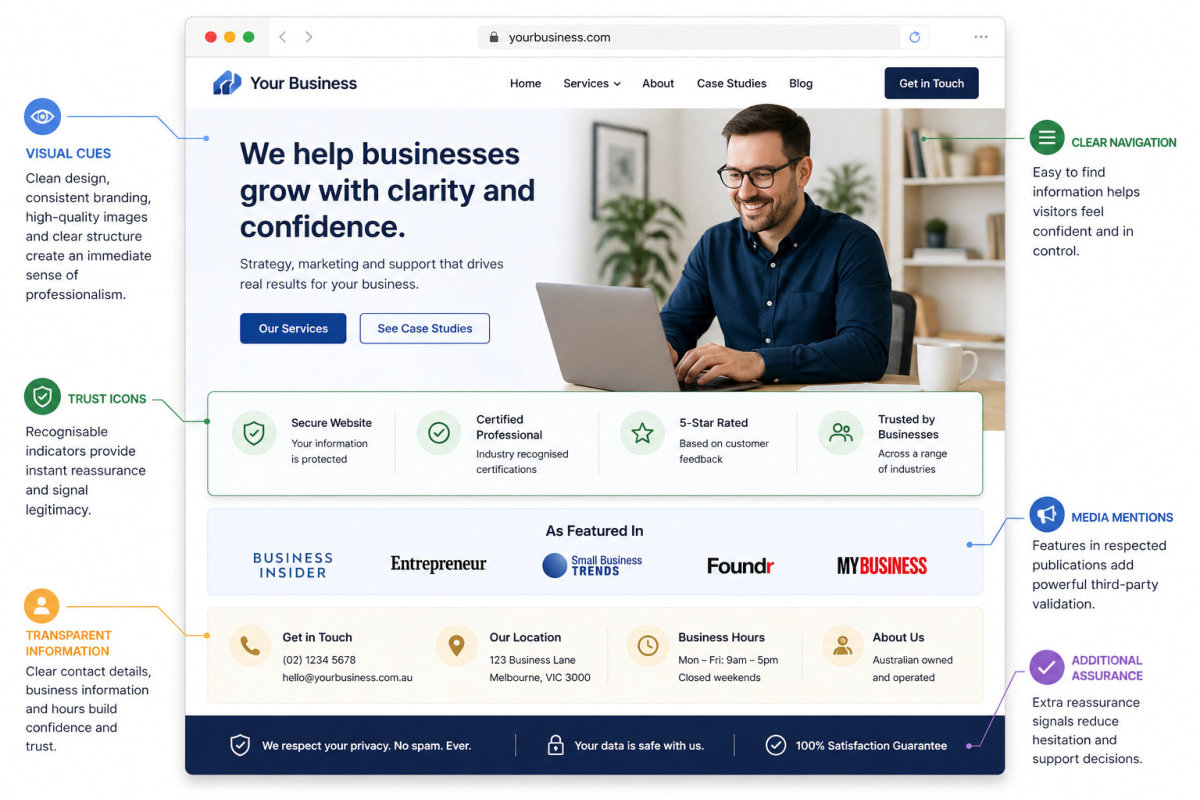
Visitors often make quick judgements based on visual cues before they fully engage with your content. Clean design, consistent branding, high-quality images, and clear structure all contribute to an immediate sense of professionalism.

While these elements may seem basic, they play a critical role in shaping first impressions. A website that looks outdated, inconsistent, or poorly structured can create doubt before a user even reads a word.

Professional presentation does not need to be complex, but it does need to feel intentional and well executed.

When the visual experience feels polished and consistent, it supports the perception that your business is credible and trustworthy.

Trust Icons and Recognisable Indicators

Trust icons are small but powerful elements that signal legitimacy. These may include security badges, certifications, professional memberships, or logos of tools and platforms you use.

They work because they provide quick, recognisable reassurance. Users do not need to analyse them in detail, they simply register that your business is established and operates within known standards.

However, these elements should be used thoughtfully. Overloading a page with too many icons can reduce their impact and make the page feel cluttered.

When used correctly, they quietly reinforce credibility without distracting from the main message. Trust Icons – Best Way to Boost Your Website’s Credibility explains how to apply these effectively.

Trust signals that increase credibility

Media Mentions and External Recognition

External validation is one of the strongest forms of trust. When your business has been featured in media, publications, or recognised platforms, it adds credibility that goes beyond what you say about yourself.

This type of recognition shows that others have acknowledged your expertise or value, which helps reduce doubt for potential clients.

Media mentions can be displayed through logos, links, or short references to where your business has been featured. Even a small number of credible mentions can make a significant difference.

If you have any form of external recognition, it should be visible. Media Mentions – The Secret Weapon for Building Trust and Authority explains how to use this effectively.

Consistency Across Pages and Content

Trust is reinforced when your website feels consistent. This includes consistent messaging, tone, design, and structure across all pages.

If users encounter conflicting information, inconsistent design elements, or unclear messaging, it creates friction and reduces confidence.

Consistency helps users feel that your business is organised and reliable. It also makes the overall experience easier to navigate and understand.

Even small inconsistencies can have an impact, particularly when users are already evaluating whether to trust your business.

Clear and Transparent Information

Transparency is another key trust signal. Visitors want to know who they are dealing with, how your service works, and what they can expect.

This includes clear contact details, visible business information, and straightforward explanations of your services. Hidden or unclear information can create suspicion and hesitation.

Transparency does not mean overwhelming users with detail, but it does mean providing enough information to support confident decision-making.

If you want to strengthen transparency and credibility across your website, Building Unshakeable Trust outlines how these elements work together to build confidence.

Trust and credibility signals on a website

Common Trust Mistakes That Cost You Enquiries

Looking Professional but Saying Nothing Meaningful

One of the most common mistakes is relying on design to do all the work. A website may look clean and modern, but if the messaging is vague or generic, it fails to build real trust.

Visitors are not just evaluating how your website looks. They are trying to understand what you do, how you work, and whether you can help them. If that information is unclear, design alone will not compensate for it.

This often happens when businesses use broad statements that could apply to anyone, rather than clearly communicating their specific value.

Without meaningful content, users may leave with a positive impression but no reason to take action.

Hiding or Underusing Testimonials and Proof

Many websites have testimonials but fail to use them effectively. They are often hidden on a separate page or placed in areas where they are unlikely to be seen.

This reduces their impact significantly. Testimonials should support the user journey at key decision points, not sit in isolation.

Another issue is using weak or outdated testimonials that do not reflect current services or results. This can create doubt rather than confidence.

Making proof more visible and relevant is one of the simplest ways to improve trust and increase enquiries.

Overloading Pages with Too Much Information

While providing information is important, too much content can have the opposite effect. When users are faced with large blocks of text or too many competing messages, it becomes harder to focus.

This can lead to confusion and reduce trust, particularly if the key points are not clear.

Effective websites present information in a structured and digestible way, making it easy for users to understand what matters most.

Clarity builds confidence, while overload creates hesitation.

Treating Trust as an Afterthought Instead of a Strategy

Many businesses assume that trust will naturally develop once their website is live. In reality, trust needs to be built intentionally through every part of the user experience.

When trust is not considered as part of the overall strategy, it often appears inconsistent or incomplete. Important signals may be missing, or they may not be placed where they have the most impact.

This can create uncertainty, even if the service itself is strong. Visitors may not feel confident enough to take the next step simply because the right reassurance is not there at the right time.

Building trust requires a structured approach, where messaging, proof, and user experience all work together. When done well, it creates a more confident and seamless journey that supports both engagement and enquiries.

Inconsistent Messaging Across the Website

Trust is weakened when different parts of your website feel disconnected. This might include changes in tone, conflicting information, or inconsistent descriptions of your services.

Users notice these inconsistencies, even if they cannot immediately identify them. It creates a subtle sense that something is not quite right.

A consistent message across all pages reinforces credibility and makes your business feel more reliable.

This requires aligning your content, structure, and calls to action so they all support the same narrative.

Lack of Transparency and Clear Information

When important information is missing or difficult to find, users may become hesitant. This includes unclear pricing, vague service descriptions, or limited contact details.

Transparency builds confidence by helping users understand what to expect. Without it, they may feel uncertain about taking the next step.

This does not mean you need to provide every detail upfront, but it does mean giving users enough clarity to feel comfortable engaging with your business.

If your website is not generating the level of trust you expect, How to Establish Credibility and Expertise on Your Website outlines practical ways to address these gaps.

Frequently Asked Questions

Trust is built through a combination of clear messaging, professional design, and strong proof. This includes testimonials, case studies, trust signals, consistent content, and transparent information about your business. Visitors need to feel confident that you are credible and capable of delivering results before they take action.

Testimonials provide social proof, showing that other clients have had a positive experience with your business. They help reduce uncertainty and make your service feel more reliable. When testimonials include specific outcomes and are placed strategically throughout your website, they can significantly improve conversion rates.

Testimonials should be placed throughout your website, not just on a single page. Key areas include service pages, landing pages, and sections where users are deciding whether to take action. This allows testimonials to support the user journey at the moments where trust is most important.

Trust signals are elements that help reassure visitors that your business is legitimate and credible. These can include trust icons, certifications, media mentions, client logos, testimonials, and clear contact information. While small individually, they work together to strengthen overall confidence.

Case studies are not always essential, but they can be very powerful for building deeper trust, especially for higher-value services. While testimonials provide quick reassurance, case studies show detailed examples of how your service works and the results it delivers. Using both creates a stronger overall credibility strategy.

A professional design is only one part of the equation. If your messaging is unclear, your proof is weak, or your user journey is not well structured, visitors may not feel confident enough to take action. Trust is built through content, structure, and credibility, not just appearance.

Some of the quickest improvements include adding stronger testimonials, making your About page more personal and clear, improving transparency around your services, and ensuring your messaging is consistent. Even small changes in these areas can have a noticeable impact on how your website performs.

Trust primarily impacts conversions, but it can also support SEO indirectly. When users stay longer, engage with your content, and navigate through your site, it sends positive signals to search engines. A trustworthy website also attracts more backlinks and referrals over time.

Building Confidence That Leads to Action

Trust is one of the most important factors in whether your website generates enquiries. Without it, even well-designed pages and strong content can struggle to convert.

Visitors are constantly evaluating whether they feel confident in your business. This decision is shaped by what they see, what they read, and how your website presents your expertise.

By using testimonials, trust signals, clear messaging, and consistent content, you create an environment where users feel reassured and supported in their decision-making.

Small improvements in these areas can have a significant impact on how your website performs. Often, it is not about adding more, but about strengthening what is already there.

If you want a website that not only looks professional but also builds trust and supports real business growth, you can explore our website design services.

You can also explore practical strategies and step-by-step resources here: Guides.

When your website builds confidence at every step, enquiries become a natural outcome rather than a challenge.

Ready to Build or Redesign Your Website?

If you’re reading this and thinking, “This explains exactly what’s wrong with my site,” you’re not alone.

Most small business websites don’t fail because of effort. They fail because they were built without a clear structure, proper planning or long-term thinking.

If you want a website that reflects your business properly, feels organised, and gives you confidence to send people to it, then it might be time for a proper redesign or rebuild.

You can see how I approach website projects here:

Website Design Services for Small Business

View recent website design projects

Whether you’re starting from scratch or improving what you already have, the goal is the same – clarity, structure and a site you’re proud to share.

Ivana Katz - Website designer