
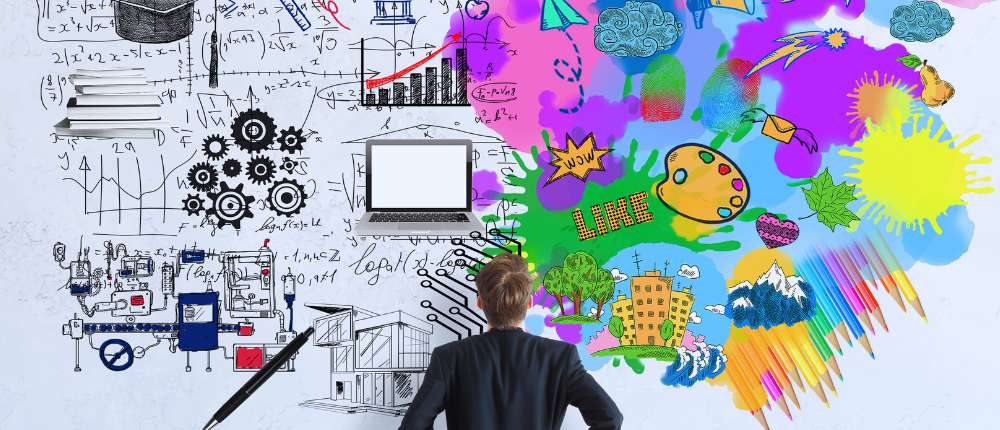
AI Powered Efficiency vs Human Creativity: What’s Best for Your Business?
AI is revolutionising how businesses operate, automating tasks, analysing data, and scaling processes with unprecedented speed. Meanwhile, human creativity remains vital for brand storytelling, emotional engagement, and innovation. The real question isn’t whether AI or creativity is superior but how businesses can integrate both for maximum impact.
Therefore, this article explores how small businesses can strike the right balance, using AI to enhance productivity without losing the unique creative spark that sets them apart.
How AI Has Transformed Digital Marketing, Customer Service, and Operational Efficiency
AI is no longer a futuristic concept—it’s a practical tool reshaping how businesses function in the following ways:
Automating Repetitive Tasks
AI-powered automation simplifies these time-consuming tasks, enabling small businesses to handle repetitive work with minimal human intervention. For example, AI-powered transcription services convert audio and video content into accurate, searchable text, saving significant time.
Further, you can find transcription specialists for every industry, ensuring high-quality documentation that meets specific needs, whether for legal proceedings, medical records, or corporate meetings. On top of that, AI-driven chatbots and automated email responses ensure customers receive instant answers, reducing wait times and improving satisfaction.
Virtual assistants enhance customer service further by managing tasks such as order tracking, appointment scheduling, and FAQ responses. It reduces the need for constant human monitoring while maintaining engagement with customers.
Another area that needed automation was scheduling. Hence, AI-powered scheduling tools assist with meeting coordination, appointment setting, and workflow management. These tools analyse availability, send reminders, and adjust schedules dynamically, ensuring seamless business operations.
Data-Driven Decision-Making
AI is revolutionising how businesses analyse data, making it easier to gain insights, predict trends, and optimise decision-making. For example, AI tools track and analyse customer interactions, identifying patterns that help businesses refine their marketing strategies. It allows businesses to understand purchasing behaviours, predict customer needs, and personalise marketing efforts to increase engagement.
AI also improves marketing performance tracking by analysing campaign results across multiple platforms. It identifies which strategies yield the best results, helping businesses refine their efforts, improve ad targeting, and maximise return on investment.
Scaling Content Production Efficiently
AI helps businesses scale content creation without sacrificing quality, ensuring they maintain a strong digital presence. For instance, AI-powered writing tools assist with generating drafts, suggesting topics, and optimising content for SEO. AI can also generate ad copy and automate social media scheduling, ensuring businesses maintain a consistent online presence while targeting their ideal audience. Additionally, an AI orchestration platform like Nexos.ai enables businesses to streamline multiple content creation processes, centralising tools for content generation, optimisation, and distribution.
Further, personalised content recommendations enhance engagement by tailoring messages to individual users. AI tracks customer interactions and suggests relevant content, improving email marketing, eCommerce strategies, and customer retention.
The Strength of Human Creativity in Business
While AI enhances efficiency and scalability, it lacks the depth of human creativity. Thus, human creativity has an irreplaceable role in the following areas:
Brand Storytelling and Emotional Engagement
AI can generate text but cannot truly understand emotions, cultural contexts, or the subtleties of human experience. Thus, a brand’s voice and personality must feel authentic, resonating with its audience on a deeper level.
Consider marketing campaigns that have gone viral due to their emotional impact. The best advertisements and content strategies tap into shared human experiences, whether nostalgia, humour, or social values. AI can assist in structuring content, but the essence of storytelling requires human insight.
Innovative Problem-solving and Adaptability
AI operates within predefined parameters, relying on past data to make predictions and generate outputs. It excels at pattern recognition and optimisation but cannot think outside the box. Businesses that depend entirely on AI for decision-making risk stagnation, as AI cannot challenge norms, take creative risks, or envision groundbreaking ideas.
Innovation often comes from human intuition, trial and error, and spontaneous inspiration. Hence, whether a business is developing a new product, responding to unexpected market shifts, or crafting a unique marketing campaign, it needs human creativity. AI can assist research and data analysis, but strategic thinking and creative execution require human input.
Personalised Customer Experience and Trust
AI-powered chatbots and automated emails can handle essential customer interactions but may fail to deliver genuine, empathetic communication.
For example, while AI can predict customer preferences based on data, it cannot replicate the warmth and authenticity of a personalised response from a skilled customer service representative. Businesses that rely too heavily on automation may alienate customers who seek meaningful engagement. Personalisation is more than just inserting a customer’s name into an email—it’s about understanding their unique needs and responding in a way that feels human.
The Limitations of AI-generated Content
AI-generated content can speed up production but often lacks originality because many AI tools pull from existing data. Thus, AI-generated content that lacks human oversight can feel formulaic, repetitive, or even incorrect. Tools like Undetectable AI help bridge this gap by transforming AI-generated drafts into natural, human-sounding text while preserving the original meaning.
AI can assist with content creation, but human writers, designers, and marketers ensure that messaging is distinct, culturally relevant, and emotionally engaging.
AI also struggles with understanding context, cultural nuances, and the subtleties of human communication. Language is complex, and the words or phrases can carry different meanings depending on cultural background, regional dialects, or situational context. AI models, which rely on pre-existing datasets, often fail to interpret these variations accurately.
Sarcasm and humour are particularly difficult for AI to grasp. Many marketing campaigns use playful language or irony to engage audiences, but AI-generated content often misinterprets these tones, leading to awkward or inappropriate messaging. Similarly, AI can misuse idiomatic expressions when it does not fully understand the cultural context in which to use them.
Thus, brands that target global audiences must be especially cautious when using AI-generated content. What resonates in one market may be ineffective or even offensive in another. Human oversight is necessary to maintain authenticity and avoid costly missteps.
Actionable Steps to Integrate AI Without Losing Creativity
Use AI for Insights, but Let Humans Shape the Message
AI-powered analytics tools provide deep insights into customer preferences, market trends, and content performance. However, data alone doesn’t drive engagement—storytelling and authenticity do. Businesses should use AI to gather information but rely on human creativity to craft compelling narratives.
Automate Routine Tasks to Free Up Creative Time
Repetitive tasks such as scheduling and customer inquiries consume valuable time needed for high-level creative work. Data entry is another time-consuming task to automate with AI-powered systems that extract, categorise, and process information with high accuracy.
Leverage AI for Content Assistance, Not Content Creation
AI tools can analyse trending keywords, suggest headlines, and structure articles, but relying on automation for full content creation risks producing generic, uninspired material. Hence, businesses should use AI to assist, not replace, human creativity.
Writers can leverage AI for drafting outlines, summarising information, or repurposing existing content, but editing and storytelling should remain in human hands. AI can also enhance content distribution by optimising publishing schedules and tailoring recommendations, but final decisions should align with strategic goals rather than algorithmic suggestions alone.
Personalise Customer Interactions with a Human Touch
AI can personalise interactions by analysing customer data, but human input ensures these interactions feel authentic. Hence, businesses should use AI to segment audiences, predict preferences, and automate initial responses while allowing human oversight to refine messaging. Further, review and adjust AI-generated recommendations to align with brand voice and customer needs.
Chatbots and automated emails can handle common inquiries, but businesses should make it easy for customers to reach a real person when needed. As such, AI can triage requests, directing complex issues to human representatives who can provide thoughtful, personalised support. This balance prevents automation from feeling impersonal or frustrating.
Test and Refine AI-human Collaboration
Simply implementing AI tools is not enough. Thus, businesses must regularly assess how well AI and human creativity work together. Testing different approaches helps identify where AI adds value and when human oversight remains essential. Rather than assuming AI will always produce the best results, businesses should compare AI-generated content, customer interactions, and marketing strategies against human-led efforts to evaluate their effectiveness.
Gathering feedback from employees and customers is crucial. Employees who interact with AI tools daily can provide insights into what improves efficiency and what disrupts workflow. On the other hand, customers may notice when automation feels impersonal or ineffective.
On top of that, as AI evolves, businesses should remain flexible, adjusting strategies based on new capabilities and challenges.
Train Teams to Work Alongside AI, Not Against It
Many businesses struggle with AI adoption because their teams resist automation, often due to fear of job loss or a lack of understanding. Therefore, the key to successful integration is training employees to work alongside AI rather than against it.
Businesses should start by educating employees on AI’s role, clarifying that it automates repetitive tasks but does not replace human creativity or strategic thinking. Further, practical training sessions help teams become comfortable using AI tools for data analysis, content optimisation, or customer engagement. The hands-on experience allows employees to see AI as a support system rather than a rigid replacement.
Encouraging collaboration in AI adoption fosters a sense of ownership, making employees more likely to embrace automation.
Adopt AI Within Budget Constraints
Adopting AI can significantly improve business efficiency, but cost is a barrier for many small businesses. High-end AI solutions require substantial investment, from purchasing software and integrating AI systems to ongoing training and maintenance. Many advanced AI tools also attract subscription fees, data storage costs, and customisation expenses.
Yet, return on investment (ROI) depends on how effectively businesses implement AI. Therefore, a well-planned AI strategy involves identifying which processes benefit most from automation and starting with cost-effective solutions before scaling up.
Affordable AI options exist in customer service, marketing automation, and content assistance. Many platforms offer free or low-cost AI-powered tools that small businesses can integrate gradually. Cloud-based AI services also allow small businesses to access powerful AI capabilities without heavy upfront investments in infrastructure.
Conclusion
The most successful businesses see AI and creativity as complementary assets, not opposing forces. As such, small businesses can achieve the best of both worlds by integrating AI strategically—using it for automation, insights, and assistance while keeping human oversight at the core. In addition, businesses should continuously evaluate AI’s impact, refining its role to ensure it enhances rather than diminishes creativity and customer engagement.
***************
Tania Nichols