

Why Website Migrations Are High-Risk SEO Events
Website migrations are among the most complex and risk-sensitive initiatives in digital marketing. Whether you are changing domains, redesigning architecture, moving to a new CMS, consolidating subdomains, or performing a large-scale replatforming, the margin for error is extremely small. A poorly executed migration can result in traffic drops, lost rankings, indexing chaos and long-term revenue damage.
This is why a structured, technically sound website migration checklist approach is critical for SEO. The Migration Checklist developed by JetOctopus provides a comprehensive, data-driven framework for managing the entire website migration process – from preparation and pre-launch validation to post-migration monitoring and recovery.
Below is a detailed summary of how JetOctopus supports SEOs and marketing managers at every stage of a website migration project plan.
A site migration process affects nearly every SEO signal:
- URL structure
- Internal linking
- Redirect logic
- Canonicalization
- Crawl budget allocation
- XML sitemaps
- Indexation signals
- Page speed and technical performance
Even small inconsistencies – such as missing redirects or accidental noindex tags – can cause search engines to drop pages from the index or reassign ranking signals incorrectly.
The key to a successful website migration plan is visibility and control. You must understand:
- What exists before migration
- What changes during migration
- What breaks after migration
This is where JetOctopus becomes essential. As an enterprise-level seo crawler, it provides deep crawl data, log file analysis and technical monitoring to protect organic traffic before, during and after migration.
Below is an expanded checklist for website migration, structured around how JetOctopus supports each phase of a website migration SEO checklist.
1. Pre-Migration Benchmarking and Data Collection
Before any migration website checklist execution begins, you must establish a baseline.
JetOctopus helps you:
- Crawl the entire existing site to create a full URL inventory.
- Identify indexable vs. non-indexable pages.
- Map status codes (200, 301, 404, 500).
- Detect canonical conflicts.
- Analyze internal link depth and structure.
- Capture metadata, hreflang, pagination and structured data.
- Extract page performance metrics.
- Analyze log files to understand how search engines currently crawl the site.
This baseline becomes your control dataset. Without it, measuring the success of a website migration project is guesswork.
2. Redirect Mapping & Validation
Redirect implementation is one of the most critical steps in any SEO website migration checklist. Missing or incorrect 301 redirects are one of the main causes of traffic loss.
JetOctopus supports redirect management by:
- Exporting full URL lists for redirect mapping.
- Detecting orphaned URLs that might be forgotten.
- Identifying redirect chains and loops.
- Validating status codes at scale.
- Comparing old vs. staging environments.
- Ensuring no important page returns 404 or 302 unintentionally.
- Verifying that redirected pages preserve metadata and canonical integrity.
This systematic redirect validation reduces ranking volatility and preserves link equity during the site migration process.
3. Staging Environment Audit
Before launch, the new site must be thoroughly tested.
JetOctopus enables technical teams to crawl staging environments and:
- Detect accidental noindex directives.
- Identify blocked resources in robots.txt.
- Verify canonical tag correctness.
- Check internal linking structure.
- Audit JavaScript rendering issues.
- Validate XML sitemaps before publication.
- Confirm hreflang configurations.
- Compare staging vs. live site discrepancies.
This step in the website migration plan ensures no hidden technical flaws are pushed to production.
4. Crawl Budget & Log File Analysis
Large websites undergoing migration web transitions often suffer crawl inefficiencies.
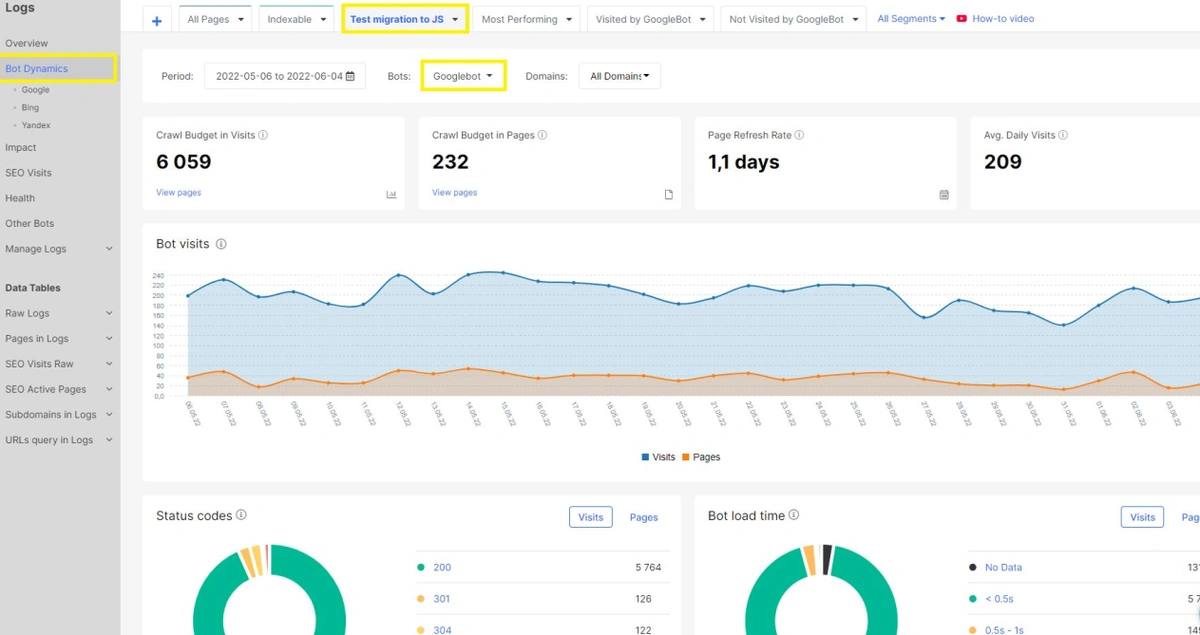
JetOctopus provides advanced log file analysis to:
- Identify how Googlebot interacts with old URLs.
- Monitor crawl frequency changes.
- Detect wasted crawl budget.
- Discover crawl traps and parameter duplication.
- Analyze bot behavior post-launch.
- Compare pre- and post-migration crawl patterns.
- Monitor response time impact on crawl activity.
Understanding crawl behavior is essential in any professional site migration guide because it allows teams to prioritize fixes based on actual search engine behavior, not assumptions.
5. Internal Linking & Architecture Preservation
A migration often modifies navigation, categories, or site structure. If not managed carefully, this can dilute internal link equity.
JetOctopus supports architectural consistency by:
- Mapping internal link flows.
- Measuring click depth distribution.
- Detecting broken internal links.
- Identifying orphaned pages.
- Analyzing anchor text distribution.
- Comparing internal linking pre- and post-migration.
- Monitoring structural changes affecting priority pages.
This protects ranking signals and ensures that important pages maintain authority during the website migration steps.
6. Indexation & Post-Launch Monitoring
The real test of a website migration SEO checklist begins after launch.
JetOctopus allows continuous monitoring to:
- Track indexable page counts.
- Identify sudden increases in 404 errors.
- Detect unintended noindex tags.
- Monitor canonical misconfigurations.
- Validate sitemap accuracy.
- Ensure redirects remain stable.
- Track technical health score changes.
- Identify duplicate content issues.
With scheduled crawls and automated alerts, teams can detect problems early – often before rankings significantly decline.
Key Benefits of Using JetOctopus in a Website Migration Project Plan
Beyond checklist execution, JetOctopus provides strategic advantages for SEOs and marketing managers managing complex migrations.
1. Enterprise-Scale Crawling
Handles millions of URLs efficiently, making it suitable for large ecommerce or content platforms.
2. Deep Technical Insights
Provides granular data beyond standard crawling tools, including log analysis and rendering insights.
3. Data Comparison Capabilities
Enables before-and-after crawl comparisons to validate success metrics.
4. Crawl Visualization
Graphical representations of site architecture help identify structural risks quickly.
5. Integration-Friendly Exports
Data exports simplify collaboration between SEO, development and product teams.
6. Continuous Monitoring
Migration is not a one-day event – JetOctopus ensures long-term stability.
7. Risk Mitigation
Proactive detection reduces the likelihood of catastrophic traffic drops.
8. Improved Communication with Stakeholders
Clear reporting enables marketing managers to justify decisions with data.
Why a Structured SEO Migration Plan Matters
A professional website migration guide must emphasize planning over reaction. The difference between a successful website migration process and a failed one is not luck – it is preparation and monitoring.
Without a clear SEO migration plan:
- Redirect equity may be lost.
- Indexed URLs may shrink dramatically.
- Search engines may take months to reprocess changes.
- Revenue and lead generation may decline.
With JetOctopus integrated into the checklist for website migration, teams gain full visibility across technical SEO layers, ensuring the migration website checklist is not merely theoretical but operational.
Conclusion
Website migrations are inevitable in growing businesses – redesigns, rebranding, CMS upgrades, domain consolidations and structural improvements all require change. However, change does not have to mean traffic loss.
The Zero Traffic Loss Migration Checklist demonstrates that successful website migration SEO depends on:
- Complete URL inventory
- Thorough redirect mapping
- Staging environment validation
- Crawl budget monitoring
- Architecture preservation
- Post-launch auditing
JetOctopus strengthens every phase of this process through scalable crawling, log analysis, data comparison and automated monitoring. For SEOs and marketing managers managing complex digital assets, it transforms migration from a high-risk operation into a controlled, data-backed project.
A website migration project should never rely on assumptions. With the right tools and a disciplined checklist approach, organic visibility can be preserved – and even improved – during structural transformation.
For organizations planning a major site migration plan or refining their SEO website migration checklist, integrating JetOctopus into the workflow ensures that technical integrity, search performance and business continuity remain protected throughout the entire migration lifecycle.
***
CP

You may also be interested in:
 https://www.web4business.com.au/wp-content/uploads/2026/05/Best-coworking-spaces-Melbourne.jpg
800
990
Ivana Katz
https://www.web4business.com.au/wp-content/uploads/2013/04/Websites4SB_200.png
Ivana Katz2026-05-04 08:28:442026-08-07 13:40:43Best Coworking Spaces in Melbourne for Web Designers
https://www.web4business.com.au/wp-content/uploads/2026/05/Best-coworking-spaces-Melbourne.jpg
800
990
Ivana Katz
https://www.web4business.com.au/wp-content/uploads/2013/04/Websites4SB_200.png
Ivana Katz2026-05-04 08:28:442026-08-07 13:40:43Best Coworking Spaces in Melbourne for Web Designers https://www.web4business.com.au/wp-content/uploads/2026/04/Why-Australian-Digital-Marketers-are-Investing-in-Home-Office.jpg
800
990
Ivana Katz
https://www.web4business.com.au/wp-content/uploads/2013/04/Websites4SB_200.png
Ivana Katz2026-04-07 08:50:412026-05-28 09:28:24Why Australian Digital Marketers Are Investing in a Proper Home Office
https://www.web4business.com.au/wp-content/uploads/2026/04/Why-Australian-Digital-Marketers-are-Investing-in-Home-Office.jpg
800
990
Ivana Katz
https://www.web4business.com.au/wp-content/uploads/2013/04/Websites4SB_200.png
Ivana Katz2026-04-07 08:50:412026-05-28 09:28:24Why Australian Digital Marketers Are Investing in a Proper Home Office https://www.web4business.com.au/wp-content/uploads/2026/02/The-Ultimate-Guide-to-Buying-Office-Chairs.jpg
800
990
Ivana Katz
https://www.web4business.com.au/wp-content/uploads/2013/04/Websites4SB_200.png
Ivana Katz2026-02-02 16:22:202026-02-05 08:22:01The Ultimate Guide to Buying Office Chairs Melbourne for Workplaces
https://www.web4business.com.au/wp-content/uploads/2026/02/The-Ultimate-Guide-to-Buying-Office-Chairs.jpg
800
990
Ivana Katz
https://www.web4business.com.au/wp-content/uploads/2013/04/Websites4SB_200.png
Ivana Katz2026-02-02 16:22:202026-02-05 08:22:01The Ultimate Guide to Buying Office Chairs Melbourne for Workplaces https://www.web4business.com.au/wp-content/uploads/2025/03/Office-space-that-works.jpg
800
990
Ivana Katz
https://www.web4business.com.au/wp-content/uploads/2013/04/Websites4SB_200.png
Ivana Katz2025-03-19 15:47:592025-12-10 12:17:32Office Space That Works: How to Make the Right Choice
https://www.web4business.com.au/wp-content/uploads/2025/03/Office-space-that-works.jpg
800
990
Ivana Katz
https://www.web4business.com.au/wp-content/uploads/2013/04/Websites4SB_200.png
Ivana Katz2025-03-19 15:47:592025-12-10 12:17:32Office Space That Works: How to Make the Right Choice https://www.web4business.com.au/wp-content/uploads/2024/07/7-ways-smart-offices-increase-productivity.jpg
800
990
Ivana Katz
https://www.web4business.com.au/wp-content/uploads/2013/04/Websites4SB_200.png
Ivana Katz2024-07-21 08:03:532025-11-12 12:03:447 Ways Smart Offices Increase Productivity and Efficiency
https://www.web4business.com.au/wp-content/uploads/2024/07/7-ways-smart-offices-increase-productivity.jpg
800
990
Ivana Katz
https://www.web4business.com.au/wp-content/uploads/2013/04/Websites4SB_200.png
Ivana Katz2024-07-21 08:03:532025-11-12 12:03:447 Ways Smart Offices Increase Productivity and Efficiency https://www.web4business.com.au/wp-content/uploads/2021/08/7-ways-to-improve-home-office.jpg
432
938
Ivana Katz
https://www.web4business.com.au/wp-content/uploads/2013/04/Websites4SB_200.png
Ivana Katz2021-08-11 12:11:132025-12-10 12:12:447 Ways to Improve and Upgrade Your Home Office
https://www.web4business.com.au/wp-content/uploads/2021/08/7-ways-to-improve-home-office.jpg
432
938
Ivana Katz
https://www.web4business.com.au/wp-content/uploads/2013/04/Websites4SB_200.png
Ivana Katz2021-08-11 12:11:132025-12-10 12:12:447 Ways to Improve and Upgrade Your Home Office